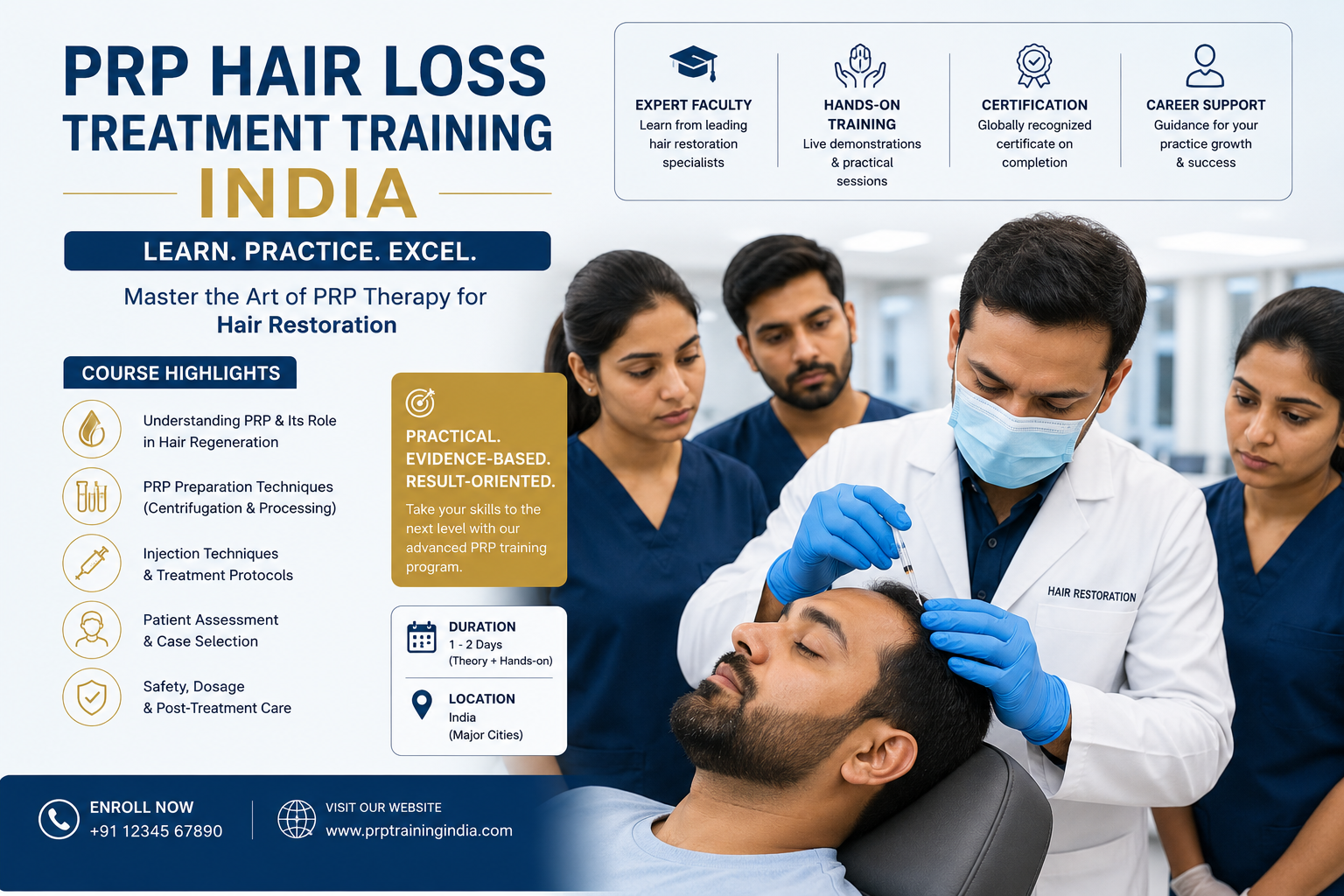
PRP hair treatment training for doctors should teach a standardised clinical protocol covering blood collection, single-spin and double-spin preparation, platelet concentration assessment, scalp treatment technique, session scheduling, and patient selection. Doctors must also understand contraindications, manage patient expectations,s and measure results through consistent photographs and trichoscopy rather than relying on subjective improvements alone.
Platelet-rich plasma (PRP) therapy uses a concentrated preparation of a patient’s own platelets. These platelets release growth factors that may support hair follicle activity and improve hair density in selected patients with androgenetic alopecia.
However, PRP outcomes vary because preparation methods, platelet concentrations, treatment schedules, and patient characteristics differ across studies.
A well-designed training programme should therefore focus on reproducible techniques, clinical judgment and objective follow-up.
At Elegance Vidhyalay, Dr. Ashutosh Shah, M.S., M.Ch., D.N.B. (Plastic Surgery), a Plastic, Reconstructive and Cosmetic Surgeon with over 22 years of experience, contributes surgical expertise to training that emphasises patient selection, procedural safety and responsible clinical practice.
Every doctor learning PRP therapy should understand why a written protocol matters.
Without standardisation, differences in blood collection, centrifugation, platelet recovery and injection technique can affect the final preparation and make treatment outcomes difficult to compare.
A complete protocol should document the following components.
Before considering PRP, doctors should assess:
Not every type of hair loss responds to PRP. Doctors must identify the underlying diagnosis before recommending treatment.
The protocol should specify the validated collection system, required blood volume, and anticoagulant used.
The appropriate volume depends on the preparation kit, manufacturer instructions, and intended treatment.
Trainees should record the device, rotor specifications, relative centrifugal force, processing time, and whether the protocol uses one or two centrifugation stages.
Settings should follow the validated device protocol rather than an arbitrary RPM value copied from another machine.
A complete protocol should explain how the team assesses platelet concentration when testing is available.
Doctors should understand that platelet concentration alone does not establish treatment quality. Platelet recovery, activation, leukocyte content and final preparation volume can also matter.
Training should cover scalp anatomy, aseptic technique, treatment-area planning, injection depth, spacing and complication prevention.
Trainees should practise under qualified supervision rather than use a generic injection pattern for every patient.
| Step | Parameter | What to record |
|---|---|---|
| Patient assessment | Diagnosis and hair loss severity | History, examination and baseline findings |
| Blood collection | Collection volume and anticoagulant | Actual volume and kit details |
| First spin | Device-validated centrifugation settings | RCF, time,e and device |
| Second spin, if applicable | Validated concentration stage | RCF, time, and final preparation |
| Platelet assessment | Platelet concentration and recovery | Available baseline and PRP counts |
| Scalp treatment | Injection depth and distribution | Treatment area and technique |
| Session planning | Initial and maintenance schedule | Treatment dates |
| Response monitoring | Photography and trichoscopy | Baseline and follow-up measurements |
Important: There is no universally validated centrifugation setting, platelet concentration, or injection depth suitable for every PRP device and patient. Training should follow the specific preparation system and clinically appropriate protocols.
Doctors who want structured procedural education can explore PRP hair training to understand the principles of preparation, patient selection, and supervised treatment.
A major component of PRP education involves understanding how centrifugation affects the final platelet preparation.
A single-spin protocol separates blood components through one centrifugation stage.
Depending on the device, the resulting preparation may contain different proportions of plasma, platelets, and leukocytes.
Potential advantages include a shorter preparation process and fewer handling steps.
However, platelet recovery and concentration depend on the collection system and validated settings.
A PRP double-spin protocol uses two centrifugation stages.
The first stage separates blood components. The second stage further processes the platelet-containing fraction to produce the intended final preparation.
Some double-spin systems achieve higher platelet concentrations, but higher concentration does not automatically mean better clinical results.
The relationship between platelet concentration and hair growth remains incompletely established.
| Feature | Single spin | Double spin |
|---|---|---|
| Centrifugation stages | One | Two |
| Processing complexity | Usually lower | Usually higher |
| Preparation time | Often shorter | Often longer |
| Platelet concentration | Device-dependent | May be higher, depending on protocol |
| Leukocyte content | Varies | Varies |
| Clinical superiority | Not conclusively established | Not conclusively established |
Which method is better?
Current evidence does not establish that double-spin PRP consistently produces better hair growth than single-spin PRP.
Doctors should learn to evaluate preparation quality, device validation, available evidence, and patient outcomes rather than assume that more centrifugation stages guarantee superior results.
The PRP hair sessions schedule should reflect the patient’s diagnosis, treatment response, and the protocol supported by the treating clinician.
For androgenetic alopecia, many published clinical protocols use an initial series of approximately three sessions at monthly intervals.
Maintenance sessions may follow, but the ideal interval and long-term schedule remain uncertain.
| Stage | Typical schedule | Assessment |
|---|---|---|
| Baseline | Before first session | Diagnosis, photographs and trichoscopy |
| Initial treatment | Approximately three monthly sessions | Tolerability and clinical progress |
| Early follow-up | Around three months | Standardised images and scalp assessment |
| Response review | Around six months | Hair density and shaft measurements |
| Maintenance | Individualised | Continued benefit and patient preference |
This schedule describes commonly used research and clinical approaches. It is not a universal treatment requirement.
Patient satisfaction matters, but subjective feedback alone cannot establish treatment effectiveness.
Doctors should use consistent measurements.
Standardised photography: Photograph the scalp from the same angles with similar lighting, camera distance, hair length, and positioning.
Trichoscopy: Examine a reproducible scalp area to assess hair density, shaft diameter, and follicular characteristics.
Hair density: Record the number of hairs within a defined measurement area, where equipment allows.
Hair shaft thickness: Track changes using consistent measurement methods.
Patient-reported outcomes: Document perceived shedding, hair appearance, treatment burden, and satisfaction.
| Measurement | Baseline | 3 months | 6 months |
|---|---|---|---|
| Hair density (hairs/cm²) | Record | Record | Record |
| Average hair shaft diameter | Record | Record | Record |
| Hair diameter diversity | Record | Record | Record |
| Standardised photographs | Capture | Repeat | Repeat |
| Patient-reported shedding | Record | Review | Review |
| Adverse effects | Record | Review | Review |
Consistent follow-up helps doctors distinguish measurable improvement from temporary changes in hair appearance.
Understanding PRP contraindications is an essential part of clinical training.
PRP should not be offered automatically to every patient with hair thinning.
Doctors must assess conditions that may make treatment inappropriate or require further evaluation.
| Clinical condition | Recommended assessment |
|---|---|
| Significant thrombocytopenia or platelet dysfunction | Avoid or defer until appropriately evaluated |
| Active scalp infection | Postpone treatment until the infection resolves |
| Systemic infection or acute illness | Assess and defer when clinically indicated |
| Anticoagulant or antiplatelet medication use | Review bleeding risk and medication indication |
| Active cancer or ongoing cancer therapy | Seek relevant specialist guidance; assess suitability |
| Uncontrolled medical condition | Stabilise or investigate before elective treatment |
| Unexplained hair loss | Establish diagnosis before treatment |
| Previous reaction to preparation components | Review product-specific risks |
Medication use requires particular care.
Patients should never stop prescribed anticoagulants or antiplatelet medications solely to undergo PRP without approval from the prescribing clinician.
Doctors should also recognise that PRP may not be appropriate for patients with certain scarring alopecias, active inflammatory scalp disease or advanced follicular loss.
In these situations, treating the underlying condition may take priority.
PRP is not a guaranteed treatment for hair regrowth.
Patients with androgenetic alopecia may experience improvement, but outcomes vary.
Doctors must explain the limitations of available evidence, possible discomfort, temporary swelling, bruising, and the need for follow-up.
A responsible training programme should teach doctors when to decline or postpone treatment rather than promote PRP as suitable for everyone.
Doctors exploring PRP training in Bharuch should prioritise clinical education that covers diagnosis, preparation protocols, patient safety, and outcome assessment.
A useful course should teach:
Doctors should also understand the differences between PRP and growth factor concentrate (GFC) preparations.
The GFC therapy training resource introduces another approach to hair-related regenerative treatments.
However, claims that one preparation is consistently superior require direct, high-quality comparative evidence.
Training should emphasise clinical evidence rather than product marketing.
PRP should form part of a broader hair loss management plan rather than automatically replace established treatments.
Topical minoxidil is an established treatment option for androgenetic alopecia.
Doctors may consider PRP as an adjunct in selected patients, but they should explain that PRP does not necessarily replace ongoing medical therapy.
Finasteride is an evidence-based treatment for appropriately selected patients with androgenetic alopecia.
Doctors must discuss indications, contraindications, and potential adverse effects before prescribing it.
PRP may be considered alongside medical treatment when clinically appropriate.
Hair transplantation redistributes existing follicles to areas of thinning or baldness.
PRP has been studied as an adjunct around hair transplantation, but protocols and evidence remain variable.
Doctors should avoid promising that PRP will guarantee graft survival or eliminate the need for medical treatment.
The Non-surgical hair loss management resource helps doctors understand how medical and procedural treatments fit into a broader management strategy.
Doctors interested in combined approaches can also explore the Hair loss workshop for further education on hair restoration principles.
Many clinical studies use approximately three initial PRP sessions spaced one month apart. Some protocols include maintenance treatments. However, no universally accepted schedule exists, and doctors should individualise treatment according to diagnosis, clinical response, and available evidence.
Doctors should assess platelet-related disorders and obtain a complete blood count when clinically indicated or required by their protocol. A platelet count can help identify significant thrombocytopenia. Testing of the prepared PRP may also help document preparation quality, although it is not routinely available in every clinical setting.
Yes, doctors may consider PRP for appropriately selected women with certain types of hair loss, including female pattern hair loss. However, they must first investigate the underlying cause and assess relevant medical conditions. PRP is not suitable for every form of hair loss.
Current evidence does not establish that GFC consistently produces better hair growth than PRP. Preparation methods and study quality vary. Doctors considering PRP training in Bharuch should learn how to compare the available evidence, treatment protocols, and limitations of both approaches.
Doctors can reduce discomfort through appropriate patient counselling, careful technique, and suitable pain-management methods. The approach should consider the treatment area, patient tolerance, and local anaesthetic safety. Any anaesthetic method requires appropriate clinical assessment and supervision.
Use standardised scalp photographs with consistent lighting, positioning, camera distance, and hair preparation. Trichoscopy can document hair density and shaft diameter within a reproducible area. Record findings before treatment and repeat measurements at planned follow-up visits.
PRP hair treatment training for doctors should focus on reproducible preparation methods, appropriate patient selection, and measurable outcomes.
Doctors must understand single-spin and double-spin preparation, platelet assessment, scalp treatment principles, and documented session schedules.
They should recognise contraindications, assess medications, and avoid offering PRP without establishing the cause of hair loss.
Standardised photography and trichoscopy help evaluate clinical response more reliably than subjective impressions alone.
PRP may complement established treatments such as minoxidil, finasteride, and hair transplantation, but it does not replace appropriate diagnosis or evidence-based medical management.
At Elegance Vidhyalay, supervised education and clinical judgment remain central to responsible procedural training.