Hair loss management is not limited to hair transplantation. Many patients first seek non-surgical options, making it important for doctors to understand proper assessment, patient selection, treatment planning, and realistic expectations before recommending a treatment. For doctors and surgeons interested in non-surgical hair restoration, platelet rich plasma hair training India can help build a structured understanding of PRP and its role within broader hair-loss management. Training should focus not only on the procedure but also on clinical decision-making, safety, and appropriate patient care.
Platelet Rich Plasma, commonly called PRP, uses a preparation derived from a patient’s own blood. In hair-loss practice, doctors may use PRP as part of a broader management strategy for selected patients.
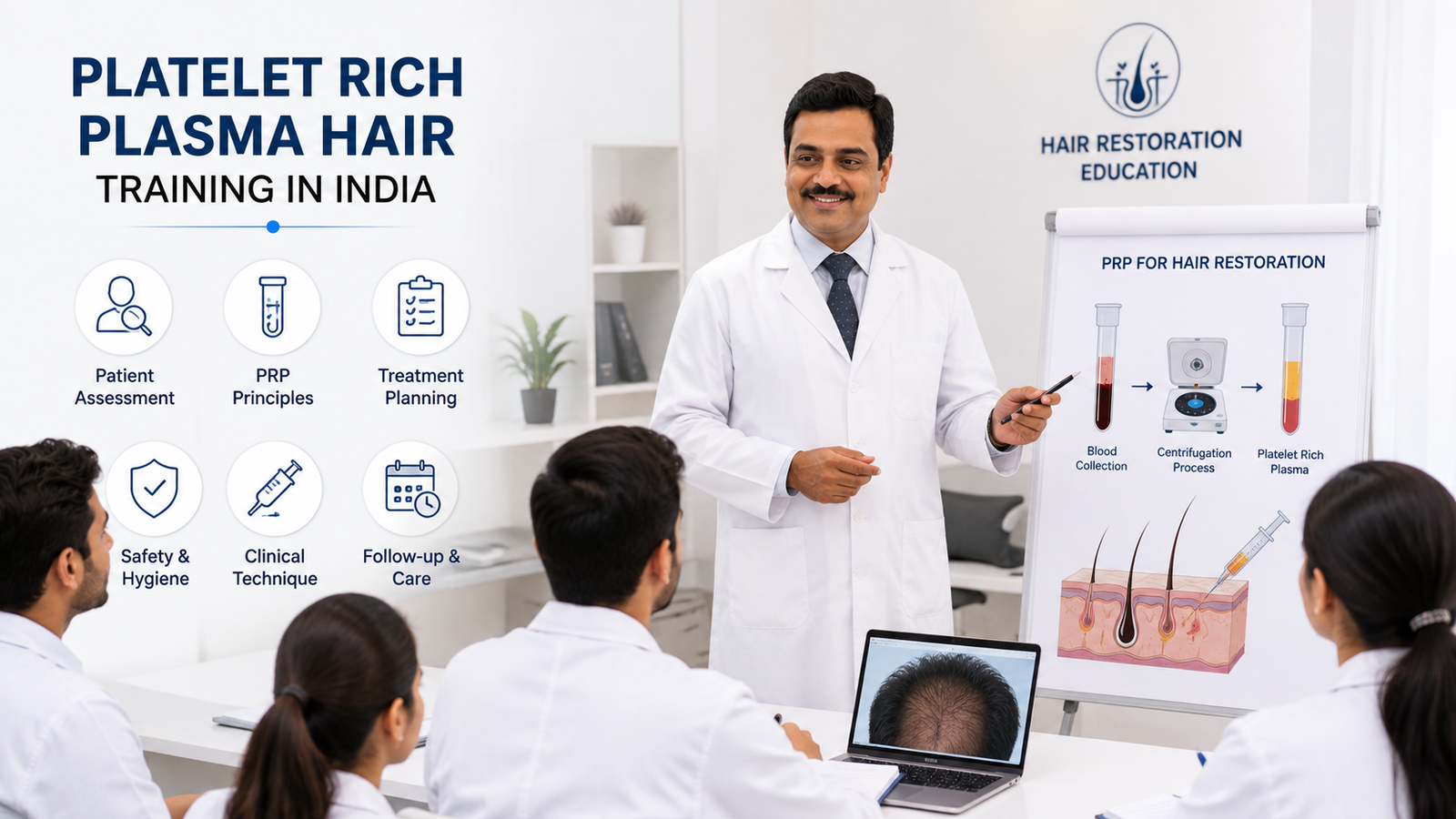
PRP hair training helps doctors understand the clinical principles surrounding the treatment. This may include patient assessment, selection, preparation principles, treatment planning, safety considerations, follow-up, and evaluation of treatment response.
Doctors should view PRP as one possible component of hair-loss management rather than a universal solution for every patient.
The first step in responsible hair-loss management is understanding why the patient is losing hair.
Different patients can present with different patterns, progression, medical histories, scalp findings, and expectations. Starting treatment without adequate assessment may lead to inappropriate treatment selection.
A structured platelet rich plasma hair training in India program should therefore help doctors understand how patient evaluation connects with treatment planning.
Doctors also need to recognize when a patient may require further investigation or referral rather than immediate procedural treatment.
Training can help doctors understand several important aspects of PRP-based hair management, such as:
The exact techniques and practical components depend on the specific training program. Doctors should check the current curriculum before enrolling.
Not every patient with hair loss will benefit equally from the same treatment.
Doctors need to consider the patient’s hair-loss pattern, progression, scalp condition, medical history, previous treatments, expectations, and other relevant clinical factors.
Good patient selection also helps doctors communicate more realistically. Instead of promising hair regrowth, doctors can explain the treatment’s intended role, limitations, and available alternatives based on an individual assessment.
PRP and hair transplantation serve different roles in hair restoration.
Some patients may be candidates for non-surgical management, while others may eventually require surgical hair restoration depending on their condition and goals.
For this reason, doctors should understand the broader spectrum of hair-loss management rather than learning PRP as an isolated procedure.
Training in non-surgical hair-loss management can help doctors decide when conservative approaches deserve consideration and when a patient may need evaluation for other treatment options.
PRP involves medical assessment, blood handling, preparation, and administration, so doctors need to follow appropriate clinical and infection-control standards.
Training should reinforce the importance of patient history, contraindication screening, aseptic practices, appropriate preparation, clinical documentation, aftercare, and follow-up.
Doctors should perform any procedure only within their professional qualifications, training, competency, and applicable medical regulations.
The selected course information lists both online and offline learning formats.
Online learning can help doctors understand theoretical concepts, patient selection, clinical reasoning, and treatment-planning principles. It also offers flexibility for practicing medical professionals.
Offline education can complement theoretical learning through direct faculty interaction and practical or clinical learning where the specific course includes it.
Doctors should confirm the exact format and hands-on components of the current batch before enrollment.
Elegance Vidhyalay offers education focused on the non-surgical management of hair loss for doctors and surgeons.
The learning environment includes guidance from Dr. Ashutosh Shah, a Plastic, Cosmetic & Reconstructive Surgeon with more than 22 years of surgical experience.
His extensive clinical and surgical experience can help participants understand hair-loss management from a broader perspective, including patient assessment, treatment selection, realistic expectations, safety, clinical decision-making, and follow-up planning.
For doctors researching platelet rich plasma hair training India, this broader approach matters because PRP should form part of an appropriate hair-loss management plan rather than function as a stand-alone solution for every patient.
Before enrolling, doctors should check the faculty’s qualifications, course curriculum, eligibility requirements, delivery format, PRP topics covered, clinical case discussions, safety education, practical components, certification, and opportunities for further learning.
Doctors should also confirm exactly what hands-on training means within the course and whether practical participation matches their qualifications and professional scope.
Platelet rich plasma hair training India can help doctors and surgeons understand PRP within the wider context of non-surgical hair-loss management.
Effective training should emphasize more than procedural steps. Doctors need a clear understanding of hair-loss assessment, patient selection, treatment planning, safety, realistic expectations, clinical decision-making, and follow-up care.
The selected Elegance Vidhyalay course targets doctors and surgeons interested in learning about non-surgical hair-loss management. Exact eligibility should be confirmed before enrollment.
The selected course information lists both online and offline delivery modes. Doctors should confirm the format available for the upcoming batch.
No single hair-loss treatment suits every patient. Doctors should assess the cause and pattern of hair loss before considering PRP or another management option.
No. PRP represents a non-surgical approach, while hair transplantation involves surgical redistribution of hair follicles. Patient assessment determines which treatment pathway may deserve consideration.
Counselling helps patients understand the proposed treatment, expected outcomes, limitations, follow-up requirements, and alternative options without creating unrealistic expectations.