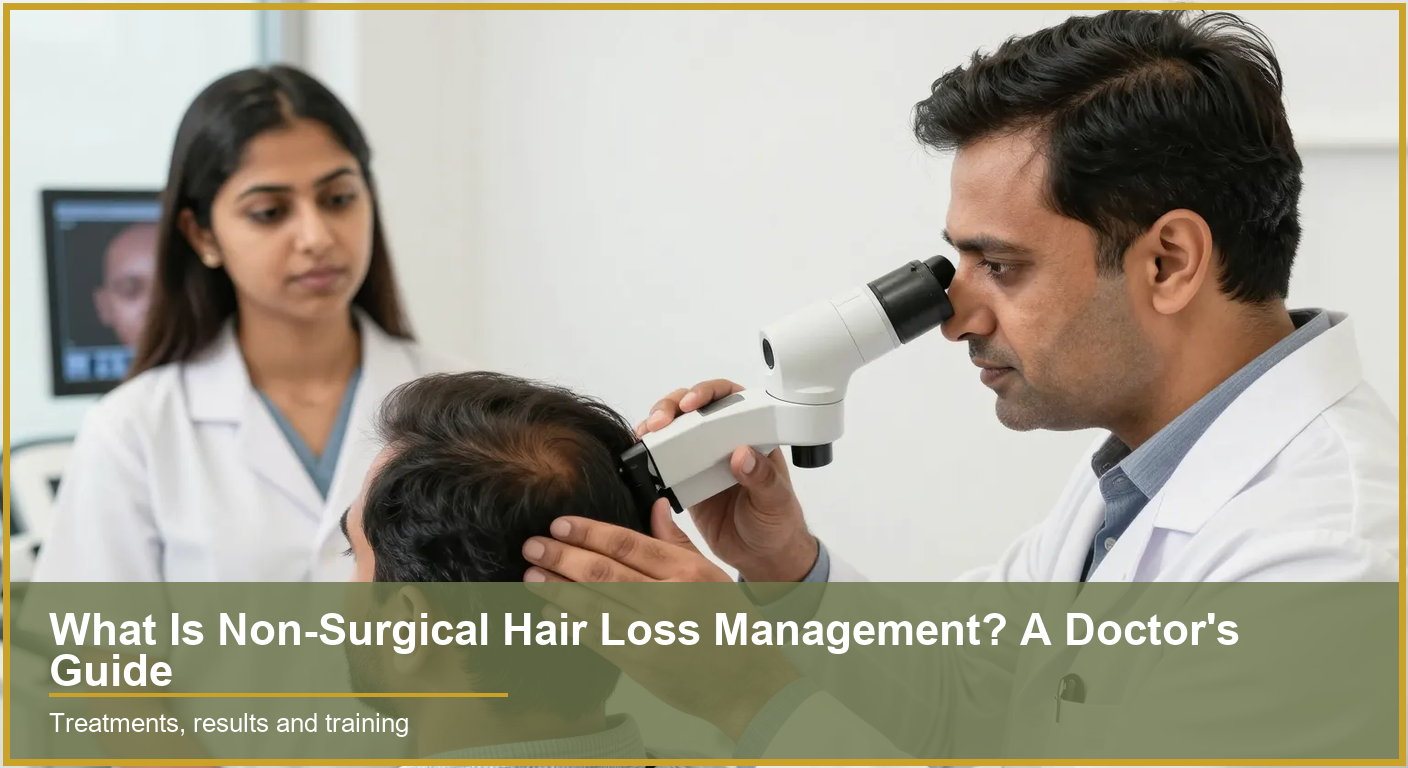
For practising doctors, non-surgical hair loss management for doctors should begin with accurate staging, appropriate investigations, and clear case selection rather than immediately choosing PRP, GFC, or medication. A structured protocol may combine topical minoxidil, selected systemic therapies where clinically appropriate, and procedural options such as PRP or GFC. The clinician should also identify patients who need further investigation or surgical referral rather than continuing ineffective non-surgical treatment.
This article is intended as a doctor-facing clinical framework, not a patient treatment guide. Individual prescribing, investigations, contraindications and monitoring should be adapted to diagnosis, patient characteristics, current evidence and applicable prescribing guidance.
A reproducible protocol begins with diagnosis.
Before prescribing medication or planning injectable treatments, document the pattern, severity, progression, and possible contributing factors.
Record:
Examine the scalp rather than treating every complaint of thinning as androgenetic alopecia.
Depending on the presentation and available expertise, assessment may include pattern evaluation, scalp examination, hair-pull assessment and trichoscopic examination.
Use a consistent staging system appropriate to the diagnosed pattern of hair loss.
The purpose of staging is not simply to place a label in the record. It establishes a baseline against which future progression or improvement can be compared.
Document:
The same staging and photography method should be used at subsequent reviews.
The supplied brief calls for a defined blood panel, but it does not provide a universal list of tests. A single fixed panel should therefore not be presented as mandatory for every patient.
Investigations should be guided by the history, examination, suspected diagnosis and clinical context.
The key principle is to investigate possible contributing causes when clinically indicated rather than automatically ordering an identical panel for every person with hair loss.
Abnormal or unexplained findings may also change whether treatment begins immediately or whether another specialist assessment is required first.
The treatment plan should distinguish between therapies rather than presenting every available modality as equally established.
The brief specifically requires consideration of:
This table should function as a clinical decision aid rather than a prescribing substitute. Exact doses and schedules should follow current evidence, product information, and applicable prescribing guidance.
Doctors who want practical exposure to medical and procedural hair-loss management can review the Hair transplant and non-surgical workshop.
A useful protocol separates diagnosis, initiation, reassessment, and longer-term planning.
Establish:
Select treatment according to diagnosis and patient suitability.
Avoid introducing multiple interventions merely to make the treatment plan appear comprehensive. The clinician should be able to explain why each modality has been selected.
Assess:
Compare the patient against the baseline using consistent clinical assessment and photography.
Do not rely entirely on patient perception or photographs taken under different lighting, angles, and hair conditions.
At later reviews, decide whether to:
The exact timeline should depend on the treatment being used rather than forcing every modality into the same schedule.
PRP is frequently offered for hair loss, but doctors should avoid treating the procedure as a standard package independent of diagnosis.
Before offering PRP, define:
The supplied brief does not specify a universal number of sessions, and PRP protocols vary.
Therefore, the treatment plan should define the selected protocol and a reassessment point rather than promising that a fixed number of sessions will work for every patient.
A doctor should also avoid continuing repeated sessions indefinitely when objective documentation shows inadequate benefit.
Further structured learning is available through the Seminar on non-surgical hair loss.
Medication requires the same structured approach as procedural treatment.
Before prescribing, the doctor should establish:
Diagnosis → indication → contraindication review → counselling → baseline documentation → prescription → monitoring → reassessment.
Document the indication, formulation, expected treatment course, counselling provided, and any relevant adverse effects during follow-up.
Oral treatment requires appropriate medical assessment and monitoring. Patient-specific risks and current prescribing guidance should determine whether it is suitable.
Antiandrogen treatment should follow appropriate patient selection, counselling, contraindication assessment and monitoring.
The patient should understand expected benefits, limitations and relevant potential adverse effects before treatment begins.
Case selection is one of the most important parts of non-surgical hair loss management for doctors.
Not every patient presenting with hair thinning should enter a PRP, GFC, or medication protocol.
Further evaluation or referral should be considered when:
The ability to decline an unsuitable treatment is part of good clinical practice.
Non-surgical treatment should not be presented as an alternative to transplantation in every case.
A surgical assessment may be more appropriate when a suitable patient has established pattern loss and wants structural restoration that medical or adjunctive treatments are unlikely to provide.
This does not mean medication becomes irrelevant. Medical management may still play a role in preserving existing hair or managing ongoing loss.
However, repeatedly selling procedural sessions to a patient whose primary goal cannot realistically be achieved by those treatments creates poor clinical alignment.
Monitoring should match the treatment.
Document:
Document:
Record the device and protocol used, treatment schedule, adherence where relevant, and objective outcome assessment.
Hair-loss photography becomes useful only when it is reproducible.
Use consistent:
Capture standard views at baseline and follow-up.
Avoid comparing a poorly lit baseline photograph with a carefully styled and brightly illuminated follow-up photograph. That comparison may exaggerate apparent improvement.
Clinical records should also document treatment changes, adverse effects, adherence, and the clinician’s objective assessment.
Learning a treatment protocol should go beyond watching a demonstration.
Doctors should understand:
For clinics that employ technical staff, the Hair transplant technician course provides another relevant training pathway.
Doctors should also review the qualifications and teaching background of those delivering training. Information about the teaching team is available through the Faculty and teaching record.
Before starting treatment, ask five questions:
| Clinical Question | Decision |
|---|---|
| Is the diagnosis sufficiently clear? | If not, investigate or refer |
| Is there a reversible contributor requiring attention? | Address it appropriately |
| Is the proposed treatment suitable for this patient? | Review risks and contraindications |
| Can non-surgical treatment realistically meet the patient’s goal? | Set expectations before treatment |
| How will success or failure be measured? | Establish baseline documentation |
This framework helps prevent the clinic from becoming modality-driven.
The diagnosis should determine treatment—not whichever procedure the clinic happens to offer.
Evidence differs by diagnosis and modality. Minoxidil and appropriate antiandrogen therapy have established roles in selected pattern hair-loss patients, while procedural and device-based treatments require careful evaluation of the available evidence and protocol.
There is no universal panel in the supplied protocol. Investigations should follow the patient’s history, examination, suspected diagnosis, and relevant clinical findings rather than using the same tests for every patient.
There is no single universal session count in the supplied brief. Define the protocol, treatment interval, and reassessment point according to the evidence and technique being used.
Patients with uncertain diagnoses, suspected scarring disease, relevant contraindications or goals unlikely to be achieved non-surgically may require further investigation, specialist referral or surgical assessment.
Monitoring should reflect the specific medicine, patient’s clinical characteristics, contraindications, potential adverse effects and current prescribing guidance.
Record baseline staging and use standardised photographs with consistent lighting, distance, angles, and hair positioning. Repeat the same views during follow-up and document treatment response and adverse effects.
Elegance Vidhyalay provides structured training options for doctors and healthcare professionals interested in developing practical clinical skills. For hair-loss practice, doctors can explore relevant workshops, seminars, and technical training while evaluating faculty experience, course structure, and hands-on exposure before enrolling.
A reliable approach to non-surgical hair loss management for doctors begins with diagnosis and case selection rather than choosing a procedure first. Just as importantly, clinicians should recognise when non-surgical management cannot realistically meet the patient’s goals. In those cases, further investigation, specialist referral or an appropriate surgical assessment may provide a more clinically responsible pathway.