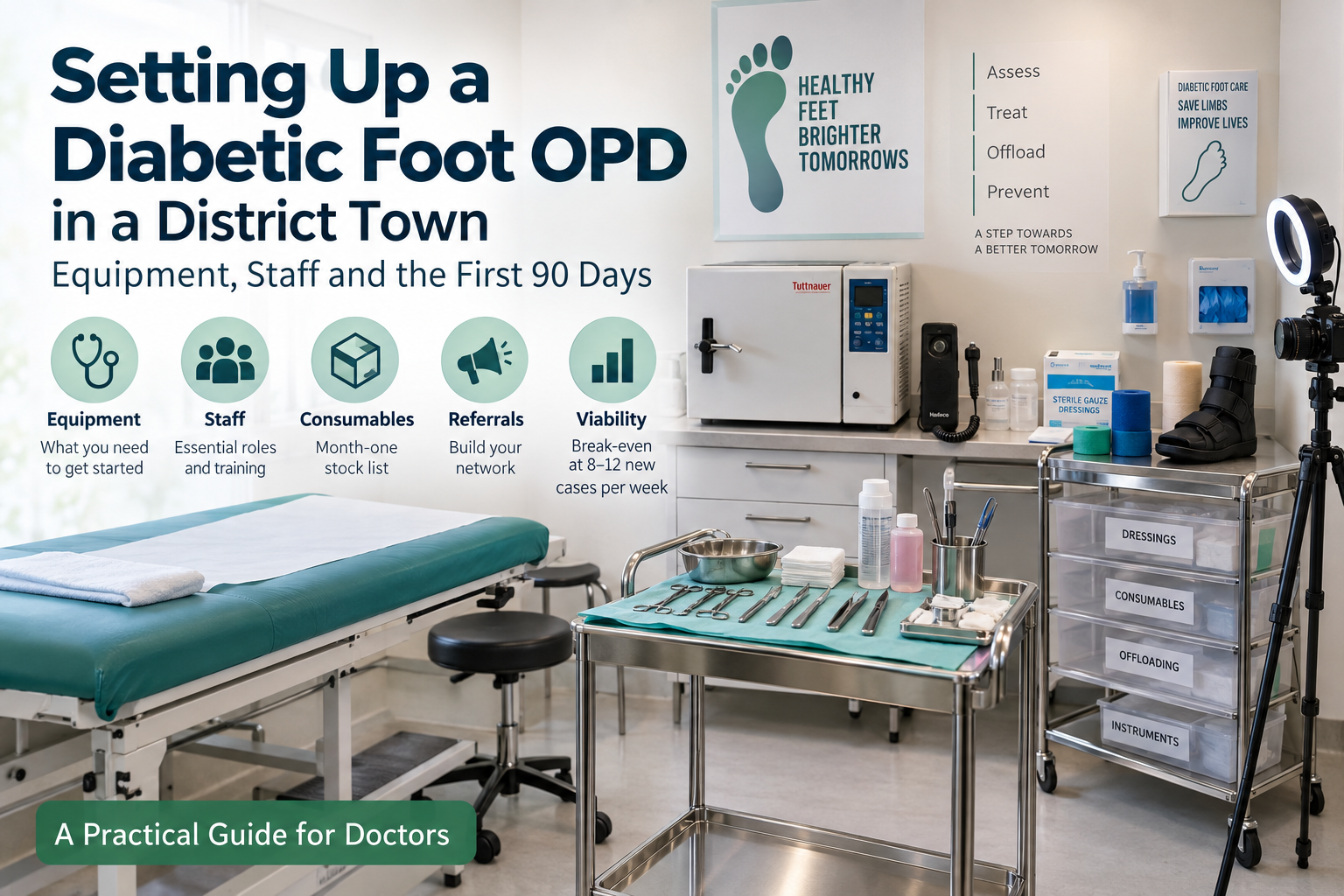
Starting a dedicated diabetic foot service does not always require a large hospital setup. For doctors considering how to start a diabetic foot clinic, a basic OPD needs a dedicated dressing room, monofilaments, a hand-held Doppler, sharp debridement instruments, an autoclave, offloading materials, and a clinical photography setup. Based on the planning benchmark provided, most services may target break-even at around 8–12 new cases per week.
The key is to start with essential equipment, trained staff, reliable infection-control processes, clear documentation, and a referral pathway for cases that exceed the clinic’s capabilities.
A diabetic foot OPD should be designed around assessment, wound care, infection control, basic vascular and neurological screening, documentation and offloading.
You do not need to purchase every advanced wound-care technology before seeing your first patient.
Start with equipment that supports safe everyday care.
| Item | Cost Band | Essential or Optional | When Needed |
|---|---|---|---|
| Dedicated examination/dressing couch | Moderate | Essential | Day one |
| Dressing trolley | Low–Moderate | Essential | Day one |
| Monofilaments | Low | Essential | Day one |
| Hand-held Doppler | Moderate | Essential | Day one |
| Debridement instrument set | Moderate | Essential | Day one |
| Autoclave/sterilisation arrangement | Moderate–High | Essential | Day one |
| Basic wound measurement tools | Low | Essential | Day one |
| Dressing storage | Low–Moderate | Essential | Day one |
| Offloading materials | Moderate | Essential | Day one |
| Clinical photography setup | Low–Moderate | Essential | Day one |
| Patient education materials | Low | Useful | First month |
| Advanced wound-care equipment | High | Optional | As case volume grows |
Actual costs vary substantially by brand, supplier, location, and whether equipment is already available within an existing practice. Obtain current quotations before budgeting rather than relying on fixed figures.
A small diabetic foot OPD does not necessarily need a large team from the beginning.
The minimum team should cover clinical assessment, wound care, sterilisation, documentation, patient education, and appointment coordination.
The treating doctor is responsible for clinical assessment, treatment planning and identifying cases requiring escalation or referral.
Training should include diabetic foot assessment, wound evaluation, neuropathy and vascular screening, infection recognition, offloading principles and appropriate referral.
A trained technician can support routine clinical workflows, including preparation for wound care, documentation and other tasks appropriate to their training and role.
Practices developing this role can review the Diabetic Foot Technician course.
Depending on the clinic structure, a nurse or trained assistant can support dressing preparation, infection-control procedures, instrument processing and patient education.
Even a small service needs reliable appointment scheduling, records, follow-up reminders, and referral coordination.
In a small existing practice, one team member may handle several administrative responsibilities.
Do not overstock expensive products during the first month.
Initial inventory should focus on products used repeatedly in routine wound care.
A basic stock may include:
Stock levels should be adjusted according to actual patient volume.
A useful approach is:
Start with essential products → monitor weekly consumption → identify frequently used items → establish reorder levels.
This reduces the risk of locking money into products that are rarely used.
| Category | Item | Cost Band | Essential or Optional | When Needed |
|---|---|---|---|---|
| Equipment | Dressing room and examination setup | Moderate | Essential | Before opening |
| Equipment | Monofilaments | Low | Essential | Day one |
| Equipment | Hand-held Doppler | Moderate | Essential | Day one |
| Equipment | Debridement instruments | Moderate | Essential | Day one |
| Equipment | Autoclave/sterilisation setup | Moderate–High | Essential | Day one |
| Equipment | Photography setup | Low–Moderate | Essential | Day one |
| Equipment | Offloading materials | Moderate | Essential | Day one |
| Staffing | Clinician | Variable | Essential | Day one |
| Staffing | Trained wound-care support | Variable | Essential | Day one |
| Staffing | Administrative support | Variable | Essential/Shared | Day one |
| Consumables | Routine dressing stock | Moderate | Essential | Before opening |
| Consumables | PPE and infection-control supplies | Moderate | Essential | Before opening |
| Marketing/Referral | Referral information for local doctors | Low | Essential | First month |
| Marketing/Referral | Professional online information | Low–Moderate | Useful | First 30–60 days |
| Marketing/Referral | Referral follow-up system | Low | Essential | First month |
This worksheet should be customised using current local supplier quotations and staffing costs.
Yes, provided the practice can create an appropriate clinical workflow and the treating team has suitable training and referral arrangements.
This can significantly reduce start-up costs.
An existing practice may already have:
However, diabetic foot care may require a dedicated dressing area and additional infection-control procedures.
The practice also needs adequate time for wound assessment and treatment. Trying to fit complex wound-care appointments into an overcrowded general OPD schedule can create workflow problems.
Doctors developing a new service within an existing practice can review Practice management for doctors.
Documentation should be designed before the first patient arrives.
Do not wait until the clinic becomes busy.
A structured diabetic foot record can include:
Photography can help document wound progression, but it requires a consistent protocol.
The clinic should establish appropriate consent and privacy procedures before routinely photographing wounds.
Use consistent:
Position → lighting → distance → scale → labelling method
This makes serial photographs more useful for comparison.
Patient images and identifiable information should be stored according to applicable privacy and institutional requirements.
A diabetic foot clinic depends heavily on timely referrals.
Referral development should focus on helping nearby clinicians understand which patients the service manages and when they should refer.
The first month should focus on operational readiness.
Prepare:
Introduce the service professionally to relevant local healthcare providers.
Potential referral sources may include physicians, diabetologists, general practitioners and other clinicians caring for people with diabetes.
Referral relationships are easier to maintain when communication works in both directions.
Where appropriate, referring clinicians should receive clear information about assessment, treatment and follow-up.
The goal is continuity of care rather than simply acquiring patients.
By the third month, review:
This information shows whether the service is developing sustainably.
A new clinic should define its limits before opening.
Some diabetic foot presentations may require urgent hospital, vascular, surgical or multidisciplinary assessment rather than routine outpatient wound care.
Referral decisions should be based on the clinician’s qualifications, competence, available facilities, and patient condition.
Potential escalation situations can include significant infection, suspected deep tissue involvement, compromised perfusion, rapidly progressive tissue damage, or cases requiring surgical management beyond the clinic’s capability.
Doctors seeking additional procedural education can review Diabetic foot surgery training.
Training does not remove the need to recognise when referral is safer.
The supplied planning benchmark suggests that many services may target approximately 8–12 new cases per week for break-even.
However, there is no universal break-even number.
The real figure depends on:
Fixed monthly costs + variable cost per case + average revenue per case + repeat visits + staffing + existing infrastructure.
A clinic operating inside an established practice may have a lower incremental fixed cost than a completely new standalone centre.
| New Cases per Week | Approx. New Cases per 4 Weeks | Planning Interpretation |
|---|---|---|
| 4 | 16 | Early-volume stage |
| 6 | 24 | Below supplied benchmark |
| 8 | 32 | Lower end of supplied break-even benchmark |
| 10 | 40 | Within supplied benchmark |
| 12 | 48 | Upper end of supplied benchmark |
| 14 | 56 | Above supplied benchmark |
| 16 | 64 | Growing service volume |
| 18 | 72 | Higher-volume service |
| 20 | 80 | Higher-volume service |
This is a planning table, not a financial guarantee. Actual break-even requires the clinic’s real costs and revenue figures.
A simple calculation is:
Monthly fixed costs ÷ average contribution per case = approximate cases required for break-even
where:
Contribution per case = average case revenue − variable cost per case.
Focus on making the service safe and repeatable.
Complete equipment procurement, establish sterilisation processes, train staff, prepare documentation, and test appointment workflows.
Avoid spending heavily on optional technology before understanding your patient mix.
By now, recurring problems will become visible.
Perhaps dressing appointments take longer than expected. Consumables may be used faster than planned. Documentation may be too complicated.
Use these observations to improve workflow.
At 90 days, review the service as a business and clinical unit.
Ask:
Doctors interested in developing clinical and practice skills can also review Programmes for doctors.
A diabetic foot OPD works through a system.
Even when the doctor has appropriate clinical knowledge, inconsistent staff processes can affect documentation, dressing preparation, follow-up, and infection control.
At Elegance Vidhyalay, training for doctors and healthcare personnel can support the development of structured clinical skills relevant to diabetic foot and wound-care services.
Training associated with Dr. Ashutosh Shah, Plastic and Reconstructive Surgeon with 22+ years of clinical experience, also emphasises the importance of appropriate assessment, procedural judgement and recognising when specialist referral is necessary.
The objective should be a team in which everyone understands their role.
A basic service needs an appropriate dressing area, assessment tools, monofilaments, a hand-held Doppler, debridement instruments, sterilisation facilities, wound-care supplies, offloading materials and a documentation/photography system.
There is no universal amount. Investment depends on whether you are starting independently or adding the service to an existing clinic, equipment brands, staffing and the range of treatments offered.
Yes, if adequate space, infection-control processes, trained staff, equipment, documentation and referral pathways are available. A dedicated dressing area can make the workflow easier.
The supplied planning benchmark suggests approximately 8–12 new cases per week, but actual break-even depends on local costs, pricing, repeat visits, and existing infrastructure.
Staff should be trained for their assigned roles in wound-care workflow, infection control, documentation, patient education, equipment handling, and appropriate escalation. Clinical responsibilities must match qualifications and competence.
Cases beyond the clinic’s facilities or clinician’s competence should be referred appropriately. Significant infection, compromised perfusion, deep tissue involvement, or complex surgical needs may require specialist or hospital-level care.
Understanding how to start a diabetic foot clinic requires more than purchasing wound-care equipment.
A practical diabetic foot OPD needs a suitable dressing room, essential assessment tools, debridement and sterilisation equipment, offloading materials, trained staff, reliable documentation, clinical photography procedures and clear referral pathways.
The first 90 days should focus on three stages:
Build the service → establish referrals → measure clinical and financial performance.