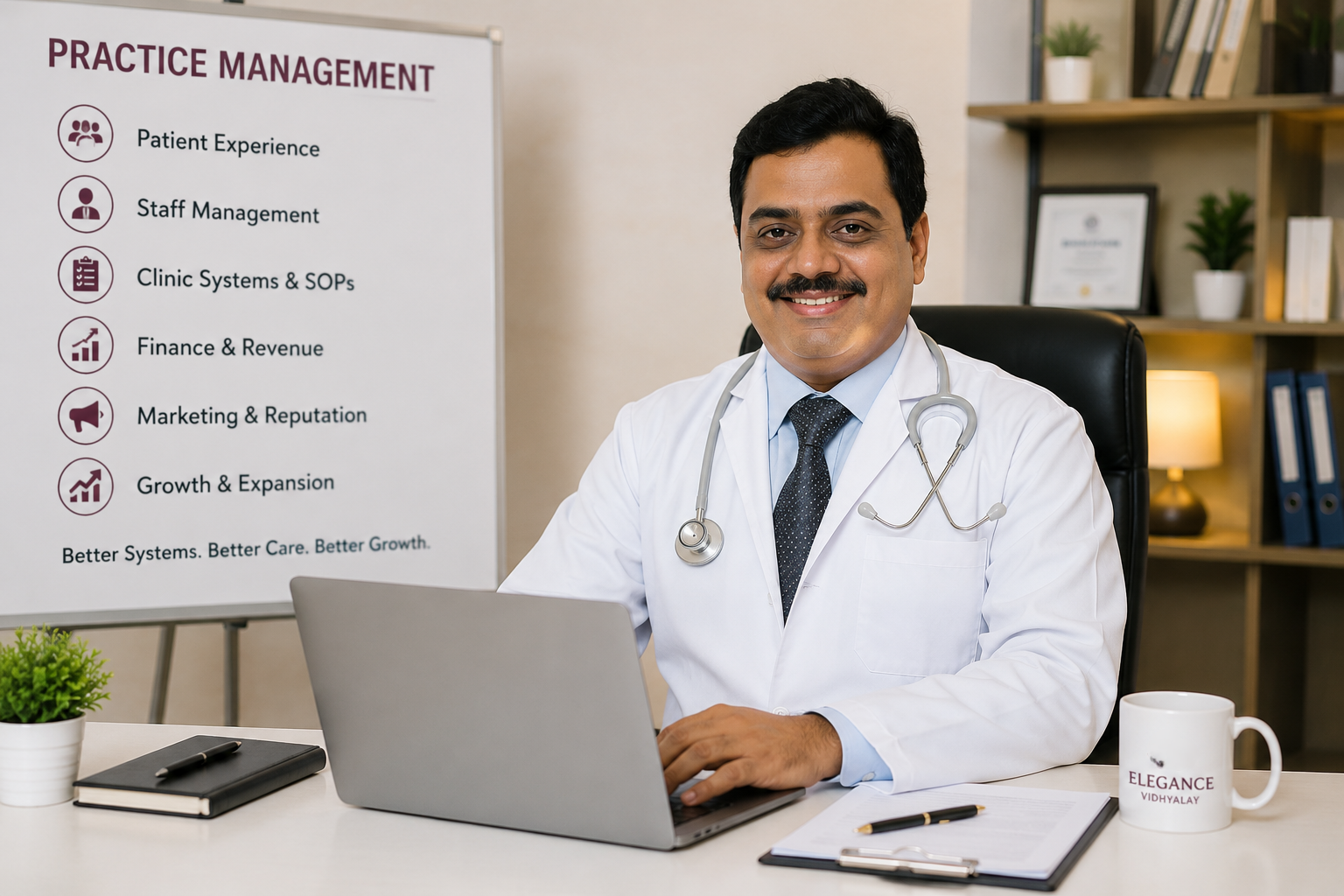
Without these systems, even a highly skilled doctor may experience long waiting times, staff confusion, billing problems, poor patient retention, and unnecessary administrative stress. This is where Practice Management for Doctors becomes important.
Clinical expertise alone does not automatically create an efficiently managed clinic.
Doctors running private practices effectively have two responsibilities: providing medical care and managing an organization. Problems can arise when the second responsibility lacks clear systems.
Elegance Vidhyalay identifies common challenges including appointment scheduling problems, staff conflicts, revenue leakage, inventory shortages, billing errors, poor online presence, increased operating costs, and employee turnover.
Practice management for doctors means creating systems that help a medical practice operate efficiently while maintaining a good patient experience.
It covers much more than managing appointments.
Important areas can include patient communication, clinic workflow, staff responsibilities, SOPs, financial planning, inventory, marketing, online reputation, and long-term growth.
The objective is to create a clinic where the doctor, staff, and patients understand how each stage of the practice should function.
Patients judge a clinic through more than the consultation itself.
They notice how easily they can book an appointment, how staff communicate with them, how long they wait, whether instructions are clear, and how smoothly follow-ups are handled.
A doctor may provide excellent treatment, but inconsistent communication or inefficient clinic processes can still negatively affect the overall patient experience.
Good practice management therefore considers the complete patient journey, not just the time spent with the doctor.
As a clinic grows, relying on verbal instructions can create inconsistency.
A Standard Operating Procedure, or SOP, gives staff a defined process for recurring tasks. This can help clarify responsibilities and improve accountability.
For example, clinics may develop structured processes for appointment handling, patient communication, documentation, inventory management, billing, follow-ups, and other routine operations.
Clear systems also become particularly useful when a doctor plans to add more staff or expand to another location.
Staff management is one of the major challenges of running a medical practice.
Doctors may have to recruit employees, define responsibilities, provide training, review performance, resolve conflicts, and maintain consistent service standards while continuing to see patients.
Practice management helps doctors think systematically about these responsibilities.
Clearly defined roles and SOPs can reduce confusion and improve accountability within the team.
A waiting room full of patients does not necessarily mean every part of the practice is financially efficient.
According to the course material, clinics may face problems such as revenue leakage, billing errors, unnecessary operational costs, and inadequate financial planning.
Doctors therefore need to understand basic business areas such as budgeting, cash-flow monitoring, expense control, inventory management, and financial reporting.
The goal is not simply to see more patients. It is to build a sustainable practice with organized financial systems.
Patients increasingly use online information when researching healthcare providers.
A clinic’s website, search visibility, reviews, and overall digital presence can influence how potential patients discover and evaluate the practice.
The Elegance Vidhyalay course therefore includes healthcare marketing, online visibility, reputation management, patient communication, and healthcare branding as part of practice management education.
Marketing should support accurate and responsible communication rather than exaggerated medical claims.
Doctors can become overwhelmed when every small decision requires their personal involvement.
Appointment issues, staff questions, stock management, patient follow-ups, and administrative approvals can repeatedly interrupt clinical work.
Creating workflows, assigning clear responsibilities, training staff, and developing SOPs can reduce unnecessary dependence on the doctor for routine operational decisions.
The doctor remains responsible for appropriate clinical decisions, while the clinic team follows defined systems for non-clinical tasks.
Opening another clinic can expose weaknesses in existing systems.
If the first clinic depends entirely on the doctor’s constant supervision, repeating the same model at multiple locations may become difficult.
Structured workflows, staff roles, SOPs, financial controls, patient communication systems, and management processes can make expansion more organized.
Elegance Vidhyalay specifically includes managing multiple clinic locations and creating systems for long-term growth among the outcomes of its course.
For healthcare professionals who want structured Practice Management for Doctors, Elegance Vidhyalay’s Practice Management Course is designed around real-world medical practice operations.
The current program is a 15-hour intensive course offered online or offline, subject to availability. It includes practical templates, case studies, SOPs, clinic growth strategies, staff management, financial planning, healthcare marketing, patient communication, and AI-powered clinic management methods.
The faculty listed for the course is Dr. Ashutosh Shah, MB, MS, M.Ch, DNB, whom Elegance Vidhyalay identifies as a board-certified Cosmetic, Plastic and Hair Transplant Surgeon. The course page also states that he has mentored more than 60 plastic surgeons.
The program is designed for doctors, surgeons, dentists, aesthetic physicians, clinic owners, healthcare entrepreneurs, hospital administrators, and medical students planning private practice.
A good doctor can still struggle to run a successful clinic because medical expertise and practice-management expertise solve different problems.
A well-managed practice needs organized patient journeys, trained staff, clear SOPs, efficient appointments, financial controls, responsible marketing, and systems that do not require the doctor to personally manage every routine task.
No. It can also be useful for doctors preparing to open their first practice. The Elegance Vidhyalay program specifically includes both existing clinic owners and doctors planning their first clinic.
Better communication, follow-up systems, scheduling, and overall patient experience can support patient retention. However, no management strategy can guarantee that every patient will return.
The current course page lists the mode as online/offline, as available.
Elegance Vidhyalay currently lists the course duration as 15 hours.
Yes. The published curriculum includes AI-powered clinic management methods alongside staff management, financial planning, marketing, SOPs, and patient communication systems.
Automated page speed optimizations for fast site performance