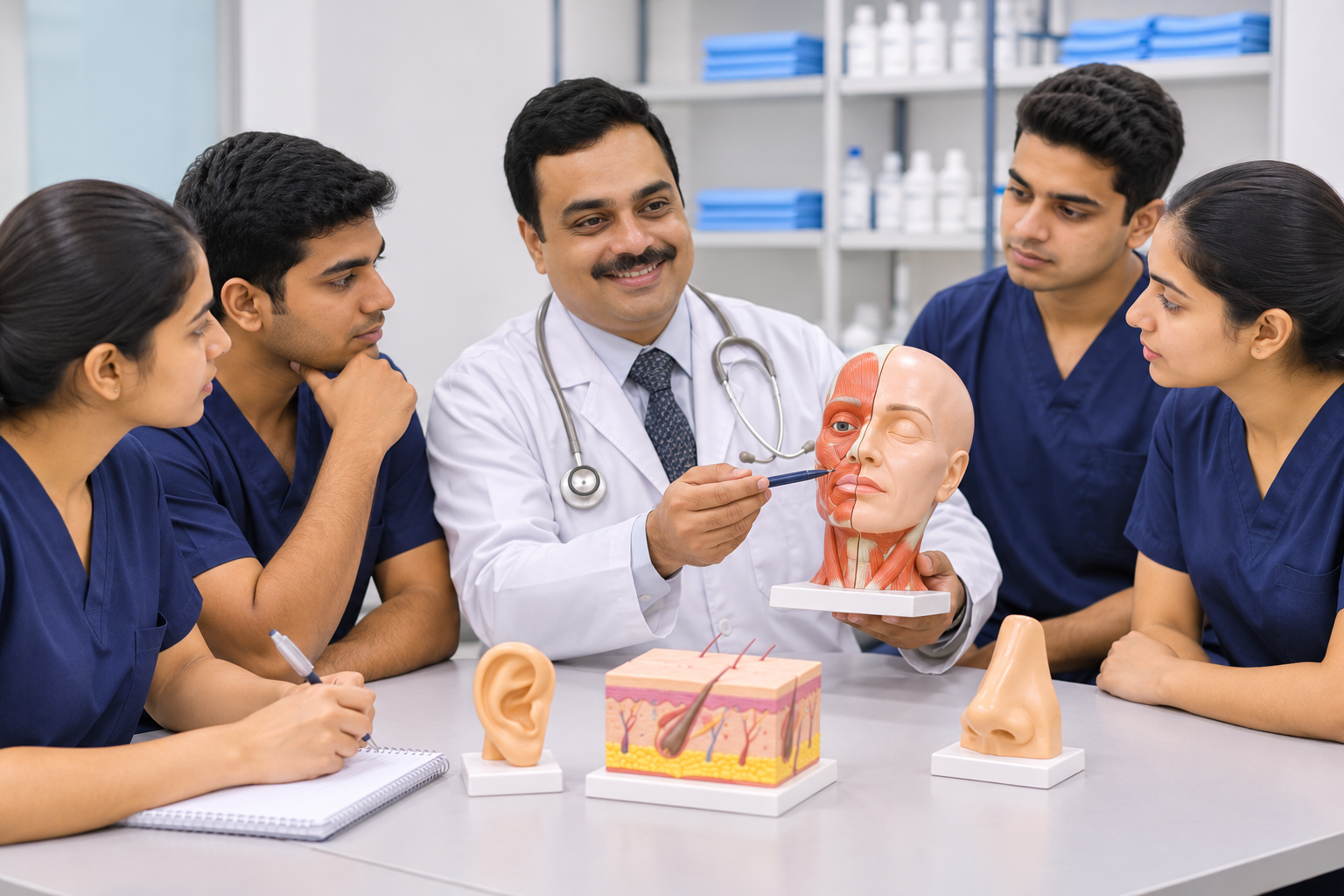
Students from Navsari can explore plastic surgery observership opportunities in Surat through structured teaching and supervised clinical observation. Contact the admissions team to confirm programme availability, duration, fees and next batch date. Before enrolling, compare observation hours, eligibility requirements, certificate details and travel or accommodation arrangements to select a programme that supports your educational goals.
A plastic surgery observership allows eligible medical students and healthcare professionals to observe clinical practice, understand patient assessment and become familiar with the principles of reconstructive and aesthetic surgery.
Unlike a surgical fellowship or formal hands-on training programme, an observership primarily focuses on observation and educational discussion.
At Elegance Vidhyalay, prospective applicants can enquire about available observership programmes, clinical exposure and admission requirements.
A plastic surgery observership may introduce participants to different aspects of clinical decision-making, surgical planning and patient care.
The exact learning activities depend on the programme’s approved structure, faculty availability and clinical permissions.
Participants may study the basic principles of plastic, reconstructive and aesthetic surgery.
Topics can include wound healing, tissue repair, reconstructive planning and the differences between functional and cosmetic procedures.
The purpose is to help observers understand how specialists evaluate clinical concerns and consider appropriate treatment options.
Clinical observation may introduce students to the consultation process.
Depending on patient consent and institutional policies, observers may see how surgeons review medical histories, examine concerns and discuss treatment expectations.
Students should understand that patient privacy and informed consent take priority over educational access.
Plastic surgery often requires individualised treatment planning.
Educational discussions may explain how surgeons evaluate patient suitability, procedure selection, potential risks and recovery considerations.
Observers may also learn why certain patients require additional investigations or specialist referrals.
Some observership programmes may permit supervised observation of surgical procedures.
However, operating theatre access depends on institutional approval, patient consent, safety requirements and the participant’s eligibility.
Observers must not assume permission to scrub in, assist or perform procedures.
Where appropriate, participants may observe how clinicians monitor recovery, discuss postoperative precautions and identify potential complications.
The learning objective is to understand clinical follow-up rather than independently manage patients.
Observership education should reinforce confidentiality, informed consent, accurate records and professional behaviour.
Eligibility depends on the programme’s objectives, clinical setting and institutional requirements.
Some observerships are intended for medical students, while others may accept qualified doctors or postgraduate trainees.
Applicants should confirm their eligibility before submitting an application.
Medical students may seek observership opportunities to understand plastic surgery as a clinical specialty.
However, eligibility may depend on their stage of medical education and institutional permission.
Qualified doctors may consider an observership to become more familiar with plastic surgery consultations, treatment planning and clinical workflows.
Participation does not provide specialist recognition or independent surgical privileges.
Eligible postgraduate trainees may pursue clinical observation relevant to their educational interests.
The institute must confirm whether their qualifications meet the programme’s requirements.
Applicants with qualifications from outside the country may need additional documentation or institutional permissions.
Depending on the admission policy, applicants may need:
For a comparison of different training formats, read fellowship observership or preceptorship.
Programme duration is an important consideration for students who need to arrange travel, accommodation or academic leave.
Observerships may differ in their schedules, teaching sessions and supervised clinical exposure.
Some programmes focus on outpatient consultations, while others may include approved operating theatre observation or case discussions.
The number of supervised observation hours helps applicants understand the expected educational exposure.
However, total hours alone do not indicate the quality or breadth of learning.
Students should also ask about case discussions, faculty interaction and the types of clinical settings included.
An observership primarily involves observing clinical activities.
Participants should not expect to perform procedures, assist during surgery or independently examine patients.
Any separate practical activity must follow the participant’s qualifications, patient consent, institutional permissions and applicable professional regulations.
Some programmes may require participants to complete a minimum number of scheduled sessions.
Students should ask whether missed sessions affect programme completion or certificate eligibility.
The cost of a plastic surgery observership depends on its duration, educational arrangements and institutional resources.
Applicants should request a written fee structure before making any payment.
Depending on the programme, fees may cover:
However, students should not assume these services are included without confirmation.
Applicants should ask about:
A programme’s usefulness depends on its learning objectives, faculty involvement and clinical observation opportunities.
Students should review the timetable and understand what activities they can observe.
The programme should clearly distinguish observation from practical clinical training.
Students considering a plastic surgery observership for students from navsari should plan their travel and accommodation around the confirmed programme schedule.
Daily commuting may suit some participants, while others may prefer temporary accommodation during consecutive training days.
Before enrolling, confirm the exact observership location and daily reporting time.
Students should also ask whether educational activities take place at one venue or across multiple approved clinical settings.
Students attending several consecutive sessions may consider hotels, hostels or paying-guest accommodation.
However, the institute must confirm whether it provides accommodation guidance.
A plastic surgery observership weekend batch may appeal to medical professionals managing academic or clinical responsibilities.
However, weekend availability depends on the current schedule and clinical activities.
Applicants should ask whether weekend participants receive the same planned educational exposure.
A pre-admission visit may help applicants understand the learning environment and programme expectations.
Students can request information about faculty, teaching facilities, attendance rules and clinical observation restrictions.
An observership can provide educational exposure, but it does not replace recognised medical qualifications or specialist surgical training.
Participants should understand the limits of the programme before making career decisions.
Observers may gain familiarity with patient consultations, surgical planning and postoperative follow-up.
This experience can help students understand the specialty’s clinical responsibilities.
Medical students may use their observations to inform future educational interests.
However, an observership does not guarantee admission to postgraduate training or specialist programmes.
Observing consultations may help participants understand how clinicians explain treatment options, risks and realistic expectations.
Students must respect patient confidentiality throughout the programme.
Applicants interested in different surgical specialties may explore related programmes.
For example, Elegance Vidhyalay provides information about an observership diabetic foot surgery.
The eligibility and learning objectives of each programme should be reviewed separately.
Qualified doctors may also benefit from understanding administrative and financial responsibilities in clinical practice.
For related reading, explore gst for plastic surgeons india.
This subject is separate from the clinical observership curriculum unless the institute confirms otherwise.
Elegance Vidhyalay provides information about education and training opportunities in medical, paramedical and aesthetic fields.
Dr. Ashutosh Shah, a Plastic, Reconstructive and Cosmetic Surgeon, is associated with the institute.
Prospective participants should verify the faculty assigned to the observership, the approved clinical observation arrangements and the programme’s eligibility requirements.
The National Skill Development Corporation (NSDC) provides general information about skills education and vocational training.
However, NSDC information does not establish recognition of a medical observership or authorisation to perform surgical procedures.
This reference does not imply that the programme has NSDC accreditation or affiliation.
Prospective applicants can follow this general enquiry process:
| Step | Action |
|---|---|
| 1 | Request the current observership brochure |
| 2 | Confirm eligibility |
| 3 | Review the approved learning objectives |
| 4 | Check observation hours and clinical access |
| 5 | Confirm duration and daily timings |
| 6 | Request the complete fee structure |
| 7 | Verify certificate details |
| 8 | Complete the institute’s approved admission process |
For updated information, visit the Elegance Vidhyalay contact us page.
Weekend batch availability depends on the institute’s current schedule and clinical teaching arrangements. Students should contact Elegance Vidhyalay to confirm upcoming dates, daily timings and observation requirements. Before enrolling, ask whether weekend participants receive comparable faculty interaction, case discussions and supervised clinical observation opportunities.
Accommodation assistance has not yet been confirmed. Students considering a plastic surgery observership for students from navsari should ask the admissions team whether hostel or PG guidance is available. They should also verify the training venue, daily schedule, travel requirements and accommodation costs before making any bookings.
The total observation hours depend on the approved programme structure. Elegance Vidhyalay’s confirmed duration is Applicants should request a breakdown of classroom discussions, outpatient observation and any approved operating theatre exposure, along with details about faculty supervision and attendance requirements.
Prospective participants can request a pre-admission visit, subject to institute availability and permission. Contact the admissions team before travelling to arrange an appointment. During the visit, ask about the learning objectives, faculty, observation facilities, eligibility requirements, clinical restrictions and certificate details.
The next confirmed batch date is Applicants should contact Elegance Vidhyalay to verify application deadlines, available seats, programme duration and reporting instructions. Students should avoid making non-refundable travel or accommodation arrangements until the institute confirms their admission and schedule.
A plastic surgery observership can help eligible students understand clinical practice through structured educational discussions and supervised observation.
Before enrolling, applicants should compare eligibility, programme duration, faculty involvement, clinical observation hours, fees and certificate details.
Travel and accommodation arrangements also deserve attention when attending sessions away from home.
Most importantly, students should understand that an observership provides educational exposure rather than independent surgical competence.
For updated programme details and admission information, contact Elegance Vidhyalay.