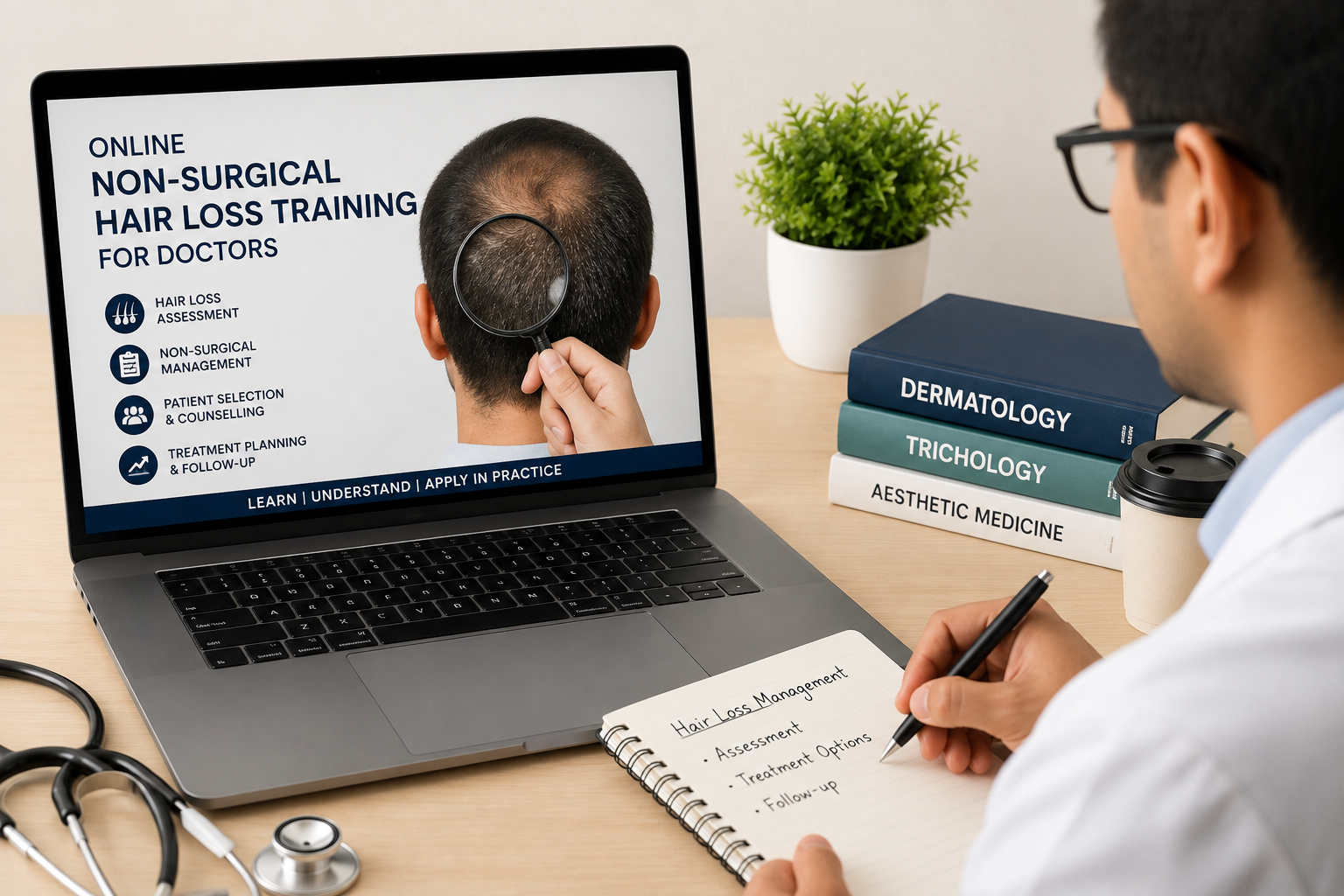
Hair loss is a common concern, but not every patient requires hair transplantation or another surgical procedure. Doctors first need to understand the cause and pattern of hair loss before considering an appropriate management approach. For doctors and surgeons interested in this area, online non-surgical hair loss training in India can provide structured education on hair-loss assessment, patient selection, non-surgical management principles, treatment planning, and follow-up. The online format also allows medical professionals to strengthen their knowledge without regularly travelling to a training centre.
Non-surgical hair loss training focuses on understanding hair-loss conditions and management approaches that do not involve hair transplantation or other surgical procedures.
A structured educational program can help doctors understand how to evaluate a patient’s concerns, identify relevant clinical factors, consider appropriate non-surgical options, and develop an individualized management plan.
The goal is not simply to learn about individual treatments. Doctors need to understand which patients may benefit, what results can realistically be expected, and when another approach or specialist evaluation may be appropriate.
Hair loss can occur for different reasons, so treatment should not begin with assumptions.
A proper assessment may involve understanding the patient’s history, pattern and progression of hair loss, scalp findings, previous treatments, general health, and other relevant factors.
Training in clinical assessment can help doctors develop a more systematic approach before recommending treatment.
This is especially important because two patients who appear to have similar hair-loss concerns may require different management strategies.
Online non-surgical hair loss training in India can help doctors understand the principles behind non-surgical hair-loss management.
Depending on the specific curriculum, educational topics may include:
The exact treatments and techniques covered should always be confirmed from the current course curriculum before enrollment.
Not every treatment suits every patient.
Doctors need to consider the type and progression of hair loss, patient expectations, previous treatments, clinical findings, and other individual factors.
Good patient selection can help doctors create more appropriate treatment plans and communicate realistic expectations.
It also helps medical professionals recognize when non-surgical management may not provide the desired outcome and when another treatment pathway should be considered.
Yes. Online education can work well for building theoretical and clinical knowledge.
Lectures, case discussions, visual learning materials, and structured teaching can help doctors understand assessment, clinical reasoning, patient selection, and management principles.
The major advantage is flexibility. Practicing doctors can continue their clinical responsibilities while studying hair-loss management from their preferred location.
However, online education should not replace appropriate supervised practical training whenever a particular treatment requires procedural competency.
Online education can make professional development easier for doctors with busy clinical schedules.
Potential advantages include flexible learning, reduced travel, access to structured educational material, convenient revision, and the ability to learn alongside existing clinical work.
Doctors can use online training to develop a stronger theoretical foundation before pursuing further practical or advanced education where required.
Elegance Vidhyalay offers a seminar focused on the non-surgical management of hair loss for medical professionals.
The selected course targets doctors and surgeons and follows an online format, making it suitable for medical professionals who want to expand their knowledge without attending regular in-person classes.
Training at Elegance Vidhyalay is guided by Dr. Ashutosh Shah, a Plastic, Cosmetic & Reconstructive Surgeon with more than 22 years of surgical experience.
His clinical experience can help doctors understand hair-loss management from a broader medical perspective, including patient assessment, treatment selection, realistic expectations, clinical decision-making, and appropriate follow-up.
Before joining an online hair-loss course, review the actual curriculum and learning format.
Doctors should check the faculty’s qualifications and experience, eligibility criteria, topics covered, duration, case-based learning, treatment modules, certification details, opportunities for further practical training, and post-course educational support.
You should also confirm whether the course matches your existing qualifications and professional learning goals.
Online non-surgical hair loss training in India can help doctors and surgeons develop a structured understanding of hair-loss assessment and non-surgical management while continuing their existing clinical practice. Rather than focusing only on individual treatments, effective education should help doctors understand patient assessment, selection, treatment planning, realistic expectations, monitoring, and clinical decision-making.
At Elegance Vidhyalay, doctors can explore online education focused on the non-surgical management of hair loss under experienced medical guidance. Doctors interested in the program should contact Elegance Vidhyalay to confirm the latest curriculum, eligibility, upcoming batch, course duration, fees, certification, and enrollment details.
The selected Elegance Vidhyalay course targets doctors and surgeons. Confirm the latest eligibility criteria directly with the institute before enrollment.
Yes. According to the selected course data, the program follows an online delivery format.
The selected program focuses on non-surgical management of hair loss. Doctors looking specifically for surgical hair transplantation training should choose a dedicated hair transplant training program.
Online education can provide theoretical and clinical knowledge. Any procedure that requires practical competency may require additional supervised hands-on training.
Different conditions can cause or contribute to hair loss. Assessment helps doctors understand the patient’s clinical situation and select a more appropriate management strategy.