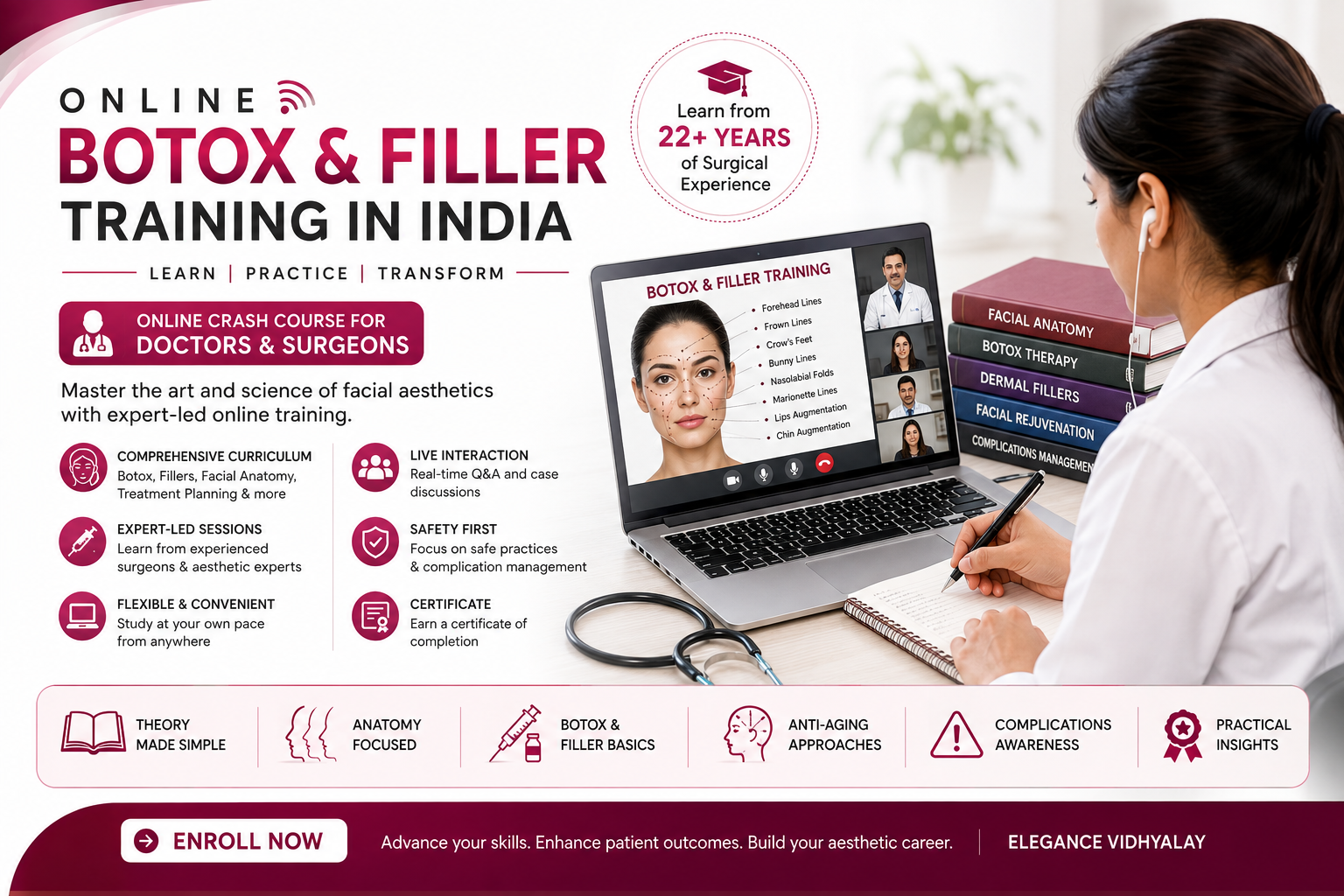
Botox and dermal fillers have become important procedures within modern aesthetic medicine. As demand for non-surgical facial treatments grows, many medical professionals want structured training without taking extended time away from their clinical practice. For doctors and surgeons looking for flexible education, online Botox filler training in India can provide a convenient way to learn facial anatomy, patient assessment, treatment planning, injection principles, complication awareness, and other essential theoretical concepts. However, online education should build knowledge rather than replace the appropriate practical experience required for injectable procedures.
Online Botox and filler training is a structured educational format that allows qualified medical professionals to study important aesthetic medicine concepts remotely.
Depending on the curriculum, training may cover:
Online learning can be particularly convenient for doctors who already manage busy clinics or hospital schedules.
The selected online Botox filler training in India is intended for doctors and surgeons interested in developing their understanding of aesthetic injectables and anti-aging treatments.
It may be useful for medical professionals who want to enter aesthetic medicine, expand their existing aesthetic practice, revise injectable concepts, or understand modern facial rejuvenation approaches.
Applicants should always confirm the course’s current eligibility requirements before enrollment.
Botox training involves much more than learning where an injection may be placed. Doctors first need to understand facial anatomy, muscle activity, patient assessment, treatment goals, dosing principles, contraindications, and potential complications. Structured online education can help doctors understand the theoretical reasoning behind treatment planning. This foundation becomes important before progressing to appropriate practical training.
Dermal fillers require a detailed understanding of facial anatomy and proportions.
Training can introduce doctors to concepts involving:
The objective should not simply be learning injection points. Doctors need to understand why, when, and for whom a treatment may be appropriate.
A strong understanding of facial anatomy is essential before performing injectable treatments.
Doctors need knowledge of muscles, vessels, nerves, fat compartments, and other important anatomical structures.
Anatomy-based training helps doctors understand treatment planning and potential risk areas rather than approaching Botox and fillers as standardized procedures.
Every patient’s facial anatomy and aesthetic goals can differ, making individualized assessment essential.
Online training can provide valuable theoretical education, but injectable procedures are practical medical skills.
Videos, lectures, diagrams, and case discussions can explain techniques and clinical concepts. They cannot completely reproduce the experience of supervised practical training.
Doctors who plan to perform injectable procedures should therefore seek appropriate hands-on learning, supervision, and competency development in addition to online education.
The main advantage is flexibility.
Doctors can study from their preferred location and fit educational sessions around clinical responsibilities.
Other potential benefits include:
This makes online education particularly useful for medical professionals who cannot regularly attend lengthy classroom programs.
Responsible aesthetic education should teach doctors not only how treatments work but also what can go wrong.
Training should help doctors recognize potential adverse effects, understand prevention principles, identify warning signs, and know when appropriate escalation or specialist management may be necessary.
This is one reason doctors should choose structured professional training rather than relying only on short social-media demonstrations or unverified online videos.
At Elegance Vidhyalay, the Botox, Filler & Anti-Aging Workshop is designed for doctors and surgeons who want structured education in aesthetic medicine. Training is guided by Dr. Ashutosh Shah, a Plastic, Cosmetic & Reconstructive Surgeon with 22+ years of surgical experience.
The learning approach helps doctors develop a stronger understanding of facial anatomy, patient assessment, Botox and filler concepts, treatment planning, facial rejuvenation, safety, and complication awareness. For medical professionals who cannot regularly travel for theoretical classes, the online format provides a flexible opportunity to strengthen their aesthetic medicine knowledge under experienced guidance.
Before choosing an online Botox and filler course, doctors should evaluate the program carefully.
Check:
A course should provide structured medical education rather than simply teach a collection of injection points.
Online Botox filler training in India can provide doctors and surgeons with a flexible way to build theoretical knowledge in aesthetic injectables while continuing their clinical practice. A strong program should focus on more than injection techniques. Doctors need to understand facial anatomy, patient selection, individualized treatment planning, safety, and complication awareness.
At Elegance Vidhyalay, doctors can explore structured Botox, filler, and anti-aging education under the guidance of Dr. Ashutosh Shah and his 22+ years of surgical experience. Enroll now to strengthen your foundation in Botox, fillers, and modern aesthetic medicine through structured professional training.
Doctors can learn important theoretical concepts online, including anatomy, patient assessment, treatment planning, injection principles, and complication awareness. Practical competency requires appropriate hands-on experience.
The selected Elegance Vidhyalay program targets doctors and surgeons. Exact eligibility should be confirmed with the institute.
Because Botox and fillers involve procedural skills, appropriate supervised practical training is important before independently performing treatments.
Facial anatomy should form an important part of responsible injectable education because knowledge of muscles, blood vessels, nerves, and other structures influences treatment planning and safety.
Yes. Online learning can be particularly convenient for practicing doctors because it allows them to study theoretical concepts around their existing clinical schedules.