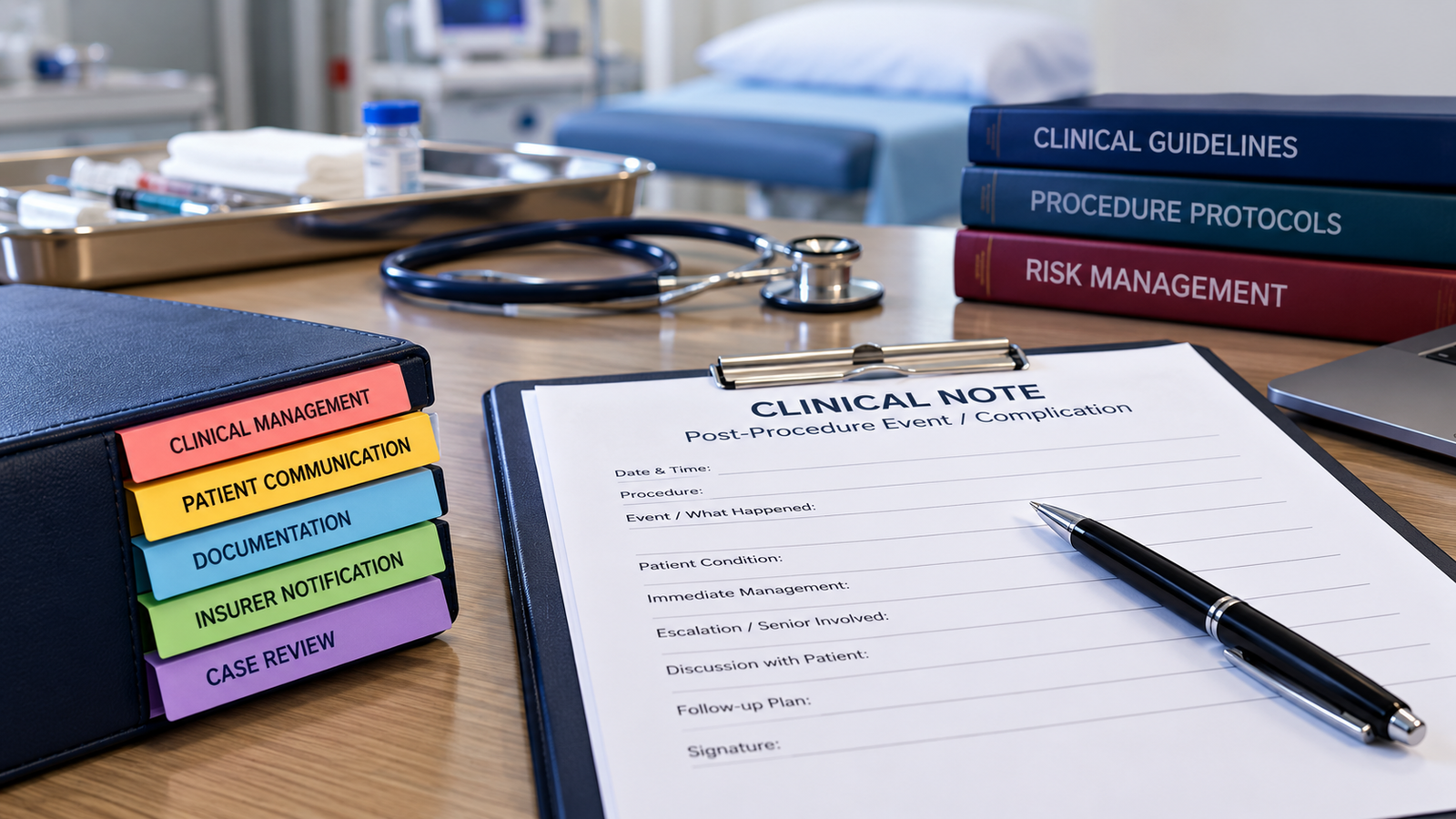
Managing a surgical complication after training requires a clear sequence of actions rather than panic or delay. Stabilise the patient first, escalate early when the problem exceeds your competence, explain plainly what happened and what you are doing, create a contemporaneous clinical record the same day, and follow your professional indemnity insurer’s notification requirements.
A complication after newly acquired procedural training can feel particularly difficult because the doctor may have limited independent experience with that event. The safest response is not to prove that you can manage everything yourself. It is to recognise the problem, protect the patient, and involve appropriate senior or specialist support when necessary.
When an adverse event occurs, priorities should remain straightforward.
Address the immediate clinical problem first.
Assess the patient, identify urgent risks, and provide care that falls within your competence. Arrange emergency transfer or specialist intervention when the clinical situation requires it.
Administrative concerns should not delay necessary patient care.
If the complication exceeds your experience, available facilities, or ability to manage safely, contact an appropriately experienced clinician or arrange transfer.
Early escalation is generally safer than continuing independently because you feel responsible for completing the treatment yourself.
Explain what has happened in understandable language.
Tell the patient:
Avoid speculation or promises about outcomes that you cannot guarantee.
Create a clear contemporaneous clinical note.
Record what happened, what you found, what you did, who you contacted, and what plan you discussed with the patient.
Then review your indemnity policy and follow its notification requirements.
Knowing when to seek help forms an important part of managing a surgical complication after training.
Escalate when:
Escalation does not necessarily mean abandoning the patient.
You should continue appropriate care while arranging the next level of management and provide the receiving clinician with relevant clinical information.
Training programmes should prepare doctors to recognise these boundaries. Doctors can review available fellowships when evaluating structured training pathways.
Patients need clear information when something unexpected occurs.
Use straightforward language rather than complicated terminology.
A useful structure is:
What happened → what it means now → what you are doing → what happens next
For example, explain that an unexpected problem has occurred, describe its known clinical significance and tell the patient what action you recommend.
Do not minimise the event simply because you worry that discussing it will create anxiety.
At the same time, do not speculate about causes before you have enough information.
The supplied brief specifically calls for honest disclosure.
Explain the known facts clearly and distinguish them from anything that remains uncertain.
The conversation should focus on:
Document the discussion in the clinical record.
Call for senior or specialist assistance early rather than late when the situation falls beyond your competence or available resources.
Do not wait until every option you know has failed before seeking help.
When calling, provide a concise clinical summary:
Information about teaching experience and faculty can also be reviewed through the Faculty and teaching record.
Write the record while events remain fresh.
Do not rely on memory several days later.
| Field | What to Record |
|---|---|
| Date and time | When the complication occurred or became apparent |
| Procedure | Procedure performed |
| Indication | Why the procedure was undertaken |
| Relevant baseline | Important pre-procedure findings |
| Event | Factual description of what occurred |
| Patient condition | Clinical findings after the event |
| Immediate action | Treatment or stabilisation provided |
| Response | How the patient responded |
| Escalation | Senior/specialist contacted and time |
| Advice received | Relevant recommendations |
| Transfer/referral | Where and why, if applicable |
| Patient discussion | What you explained |
| Questions | Important patient questions and responses |
| Follow-up | Monitoring and review plan |
| Notification | Relevant insurer or institutional notification |
| Clinician | Name and identification of person completing the note |
Write factual observations rather than defensive explanations.
Do not rewrite an earlier record to make the sequence of events appear different.
If additional information requires documentation later, make an appropriately dated additional entry according to your clinic’s record-keeping process.
Preserving chronology matters because the record should allow another clinician to understand what happened and when.
The supplied plan requires a response framework covering the first hour through the first week.
| Time | Clinical Action | Communication Action | Documentation Action | Notification Action |
|---|---|---|---|---|
| First hour | Assess, stabilise and escalate when required | Explain immediate findings and plan | Record event, findings and treatment | Check urgent internal/reporting requirements |
| Same day | Continue treatment, monitoring or transfer | Update patient about known situation and next steps | Complete contemporaneous note | Follow applicable indemnity notification requirements |
| Within 48 hours | Review progress and specialist recommendations | Provide relevant update | Add new clinical findings and decisions | Complete required follow-up notifications |
| Within one week | Review recovery and ongoing treatment | Discuss progress and plan | Maintain follow-up record | Review whether further insurer/institutional information is required |
This table provides a workflow rather than universal legal deadlines. Doctors should follow the specific requirements that apply to their practice, institution and indemnity arrangement.
Do not assume that notification only becomes necessary after a patient makes a formal claim.
Review your policy’s requirements when a significant adverse event or circumstance occurs.
Keep readily accessible:
When contacting the insurer, provide accurate factual information.
Avoid guessing about liability or the eventual outcome.
Doctors establishing procedural services can also review Practice management for doctors.
The supplied brief says to notify the indemnity insurer, but the exact contractual requirements and timing depend on the individual policy.
Check your policy and follow its notification terms.
If you are uncertain whether an incident requires notification, contact the insurer or appropriate professional adviser rather than assuming that you can wait.
The supplied content brief does not provide jurisdiction-specific legal rules about apologies or admissions.
Therefore, the blog should not make a universal claim that an apology either creates liability or can never affect a legal case.
The practical priority is to communicate compassionately and truthfully, explain the known clinical facts, address the patient’s immediate needs and follow applicable professional and indemnity guidance.
The responsibility does not finish when the patient becomes stable.
Arrange appropriate:
Make sure the patient understands whom to contact if symptoms change.
Every complication offers an opportunity to examine whether the clinical system needs improvement.
Once the immediate situation has settled, review the case systematically.
Ask:
Look again at the original indication, risk factors, and contraindications.
Consider whether your training and supervised experience adequately prepared you for both the procedure and its complications.
Check whether the clinic had the equipment, medicines, monitoring and emergency arrangements required for the procedure.
Review whether the consent process appropriately covered relevant risks, alternatives, and expected outcomes.
Identify whether earlier recognition could have changed management.
If escalation occurred late, determine why.
Review what the patient understood and whether communication could improve.
Check whether another clinician could reconstruct the sequence of events from the notes alone.
A complication review should result in action where the review identifies a meaningful weakness.
Possible changes include:
Document relevant changes so the review becomes part of quality improvement rather than an informal discussion that everyone later forgets.
Doctors often focus on learning how to perform a procedure. Training should also cover what happens when the expected course does not occur.
At Elegance Vidhyalay, doctors can explore structured Programmes for doctors that support continued development of clinical and procedural skills.
Dr. Ashutosh Shah, Plastic and Reconstructive Surgeon with 22+ years of clinical experience, contributes clinical experience relevant to procedural training, case selection, recognising complications, escalation, and appropriate clinical documentation.
Doctors should consider complication recognition and escalation pathways when assessing a course, rather than evaluating training solely by the number of procedures demonstrated.
Explain honestly what happened, what you currently know, and what you are doing about it. Avoid speculation and document the discussion clearly.
Escalate early when the complication falls outside your competence, the patient deteriorates, you remain uncertain about management, or your facility cannot provide the required care.
Record the timeline, clinical findings, complication, immediate treatment, patient response, escalation, advice received, patient discussion, referral or transfer, and follow-up plan.
Follow your policy’s notification requirements. Do not assume you can wait for a formal complaint or claim before contacting the insurer.
The supplied brief does not establish a universal legal rule. Communicate honestly and compassionately while following applicable professional, legal and indemnity guidance.
Review patient selection, procedure planning, consent, technique, recognition, escalation, communication, documentation and follow-up. Convert identified weaknesses into specific practice changes.
Managing a surgical complication after training begins with patient safety rather than concern about reputation or blame.
Stabilise the patient, recognise when the situation exceeds your competence, escalate early, communicate honestly, create a contemporaneous record and follow your indemnity notification requirements.
After the immediate problem resolves, review the case systematically. Identify what went well, what failed, and what needs to change before the next procedure.
The goal of complication review is not merely to document that an adverse event occurred. It is to use the experience to improve patient selection, preparation, escalation, communication, and clinical practice.