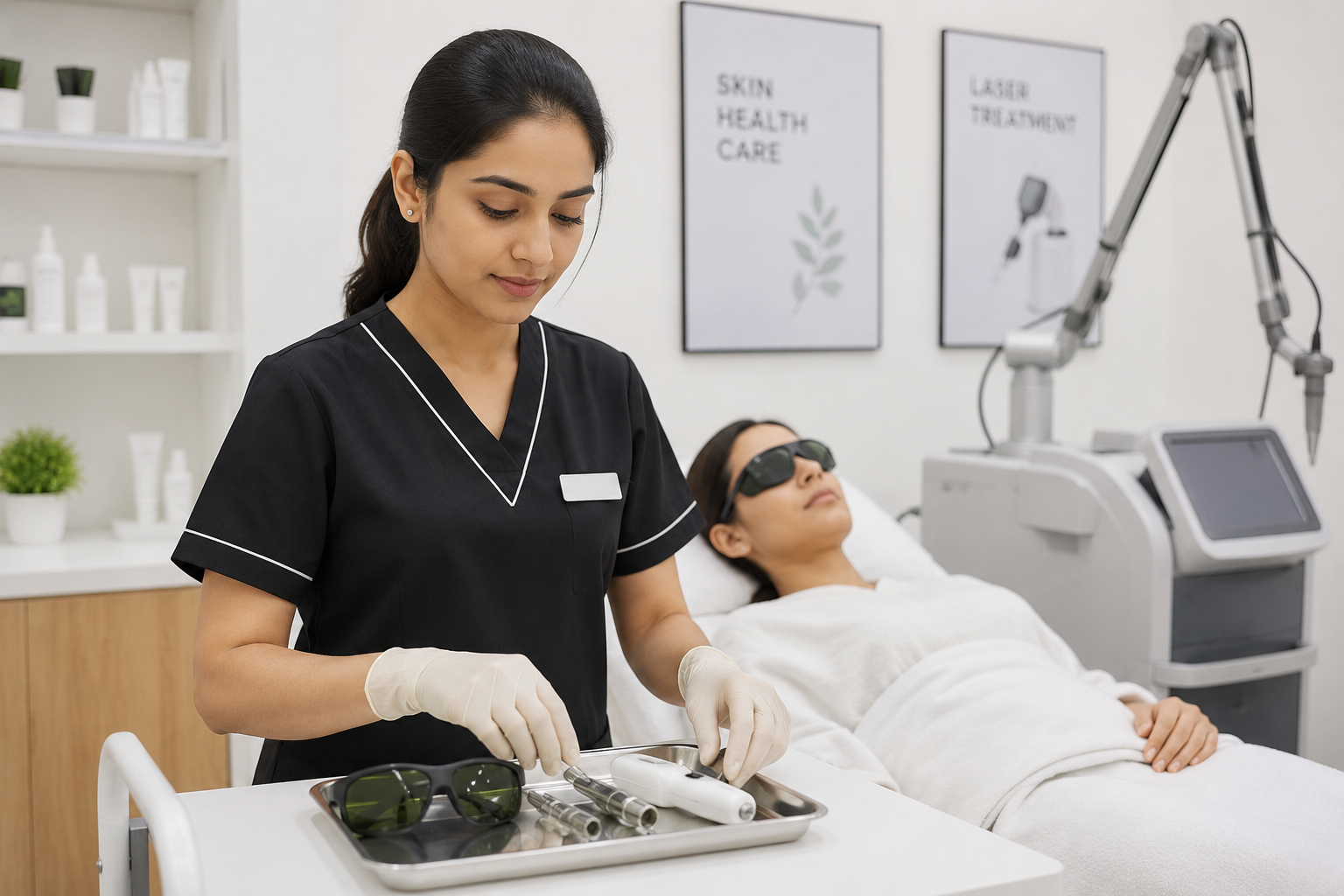
The growth of cosmetic dermatology, laser treatments, and aesthetic procedures has created new career opportunities for trained clinical support professionals. Modern aesthetic clinics need assistants who understand patient preparation, treatment-room protocols, equipment basics, infection control, documentation, and post-procedure care. A Laser and Cosmetic Procedure Physician Assistant Course in India can help paramedics and clinical assistants develop structured knowledge for working alongside qualified doctors in cosmetic and laser practices.
Unlike a doctor-focused course that teaches independent diagnosis or treatment, physician assistant training focuses on supporting the medical team safely and efficiently within the learner’s permitted scope of practice.
This is a specialized training program for individuals who want to develop knowledge and skills relevant to working as an assistant in aesthetic, cosmetic, and laser clinics.
The course can introduce learners to the workflow of a modern aesthetic practice, including how clinics prepare patients, maintain treatment areas, assist doctors, handle equipment appropriately, document care, and guide patients according to the treating doctor’s instructions.
The selected Elegance Vidhyalay program offers both online and offline learning, making it suitable for learners seeking theoretical education as well as practical exposure.
The Laser and Cosmetic Procedure Physician Assistant Course in India is primarily targeted toward paramedics and assistants who want to build specialized knowledge in aesthetic healthcare.
It may be relevant for people already working in:
Exact admission requirements should always be confirmed with the institute before enrollment.
Aesthetic treatments require careful coordination before, during, and after a procedure.
While the qualified doctor remains responsible for medical assessment, diagnosis, treatment decisions, and procedures that require medical expertise, trained assistants can play an important supporting role.
A knowledgeable assistant can help maintain an organized clinical environment, prepare patients appropriately, follow infection-control protocols, manage documentation, support procedure-room workflows, and communicate instructions clearly.
This can contribute to smoother clinic operations and a better patient experience.
A structured physician assistant course should build knowledge progressively rather than focusing only on individual treatments.
Learners first need a basic understanding of skin structure and common concerns encountered in cosmetic practice.
Training may introduce concepts related to:
This foundation helps assistants better understand the procedures they observe and support.
Laser technology plays an important role in modern cosmetic practice.
The course can introduce students to the basic principles of laser and energy-based treatments, their clinical applications, and the importance of following safety protocols.
Depending on the curriculum, learners may receive exposure to procedures used for concerns such as hair reduction, pigmentation, skin rejuvenation, and other aesthetic indications.
The goal for physician assistants is to understand the clinical environment and safely assist qualified practitioners, not to independently diagnose patients or perform medical procedures beyond their authorized scope.
Students can also become familiar with commonly discussed cosmetic and aesthetic procedures.
This may include an introduction to:
Understanding the purpose and workflow of these treatments can help assistants provide more effective clinical support.
A significant part of a physician assistant’s role involves preparing the clinical environment and supporting the treating practitioner.
Training may help learners understand:
These everyday responsibilities are important for efficient aesthetic practice.
Patient safety should remain central to every aesthetic clinic.
Students need to understand hygiene, infection prevention, appropriate handling of clinical materials, treatment-room preparation, and safety protocols.
Rather than simply learning how procedures work, professional training should help assistants understand why each safety step matters.
A patient’s experience does not begin and end with the treatment itself.
Physician assistants may support patients before and after procedures under the direction of the treating medical professional.
This can involve helping patients understand preparation instructions, reinforcing aftercare advice provided by the doctor, organizing follow-up appointments, and communicating concerns to the clinical team.
Good communication can make patients feel more comfortable and improve continuity of care.
Online education can provide a useful foundation in terminology, theory, protocols, and clinical workflows. However, working inside an aesthetic clinic also requires familiarity with the actual clinical environment.
Practical exposure can help students understand how a treatment room operates, how professionals communicate with patients, how equipment fits into clinical workflows, and how assistants coordinate with doctors.
Because the selected course offers both online and offline delivery modes, learners can benefit from flexible theoretical learning while also seeking practical exposure where included in their program.
Before selecting a program, students should look beyond the course title.
A strong training program should provide structured education relevant to real clinical responsibilities. Important areas include a clear curriculum, experienced faculty, patient-safety education, practical demonstrations, clinical workflow training, case-based learning, and appropriate mentorship.
The course should also clearly explain what assistants can and cannot do based on their qualifications and applicable professional requirements.
Completing specialized training can strengthen a learner’s knowledge when pursuing support roles in aesthetic healthcare.
Depending on qualifications, experience, employer requirements, and applicable regulations, opportunities may exist in cosmetic clinics, dermatology practices, plastic surgery centers, laser clinics, hair restoration centers, and multidisciplinary aesthetic facilities.
A course should be viewed as professional skill development rather than a guarantee of employment or authorization to independently perform medical procedures.
At Elegance Vidhyalay, the Laser and Cosmetic Procedure Physician Assistant Course is designed for paramedics and assistants who want structured education relevant to today’s aesthetic and cosmetic healthcare environment.
Training at Elegance Vidhyalay is guided by Dr. Ashutosh Shah, a Plastic, Cosmetic & Reconstructive Surgeon with 22+ years of surgical experience. His clinical experience helps learners understand how aesthetic clinics approach patient care, safety, treatment workflows, and professional standards.
The program emphasizes:
The emphasis remains on helping learners become competent clinical support professionals who work alongside qualified medical practitioners within their appropriate scope of practice.
The aesthetic industry needs more than advanced technology; it needs trained professionals who understand how to support patients and practitioners throughout the treatment journey.
A Laser and Cosmetic Procedure Physician Assistant Course in India can help paramedics and assistants build specialized knowledge in cosmetic procedures, laser-clinic workflows, patient support, and safety.
If you want to develop career-focused skills for working in a modern aesthetic practice, enroll at Elegance Vidhyalay and take the next step toward becoming a professionally trained cosmetic procedure physician assistant.
It is specialized training that introduces physician assistants, paramedics, and clinical support professionals to laser and cosmetic treatment workflows, patient support, safety protocols, and aesthetic clinic practices.
The selected course primarily targets paramedics and assistants. Applicants should confirm the exact eligibility criteria with Elegance Vidhyalay before enrolling.
According to the selected course information, the delivery mode is both online and offline, allowing learners to access flexible education while benefiting from practical learning opportunities where provided.
The course focuses on knowledge relevant to laser and cosmetic procedure assistance. The exact procedures and level of practical training depend on the curriculum and the learner’s professional scope.
Completing a training course does not automatically authorize someone to independently diagnose patients, prescribe treatment, or perform procedures reserved for appropriately qualified medical professionals. Responsibilities depend on qualifications, professional scope, applicable regulations, and clinical supervision.
Elegance Vidhyalay provides career-focused aesthetic education with expert guidance, structured learning, practical exposure, and an emphasis on clinical safety and professional standards.