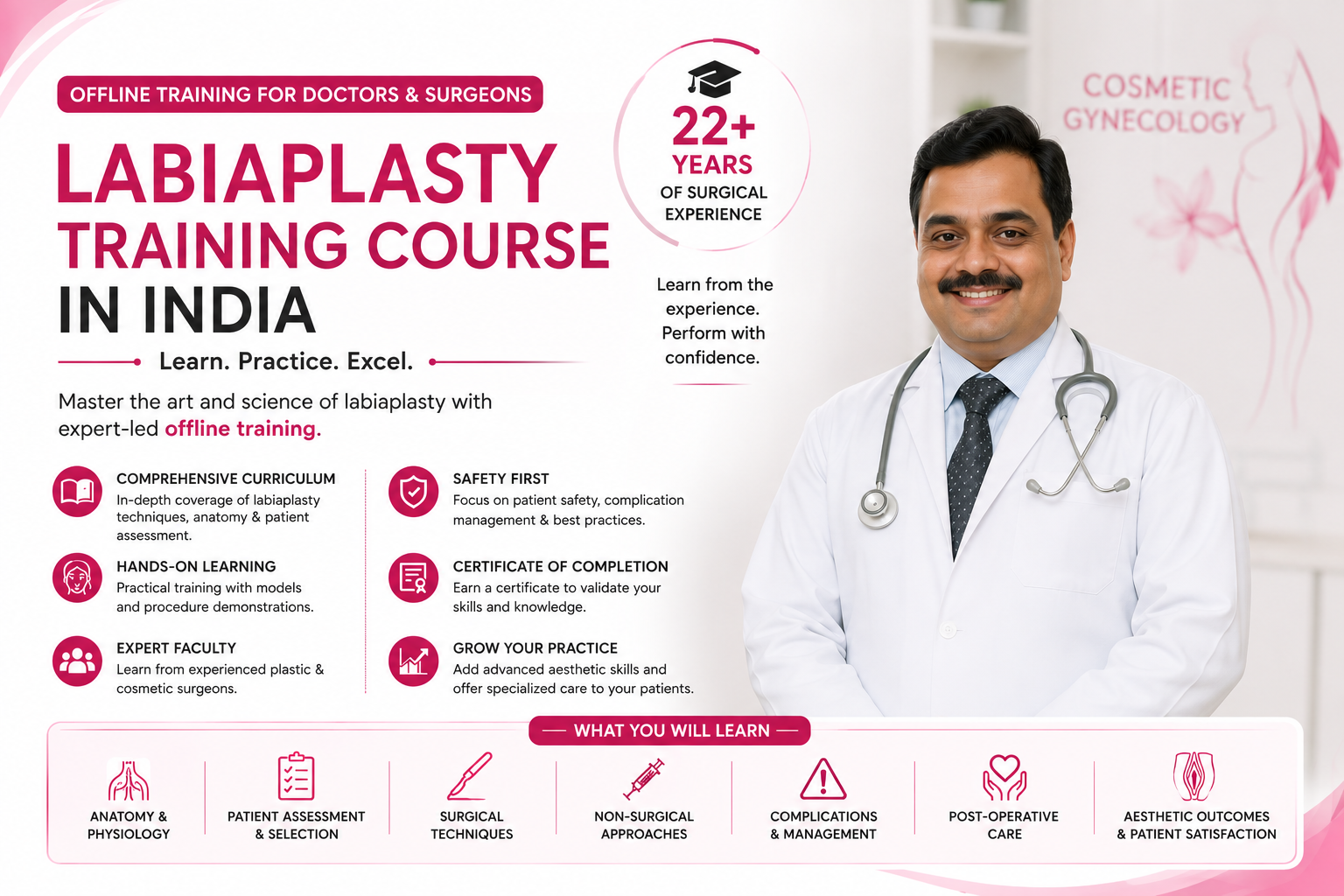
Labiaplasty is a specialized procedure within cosmetic gynecology that requires careful patient assessment, a sound understanding of anatomy, appropriate surgical planning, and responsible postoperative care. For doctors and surgeons interested in expanding their knowledge in this field, structured professional education can provide a clearer learning pathway. A labiaplasty training course in India can help qualified medical professionals understand the principles of the procedure, patient selection, surgical planning, safety considerations, and clinical decision-making under experienced guidance.
A labiaplasty training course is a focused medical education program that introduces qualified doctors to the assessment, planning, and surgical principles involved in labiaplasty.
Because this is a surgical procedure, training should go beyond simply explaining operative steps. Doctors need to understand anatomy, indications, patient expectations, procedure selection, potential complications, recovery, and follow-up care.
A structured course brings these areas together within a professionally supervised learning environment.
The selected labiaplasty training course in India targets doctors and surgeons interested in cosmetic gynecology.
It may be relevant for qualified medical professionals who want to:
Doctors should confirm the course’s current eligibility requirements before enrolling.
Understanding anatomy is essential before learning any intimate surgical procedure.
Training should help doctors develop an appropriate understanding of the relevant anatomical structures and how anatomical variations can influence assessment and surgical planning.
Not every patient requesting labiaplasty necessarily requires or is suitable for surgery.
Doctors need to understand the patient’s concerns, symptoms where relevant, expectations, medical history, anatomy, and reasons for seeking treatment.
Training can help participants develop a more systematic approach to consultation and appropriate patient selection.
Labiaplasty should not follow an identical approach for every patient.
Anatomy, concerns, treatment goals, and clinical findings may differ. Structured education can help doctors understand how these factors influence individualized surgical planning.
The emphasis should remain on appropriate clinical judgment rather than simply memorizing a technique.
The selected program follows an offline training format.
For procedure-oriented medical education, in-person learning provides important advantages. Participants can interact directly with faculty, discuss clinical situations, ask procedure-specific questions, and observe demonstrations or practical components when included in the program.
This direct learning environment can make it easier to connect anatomical knowledge and surgical theory with clinical decision-making.
No short training program should be viewed as an automatic pathway to surgical expertise.
A focused course can provide valuable education, but developing surgical competency also requires appropriate qualifications, supervised clinical exposure, continued practice, mentorship, and experience.
Doctors should therefore view training as part of their ongoing professional development, rather than assuming that completing a course alone establishes independent competency.
Responsible surgical education should teach doctors what can go wrong as well as how a procedure is planned.
Training should address patient safety, appropriate case selection, postoperative monitoring, complication awareness, and when further specialist management may be required.
Understanding when not to perform a procedure is also an important part of responsible cosmetic surgery training.
At Elegance Vidhyalay, labiaplasty education forms part of structured cosmetic gynecology training designed for doctors and surgeons.
Training is guided by Dr. Ashutosh Shah, a Plastic, Cosmetic & Reconstructive Surgeon with 22+ years of surgical experience.
Experienced surgical mentorship can help participants understand more than procedural steps. Doctors can develop their understanding of patient assessment, relevant anatomy, individualized treatment planning, surgical principles, safety, postoperative considerations, and clinical judgment.
The offline learning format also provides opportunities for direct faculty interaction and focused discussion.
Before selecting a labiaplasty training course in India, review the complete program rather than choosing based only on certification.
Check the faculty’s qualifications and experience, eligibility requirements, curriculum, training format, practical or demonstration components, batch size, certification, and availability of mentorship.
Doctors should also ensure that any procedure they subsequently perform falls within their qualifications, competency, applicable professional requirements, and scope of practice.
The selected Elegance Vidhyalay program targets doctors and surgeons. Applicants should confirm exact eligibility before enrolling.
Yes. The selected course information specifies an offline training format.
Training can include relevant anatomy, patient assessment, patient selection, surgical planning, procedure principles, safety, postoperative care, and complication awareness.
Yes. Because labiaplasty is a surgical procedure, appropriate practical and supervised clinical exposure is important for developing procedural competency.
Training is guided by Dr. Ashutosh Shah, Plastic, Cosmetic & Reconstructive Surgeon with 22+ years of surgical experience.
A labiaplasty training course in India can help qualified doctors and surgeons build structured knowledge of this specialized area of cosmetic gynecology.
At Elegance Vidhyalay, offline training provides an opportunity to learn under the guidance of Dr. Ashutosh Shah and his 22+ years of surgical experience, with emphasis on anatomy, patient assessment, planning, safety, and responsible surgical education.
Doctors interested in expanding their cosmetic gynecology knowledge can contact Elegance Vidhyalay to check eligibility, upcoming course dates, practical training details, and enrollment availability.