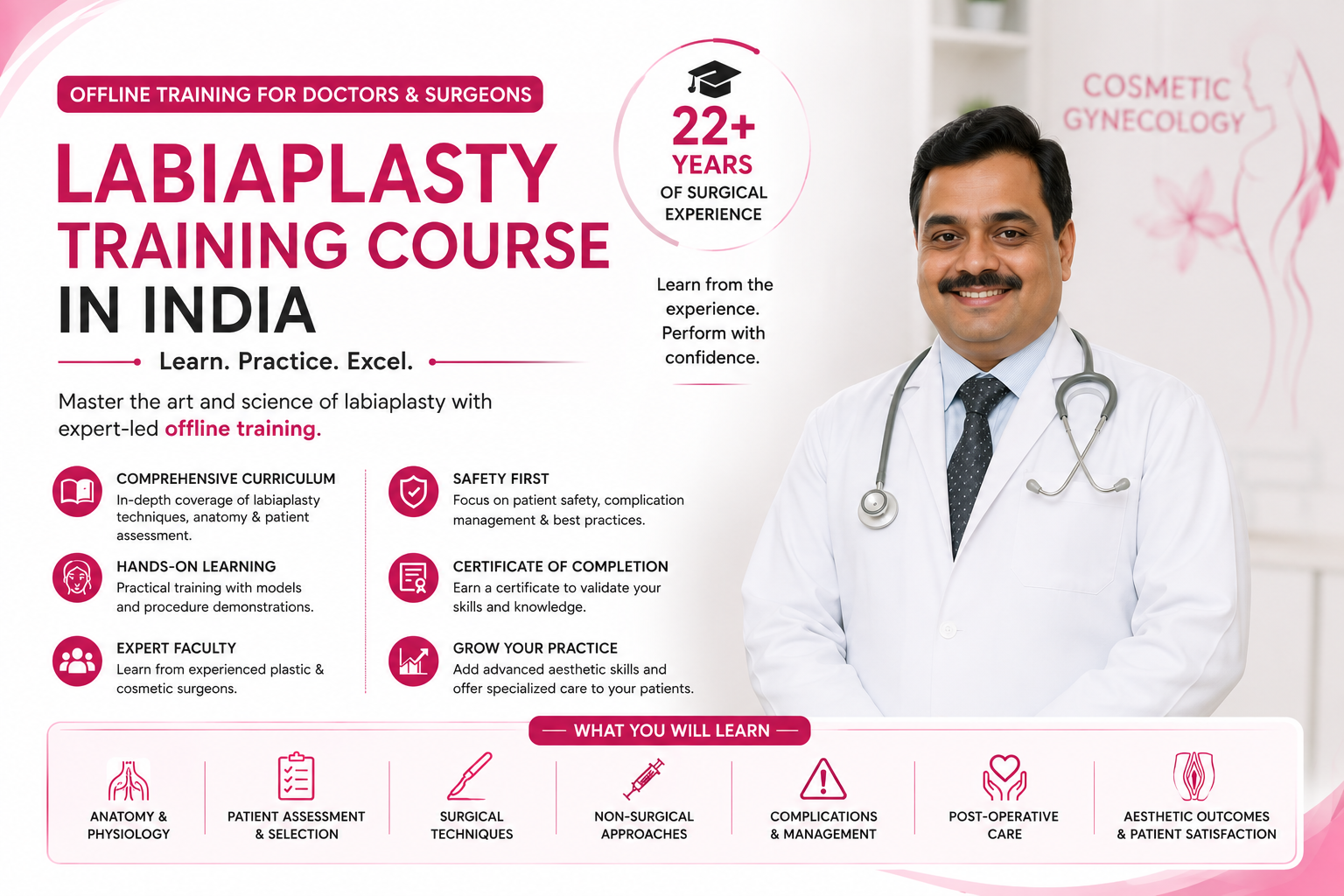
A labiaplasty training course for gynaecologists and plastic surgeons should cover vulvar anatomy, trim and wedge techniques, patient counselling, informed consent, appropriate patient selection and complication management. Surgeons must understand normal anatomical variation, identify patients who should not undergo cosmetic surgery and develop supervised procedural skills before operating independently.
Labiaplasty is a surgical procedure that changes the size or shape of the labia minora, usually for aesthetic preferences, physical discomfort or both.
Some patients report discomfort during exercise, irritation from clothing or concerns about labial appearance. However, variation in labial size, colour, shape and symmetry is normal.
Not every patient seeking labiaplasty needs surgery.
For doctors, the challenge involves more than choosing a surgical technique. Safe practice requires careful patient assessment, realistic counselling and respect for individual preferences.
A structured labiaplasty training course should teach surgeons when an operation may be appropriate, when conservative management is preferable and when surgery should be declined or deferred.
This guide explains the competencies that gynaecologists and plastic surgeons should develop before offering labiaplasty.
Labiaplasty involves delicate anatomy, vascular structures, sensory nerves and tissues that influence comfort and sexual function.
Doctors require a suitable surgical foundation before undertaking procedure-specific training.
Gynaecologists may already have experience with vulvar anatomy, examination, suturing and the management of genital conditions.
However, routine gynaecological experience does not automatically establish competence in aesthetic labial surgery.
Additional training should cover tissue preservation, cosmetic planning, scar placement and complication management.
Plastic surgeons often have experience with soft-tissue reconstruction, tissue handling and scar management.
They still need procedure-specific training in vulvar anatomy, functional considerations and patient-centred counselling.
Before performing labiaplasty independently, a surgeon should demonstrate:
Training should include supervised experience and documented assessment rather than relying only on attendance certificates.
Two commonly described approaches are the trim technique and wedge technique.
Neither is universally superior.
The surgeon must consider anatomy, patient goals, tissue quality and the risks associated with each approach.
The trim technique removes tissue along the free edge of the labia minora.
It may suit patients seeking a reduction in the length of the labial edge or changes to irregular or darkly pigmented margins.
The approach creates a new labial edge.
Potential limitations include visible edge scarring, contour irregularities, over-resection and altered sensation.
Careful tissue preservation is essential.
The wedge technique removes a selected section of labial tissue while preserving much of the original free edge.
It may be considered when maintaining the natural labial border is an important surgical objective.
However, wound tension and blood supply require particular attention.
Wound separation, tissue compromise and contour distortion are recognised complications.
| Factor | Trim Technique | Wedge Technique |
|---|---|---|
| Main approach | Reduces tissue along the free labial edge | Removes a selected wedge of tissue |
| Potential indication | Excess edge length or irregular margins | Selected patients seeking edge preservation |
| Labial edge result | Creates a new free edge | Preserves much of the original edge |
| Scar location | Along the labial margin | Across the labial tissue at the repair site |
| Wound dehiscence | Possible, particularly with tension or poor healing | Recognised concern, particularly with tension or compromised blood supply |
| Over-resection risk | Present | Present |
| Learning curve | Requires precise contour planning and tissue preservation | Requires careful planning of tissue alignment and vascular preservation |
| Main limitation | Edge irregularity or excessive reduction | Wound separation or distortion |
Important: Complication rates vary across studies and surgical settings. A particular technique should not be advertised as universally safer without appropriate evidence.
A good labiaplasty training course should teach both approaches, their limitations, and the importance of selecting the appropriate procedure rather than applying one technique to every patient.
Informed consent is one of the most important elements of female genital cosmetic surgery.
The American College of Obstetricians and Gynecologists (ACOG), in Committee Opinion No. 795, emphasises that patients considering elective female genital cosmetic procedures should receive information about potential complications and the limited high-quality evidence supporting some advertised benefits.
The Royal College of Obstetricians and Gynaecologists (RCOG) has also highlighted ethical concerns surrounding female genital cosmetic surgery, including unrealistic appearance expectations and insufficient discussion of normal anatomy.
Labia differ naturally in:
There is no single medically correct labial appearance.
Doctors should explain that asymmetry or visible labia are not automatically abnormal.
The surgeon should ask whether the patient experiences physical symptoms, appearance-related concerns or both.
A patient reporting persistent irritation may need assessment for dermatological, inflammatory or other vulvar conditions before cosmetic surgery is considered.
Depending on the concern, alternatives may include:
Labiaplasty cannot guarantee a particular appearance, improved sexual satisfaction, or complete relief from discomfort.
Patients should understand that scars, asymmetry and changes in sensation may occur.
Consent should address postoperative swelling, wound care, activity restrictions, follow-up appointments and the possibility of revision surgery.
Before scheduling elective surgery, the surgeon should confirm:
A signed form does not replace a thorough counselling discussion.
Patient selection is a central component of cosmetic gynecology training.
Surgeons must recognise when surgery may cause more harm than benefit.
Elective cosmetic labiaplasty should generally not be offered to individuals younger than 18.
Genital anatomy continues to develop during adolescence.
Exceptions may arise when a specialist identifies a significant congenital abnormality, injury or other clear medical indication.
Such cases require careful multidisciplinary assessment, appropriate consent and compliance with applicable law.
Body dysmorphic disorder involves persistent distress or preoccupation with perceived appearance defects.
Patients may seek repeated procedures without achieving relief from their concerns.
Doctors should screen for disproportionate distress, repetitive checking behaviours and unrealistic expectations.
Suspected cases require appropriate mental health assessment before considering elective surgery.
Surgery should be deferred when a patient expects:
The surgeon should clarify what the procedure can realistically achieve.
A patient should never undergo cosmetic genital surgery because of pressure from a partner, family member or another person.
Consent must be informed and voluntary.
Active infection, untreated vulvar disease or poorly controlled medical conditions may increase surgical risks.
Doctors should address these conditions before reconsidering surgery.
Elective surgery may need to be postponed if a patient cannot follow postoperative instructions or attend necessary follow-up visits.
The decision should reflect individual circumstances rather than assumptions about the patient.
Doctors evaluating labiaplasty training in Nashik should look beyond the course title and advertised certificate.
A meaningful programme should explain the qualifications required for admission, the teaching format, and the level of supervised experience provided.
Doctors can explore the cosmetic gynecology course and cosmetic gynecology training for gynaecologists to review relevant educational pathways.
Course content and hands-on opportunities should be confirmed directly with the training provider.
Completing a short course does not automatically establish independent surgical competency.
Labiaplasty complications can affect appearance, comfort and function.
Training should emphasise careful planning and recognition of surgical limitations.
Wound dehiscence occurs when a surgical wound partially or completely separates.
Potential contributing factors include excessive tension, infection, tissue trauma and compromised blood supply.
Management depends on the extent of separation, tissue viability, and infection status.
Some wounds can heal with appropriate local care, while others require specialist intervention or delayed revision.
Over-resection means removing more tissue than is appropriate for the patient’s anatomy and goals.
It may cause discomfort, exposure of sensitive tissues, contour problems, or dissatisfaction.
Revision can be challenging because the remaining tissue may be limited.
Preventing excessive removal is therefore a critical training objective.
Patients may experience temporary or persistent changes in sensation.
Surgeons must understand the relevant neurovascular anatomy and explain sensory risks during consent.
Some degree of scarring is unavoidable.
Asymmetry may remain or develop after healing.
Surgeons should avoid promising perfectly symmetrical results.
Training should include recognition of postoperative bleeding, haematoma, infection and delayed healing.
Doctors must know when urgent assessment or referral is necessary.
For additional professional guidance, the article on managing complications discusses the importance of recognising and responding to postoperative problems.
Some clinics promote laser labiaplasty as a more advanced alternative to conventional surgery.
However, the use of a laser does not automatically make a procedure safer.
Outcomes depend on patient selection, surgical technique, tissue handling, surgeon competence, and postoperative care.
Laser-based cutting can still cause thermal injury, scarring, wound-healing problems, and altered sensation.
Doctors should evaluate the evidence supporting specific devices and avoid claims that laser surgery guarantees less pain, faster recovery or superior cosmetic results.
Training should focus on anatomy, patient safety, and surgical judgment rather than marketing terminology.
Doctors interested in related procedural education may also review vaginal rejuvenation training.
The labia contain delicate tissue, and even small changes in surgical planning can affect the final appearance and function.
Supervised training allows doctors to discuss patient selection, operative decisions, tissue preservation, and postoperative complications with experienced faculty.
Dr. Ashutosh Shah, MBBS, MS, MCh, DNB, is a Plastic and Reconstructive Surgeon associated with Elegance Vidhyalay. His surgical background reflects the importance of anatomy-based planning, appropriate patient selection, and supervised clinical education. Doctors should confirm the specific faculty and procedural supervision available for any labiaplasty programme before enrolling.
A responsible training programme should encourage surgeons to operate only within their demonstrated competencies and available clinical resources.
A qualified gynaecologist may pursue labiaplasty training, but course attendance alone does not establish independent competency. The doctor needs appropriate procedural supervision, practical assessment, institutional privileges and compliance with applicable professional requirements.
There is no universally accepted number of supervised labiaplasty cases that guarantees competence. The required experience depends on the surgeon’s existing skills, the procedures taught and the quality of supervision. Doctors considering labiaplasty training in nashik should ask how competency is assessed and documented.
Not necessarily. Laser instruments do not eliminate bleeding, scarring, wound separation or altered sensation. Safety depends on surgeon experience, patient selection, tissue handling and appropriate postoperative care. No device should be presented as risk-free.
Doctors should ask about persistent appearance-related distress, repetitive checking, avoidance behaviours and expectations from surgery. Validated screening questionnaires may help identify concerns, but they do not replace clinical assessment. Suspected body dysmorphic disorder warrants appropriate mental health evaluation.
Patients generally need guidance on hygiene, swelling management, wound protection and avoiding activities that place friction or tension on the surgical area. Strenuous exercise and sexual activity are commonly restricted for several weeks, depending on healing and the surgeon’s instructions. Follow-up is essential.
Elective cosmetic labiaplasty is generally inappropriate for minors. Rare cases involving significant congenital abnormalities, trauma or another clear medical indication require specialist assessment, careful consideration of development and appropriate consent and safeguarding procedures.
A labiaplasty training course should prepare qualified gynaecologists and plastic surgeons to make safe, ethical and evidence-informed decisions.
Training must extend beyond trim and wedge techniques.
Surgeons need a clear understanding of normal vulvar anatomy, realistic patient expectations, informed consent, contraindications and postoperative complications.
The most important competency is recognising when surgery is appropriate and when it should be deferred or avoided.
Through structured education and supervised clinical training, doctors can develop the knowledge needed to provide responsible care.