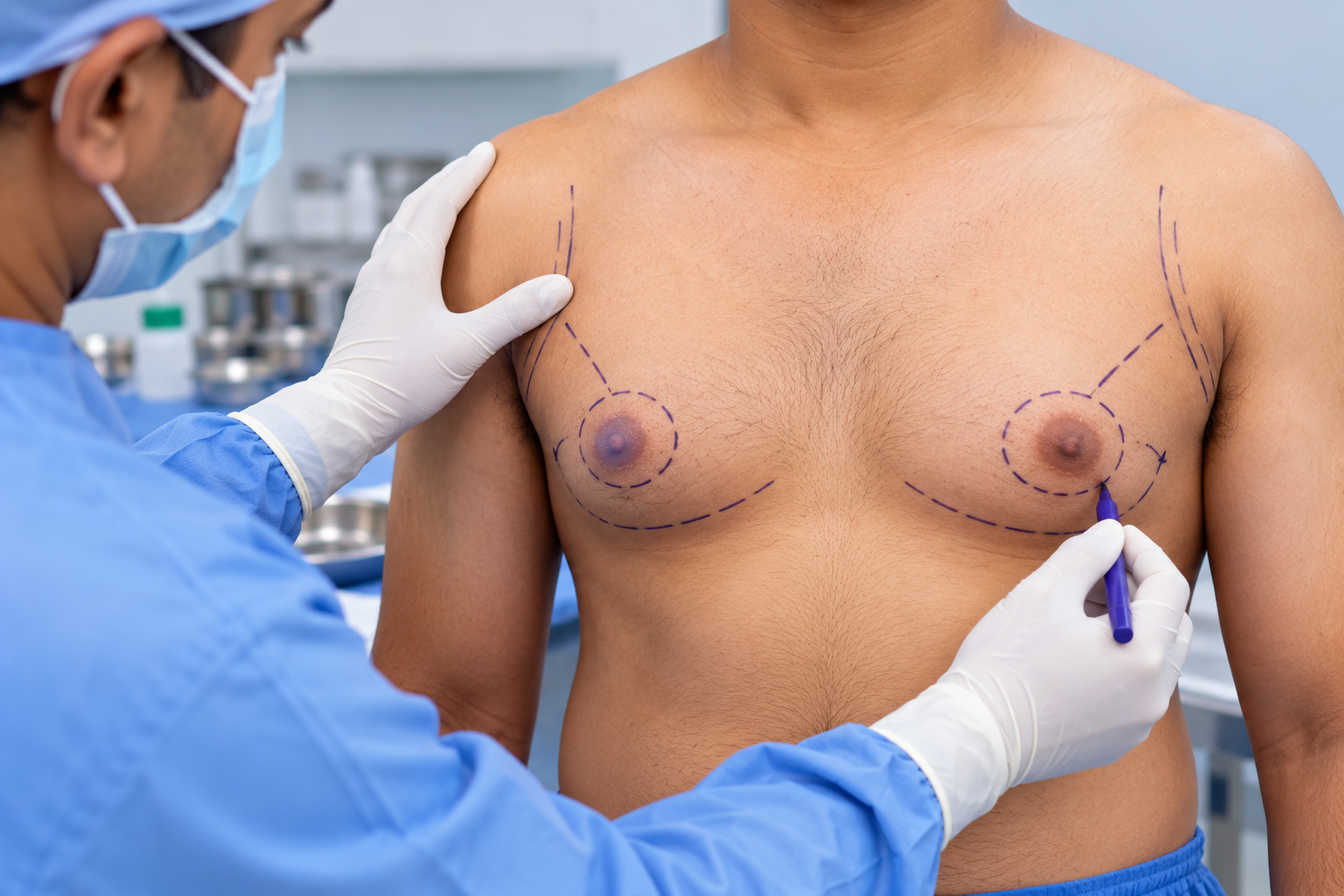
A newly trained surgeon should start independent gynecomastia work with carefully selected lower-complexity cases, usually small to moderate enlargement without major skin excess. Cases requiring extensive gland excision, skin resection, nipple repositioning, or revision surgery should remain mentored until the surgeon has demonstrated consistent planning, haemostasis, contour control, complication recognition, and postoperative management. A gynecomastia surgery course should therefore teach more than liposuction and gland removal. The surgeon needs to understand how breast size, gland-to-fat ratio, skin excess, asymmetry, nipple position and previous surgery change the operative plan.
At Elegance Vidhyalay, this progression is particularly important when teaching surgeons how to move from supervised cases to appropriately selected independent practice. Training under experienced faculty, including Dr. Ashutosh Shah, M.S., M.Ch., D.N.B. (Plastic Surgery), should emphasise case selection as strongly as operative technique.
A technically possible operation is not necessarily the right first independent operation for a newly trained surgeon.
The first step is understanding what the grade actually describes.
The classic Simon classification divides gynecomastia into:
Grade I: Small enlargement without excess skin.
IIa: Moderate enlargement without excess skin.
IIb: Moderate enlargement with excess skin.
III: Marked enlargement with substantial skin excess.
This distinction matters because surgical complexity generally increases as skin redundancy and ptosis increase. Published surgical reviews show that lower grades can often be treated with minimally invasive or skin-sparing approaches, whereas substantial skin excess may require skin resection and more extensive surgery.
The grade alone, however, does not determine the operation.
Two patients who look similar externally may contain very different proportions of fat and dense glandular tissue. A predominantly fatty chest may respond substantially to liposuction, whereas a firm retroareolar gland may require direct or pull-through gland excision.
This is why gyno surgery training should teach the surgeon to assess:
Surgical literature similarly emphasises breast size, tissue predominance, ptosis and skin redundancy when selecting an operative approach.
A surgeon completing a gynecomastia course in Pune should not choose the first independent cases merely because patients are available.
Early independent cases should be predictable.
A suitable early case generally has limited enlargement, good skin elasticity, no major ptosis, no previous chest surgery, no major asymmetry, and a straightforward combination of fat and accessible glandular tissue.
In practical training terms, carefully selected Simon grade I and IIa cases can therefore be more appropriate for the transition to independent operating than severe cases with skin excess.
Published evidence supports the relative technical simplicity of lower grades. One series of grade I–II patients used liposuction combined with minimal periareolar gland excision, while broader reviews show that more severe disease increasingly requires skin resection or other extensive approaches.
However, no universal evidence-based number of assisted operations makes a surgeon automatically competent.
The decision to operate independently should instead reflect demonstrated competency in assessment, surgical planning, liposuction, gland management, haemostasis, symmetry assessment, closure, postoperative care and complication management.
For a surgeon’s first 10 independent cases, Elegance Vidhyalay’s training principle should be to select for predictability, not variety.
Prefer patients with:
The “first 10” is a practical faculty-attributed case-selection framework, not a published universal licensing threshold or guarantee of competency.
Surgeons should progress according to demonstrated skills and outcomes rather than simply counting procedures.
For more detail on this principle, see Supervised case numbers before independent practice.
Liposuction works primarily on fatty tissue. Dense glandular tissue beneath the nipple-areola complex may require direct excision or another gland-removal technique.
This transition is important during training.
A surgeon needs to learn how much gland can safely be removed while maintaining a smooth chest contour and preserving appropriate tissue beneath the nipple-areola complex.
Over-resection can produce a depressed central chest appearance commonly described as a saucer deformity. Under-resection can leave persistent fullness.
This balance is one reason gland excision deserves supervised training.
The pull-through gland excision technique may reduce the size of visible incisions in selected cases, but a small incision does not make the operation simple. The surgeon still needs to understand the plane of dissection, gland distribution, haemostasis, and contour assessment.
Complexity increases further when skin needs to be removed.
Patients with significant skin redundancy or ptosis may require periareolar skin reduction, wider skin excision, nipple repositioning or more extensive reduction techniques. Published surgical algorithms likewise move toward skin-resection procedures as the severity of skin excess increases.
These should not generally be the newly trained surgeon’s first unsupervised cases.
The Cosmetic Surgery Fellowship can provide a broader framework for surgeons who need supervised exposure beyond straightforward chest-contouring cases.
| Grade/presentation | Tissue and skin pattern | Typical surgical direction | Early independent or mentored? | Key complication to watch |
|---|---|---|---|---|
| Simon I | Small enlargement, no skin excess | Liposuction where fatty; limited gland excision where required | Carefully selected early independent case after competency demonstrated | Under/over-resection, contour irregularity |
| Simon IIa | Moderate enlargement, no skin excess | Liposuction ± gland excision | Selected early independent case after supervised competency | Haematoma, asymmetry, saucer deformity |
| Simon IIb | Moderate enlargement with skin excess | Liposuction/gland management; skin strategy may be needed | Mentor recommended while developing experience | Skin redundancy, contour irregularity, scars |
| Simon III | Marked enlargement with significant skin excess | Gland/fat removal plus skin-resection strategy; nipple management may be required | Mentored until advanced competency established | Haematoma, wound problems, nipple-areola compromise |
| Revision / marked asymmetry | Scarred or altered anatomy | Individualised secondary correction | Mentor recommended for newly trained surgeon | Further contour deformity, vascular compromise |
| Bodybuilder / complex gland-dominant presentation | Dense gland may coexist with low fat and history requiring careful evaluation. | Individualised gland excision and contour strategy | Mentor advisable early in practice | Crater/saucer deformity, bleeding, asymmetry |
The table is a training framework rather than a rigid treatment algorithm. Actual surgery must be selected according to examination, tissue characteristics, patient factors and surgeon competence.
A surgeon should not begin independent gynecomastia practice simply because they can complete the technical steps of liposuction and excision.
They must also know what to do when the operation does not follow the expected course.
Haematoma is one of the important early complications of gynecomastia surgery and has been reported frequently in the surgical literature.
A trainee needs to recognise rapidly increasing swelling, asymmetry, pain, tension and other concerning postoperative changes. More importantly, the surgeon must have a clear escalation pathway and understand when urgent operative reassessment is necessary.
Uneven fat removal, residual gland, aggressive excision or poor transition between treated and untreated areas can create visible irregularities.
Prevention begins with careful marking and continues throughout liposuction, gland removal, and final intraoperative contour assessment.
A saucer or crater-like depression can occur when too much tissue is removed beneath the nipple-areola complex.
Avoiding this complication requires judgment about the thickness of tissue that should remain and careful feathering of surrounding contours. Over-resection and saucer-type deformity are recognised complications in gynecomastia surgery course.
More extensive dissection and skin procedures increase the importance of preserving blood supply to the nipple-areola complex.
Nipple necrosis is among the major complications reported in reviews of surgical gynecomastia treatment.
A newly trained surgeon should therefore gain mentored experience before taking on cases requiring extensive skin resection or nipple repositioning.
A surgeon encountering an unexpected postoperative problem should already know the escalation process. Elegance Vidhyalay’s guide to managing your first surgical complication after training discusses why complication planning is part of becoming independently competent.
A training logbook should show more than the number of operations attended.
For every case, record:
Photographic documentation, where appropriately consented and securely handled, can also help the trainee and supervisor evaluate contour, symmetry, scarring and consistency over time.
The logbook should demonstrate progression from observation to assistance, supervised performance and eventually appropriately selected independent practice.
Prospective trainees should also review the Elegance Vidhyalay faculty when considering who will supervise their operative development.
A muscular chest can make even small contour irregularities conspicuous.
A bodybuilder may also present with dense glandular tissue and a history of anabolic-androgenic steroid use that needs to be identified during medical assessment. The surgeon must evaluate the cause and stability of the condition rather than treating every chest enlargement as a straightforward contouring problem.
Revision gynecomastia is another advanced category.
Previous surgery can alter tissue planes, vascularity, and contour. The surgeon may face residual gland, excessive previous resection, scar tethering, asymmetry, or nipple deformity.
Revision surgery therefore tests reconstructive judgment as much as basic gynecomastia technique.
For newly trained surgeons, mentoring on these cases provides an additional safety layer while experience develops.
Not always. The operative plan depends on the amount of fat, dense gland, and skin excess rather than the grade alone. Liposuction can treat fatty tissue effectively, but persistent glandular tissue may require excision. Published grade I–II series commonly combine liposuction with gland removal where necessary.
There is no universal number that guarantees competence. Surgeons considering a gynecomastia course in Pune should focus on demonstrated skills, outcomes, and supervisor assessment. Independent practice should begin only after the trainee can appropriately select patients, plan surgery, perform required techniques, and recognise and manage complications.
Saucer deformity usually results from excessive central tissue removal, creating a depression beneath or around the nipple-areola complex. Prevention requires controlled gland excision, appropriate preservation of tissue beneath the areola, smooth contour transitions, and repeated intraoperative assessment rather than pursuing maximal gland removal.
They are generally poor choices for a newly trained surgeon’s earliest independent cases. The cause of gynecomastia should first be evaluated, and a muscular chest can make small contour defects highly visible. Dense gland, expectations, and recurrence-related factors can also make planning more demanding.
Management depends on its size, progression and clinical findings. A rapidly enlarging or tense postoperative collection requires prompt surgical assessment and may require evacuation and haemostasis. Training should teach both prevention and an escalation plan because haematoma is a recognised early complication of gynecomastia surgery.
Course eligibility and appropriate clinical scope should be checked before enrolment. A general surgeon may pursue additional training where the programme accepts their qualification, but course completion alone does not establish competency for every gynecomastia presentation. Supervised training and progressive case selection remain important before independent practice.
A gynecomastia surgery course should teach surgeons when to operate independently just as carefully as it teaches how to perform liposuction and gland excision.
Lower-complexity cases with limited enlargement, little or no skin excess, predictable anatomy, and no previous surgery are more appropriate for the transition toward independent operating. Cases involving major skin redundancy, nipple repositioning, substantial asymmetry, revision surgery or complex anatomy deserve further mentored experience.
Published literature confirms that operative strategy changes with breast size, skin redundancy, tissue composition, and ptosis, while recognised complications include haematoma, contour irregularity, saucer deformity, and nipple-areola problems.
At Elegance Vidhyalay, training under experienced faculty such as Dr. Ashutosh A Shah, M.S., M.Ch., D.N.B. (Plastic Surgery) should focus on progressive responsibility, careful patient selection, and honest review of outcomes.