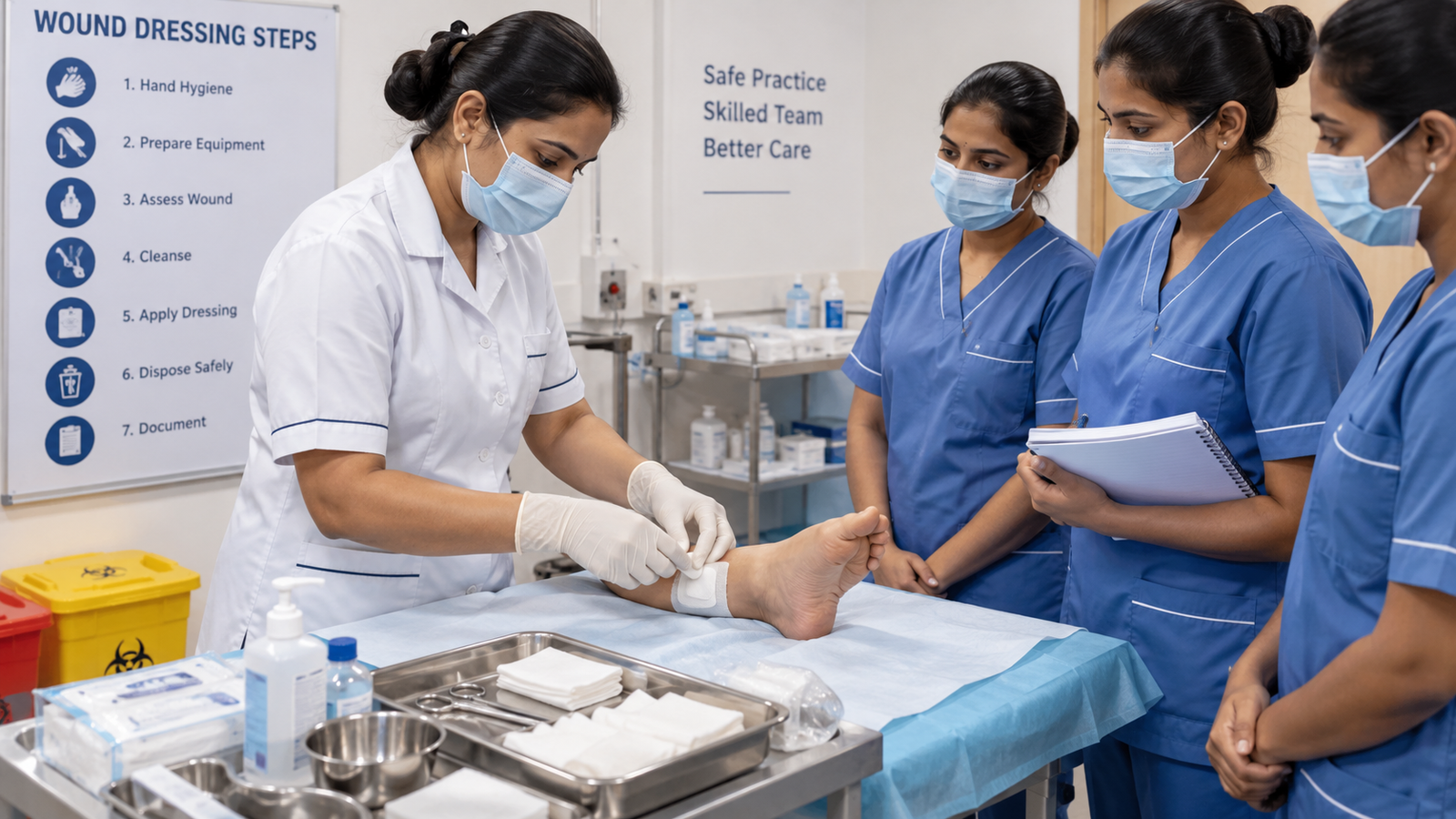
Training nursing staff in wound dressing should focus on demonstrated competence rather than attendance. For training clinic staff in wound dressing, a practical programme can be structured into six 90-minute sessions covering asepsis and hand hygiene, wound assessment and measurement, dressing selection, application technique, documentation, and escalation.
The goal is not simply to teach staff how to change a dressing. Staff should understand how to maintain asepsis, observe and document a wound consistently, follow the prescribed dressing plan, recognise problems, and know exactly when to stop and call the doctor.
Before practising wound dressing, staff need a clear foundation in infection prevention.
The first session should cover:
Staff should demonstrate these steps before progressing to wound-contact skills.
A useful principle is simple: if aseptic technique is unreliable, the trainee should not progress to independent dressing procedures.
The supplied curriculum uses six sessions of 90 minutes each.
| Session | Objective | Hands-On Component | Duration | Assessment Method |
|---|---|---|---|---|
| 1. Asepsis & Hand Hygiene | Establish safe preparation and infection-control technique | Hand hygiene, PPE, sterile-field preparation and disposal | 90 min | Direct observation |
| 2. Wound Assessment & Measurement | Teach consistent observation and measurement | Identify wound features and practise length, width and depth measurement | 90 min | Observed assessment and documentation |
| 3. Dressing Selection | Understand how the prescribed dressing relates to wound findings | Review dressing materials and appropriate handling | 90 min | Case-based questioning and demonstration |
| 4. Application Technique | Perform the dressing process correctly | Preparation, cleansing and application according to clinic protocol | 90 min | Directly observed practice |
| 5. Documentation | Create a consistent clinical record | Complete wound notes, measurements and treatment documentation | 90 min | Record review |
| 6. Escalation | Recognise situations that require doctor review | Scenario-based recognition and escalation practice | 90 min | Observed scenarios and verbal assessment |
Completing all six sessions does not automatically mean that a staff member is competent. The supervisor should assess actual performance.
This session establishes the safety foundation.
Staff should learn the clinic’s standard sequence:
Prepare area → perform hand hygiene → organise supplies → use appropriate PPE → establish the working field → perform the assigned dressing procedure → dispose of waste correctly → document care.
Common errors include touching non-clean surfaces after preparing equipment, moving between clean and contaminated items incorrectly, and failing to recognise when gloves need changing.
The trainer should correct these errors during practice rather than allowing incorrect habits to become routine.
Staff involved in wound care need a consistent method of observing and recording findings within their assigned role.
Training can include documenting:
Measurements should use the same clinic method at every visit, so serial records remain comparable.
Staff should not independently diagnose a change that falls outside their role. They should document what they observe and escalate concerning findings according to protocol.
Structured wound-care skills can also be developed through the Diabetic foot technician course.
Staff should understand the purpose of the dressing prescribed by the treating clinician.
Training should cover the basic characteristics of dressing materials used within the clinic and the correct way to prepare and handle them.
The objective is not to encourage staff to independently change a treatment plan outside their role.
Instead, they should learn to recognise when:
In these situations, staff should seek appropriate clinical review rather than improvising.
The fourth session brings the earlier skills together.
The trainee should demonstrate the clinic’s complete dressing workflow under observation.
The assessment can examine whether the trainee:
Repeated observed practice is more useful than simply recording that a trainee attended a class.
A technically correct dressing with poor documentation leaves an incomplete clinical record.
Staff should learn what the clinic expects them to document after every dressing.
A standard record may include:
| Field | Record |
|---|---|
| Date/time | When care occurred |
| Wound/site | Exact location |
| Measurements | Length, width, and depth where required |
| Observations | Relevant wound and surrounding skin findings |
| Dressing | What was applied according to the plan |
| Patient response | Relevant symptoms or concerns |
| Escalation | Whether doctor review was requested |
| Advice | Instructions provided within staff role |
| Next review | Planned follow-up |
| Staff identification | Person completing the record |
The clinic should use one consistent documentation format rather than allowing every staff member to develop a different method.
The final session is particularly important.
Competent staff need to know not only what they can do, but also when they must stop and call the doctor.
Use realistic scenarios during training and ask the trainee what they would do next.
Examples may include unexpected wound deterioration, new systemic symptoms, uncontrolled bleeding, rapidly changing tissue appearance, significant new pain, or uncertainty about the prescribed treatment.
The purpose is to establish a clear escalation habit.
Attendance answers only one question: Was the person present?
Competence asks whether the person can safely perform the assigned task.
Assessment should therefore use observed practice.
A simple competency record can include:
| Skill | Observed | Competent | Needs Further Practice |
|---|---|---|---|
| Hand hygiene | ✓ | ||
| Dressing-area preparation | ✓ | ||
| Aseptic technique | ✓ | ||
| Wound measurement | ✓ | ||
| Dressing application | ✓ | ||
| Waste disposal | ✓ | ||
| Documentation | ✓ | ||
| Escalation recognition | ✓ |
The supervising clinician should sign off competence only after observing satisfactory performance.
Problem: The trainee touches a contaminated surface and continues.
Correction: Stop the exercise, identify where contamination occurred, reset and repeat the sequence.
Problem: Different measurement methods make serial wound records difficult to compare.
Correction: Establish one clinic measurement protocol and practise it repeatedly.
Problem: Staff substitute or modify treatment without appropriate clinical review.
Correction: Define which decisions require doctor approval.
Problem: The dressing is completed, but findings, measurements, or treatment details are missing.
Correction: Make documentation part of the procedure checklist rather than a separate optional task.
Problem: Staff recognise that something has changed but continue routinely.
Correction: Use scenario training and a visible escalation card.
A short wall-mounted protocol should be easy to read during daily work.
BEFORE
DURING
AFTER
Staff working around procedure-room environments may also benefit from relevant training such as the Operation Theatre Technician course.
The clinic should create a clear escalation policy appropriate to its services and staff roles.
STOP AND SEEK DOCTOR REVIEW WHEN:
The principle should be: when the clinical situation moves beyond the written protocol or the staff member’s competence, escalate rather than improvise.
The supplied plan does not specify a fixed refresher interval, so an arbitrary schedule should not be presented as a universal requirement.
Clinics can use competency reviews based on factors such as:
An incident or repeated documentation problem may also indicate that retraining is needed before the next routine review.
A clinic does not need to treat training as a one-time lecture.
A stronger system is:
Teach → demonstrate → supervised practice → observe → correct → reassess → sign off → periodically review.
This approach creates evidence of actual skill development.
At Elegance Vidhyalay, structured healthcare training can support doctors and clinical staff who want to develop practical skills and standardised clinical workflows. Available options can be reviewed through the Certified courses.
Doctors establishing staff-training and documentation systems can also review Practice management for doctors.
The supplied curriculum uses six 90-minute sessions. However, completing the sessions does not itself establish competence. Staff should demonstrate the required skills through supervised and observed practice.
Training does not automatically determine professional scope. The clinic must consider the person’s qualifications, permitted role, competence, supervision, and applicable requirements before assigning wound-care responsibilities.
Assess competence through directly observed practice, wound measurement, dressing technique, documentation, and escalation scenarios. Attendance alone should not be used as proof of competence.
Include hand hygiene, preparation, aseptic technique, wound assessment, measurement, prescribed dressing application, waste disposal, documentation, and clear escalation instructions.
There is no fixed interval in the supplied plan. Clinics should schedule competency reviews according to staff roles, performance, protocol changes, and identified training needs.
Staff should escalate unexpected deterioration, significant bleeding, concerning systemic symptoms, major changes in pain or wound appearance, unclear instructions, or any situation outside their assigned competence.
Effective training of clinic staff in wound dressing requires more than demonstrating how to apply gauze or a dressing product.
A structured six-session curriculum can cover asepsis and hand hygiene, wound assessment and measurement, dressing selection, application technique, documentation and escalation, with each session lasting 90 minutes.
The most important principle is that competence should be demonstrated through observed practice, not assumed from attendance.
Clinics should combine practical training with a wall-mounted dressing protocol, clear documentation standards, and an escalation card that tells staff when they must stop and call the doctor. This creates a more consistent in-clinic wound-care workflow while keeping clinical decisions within appropriate professional roles.