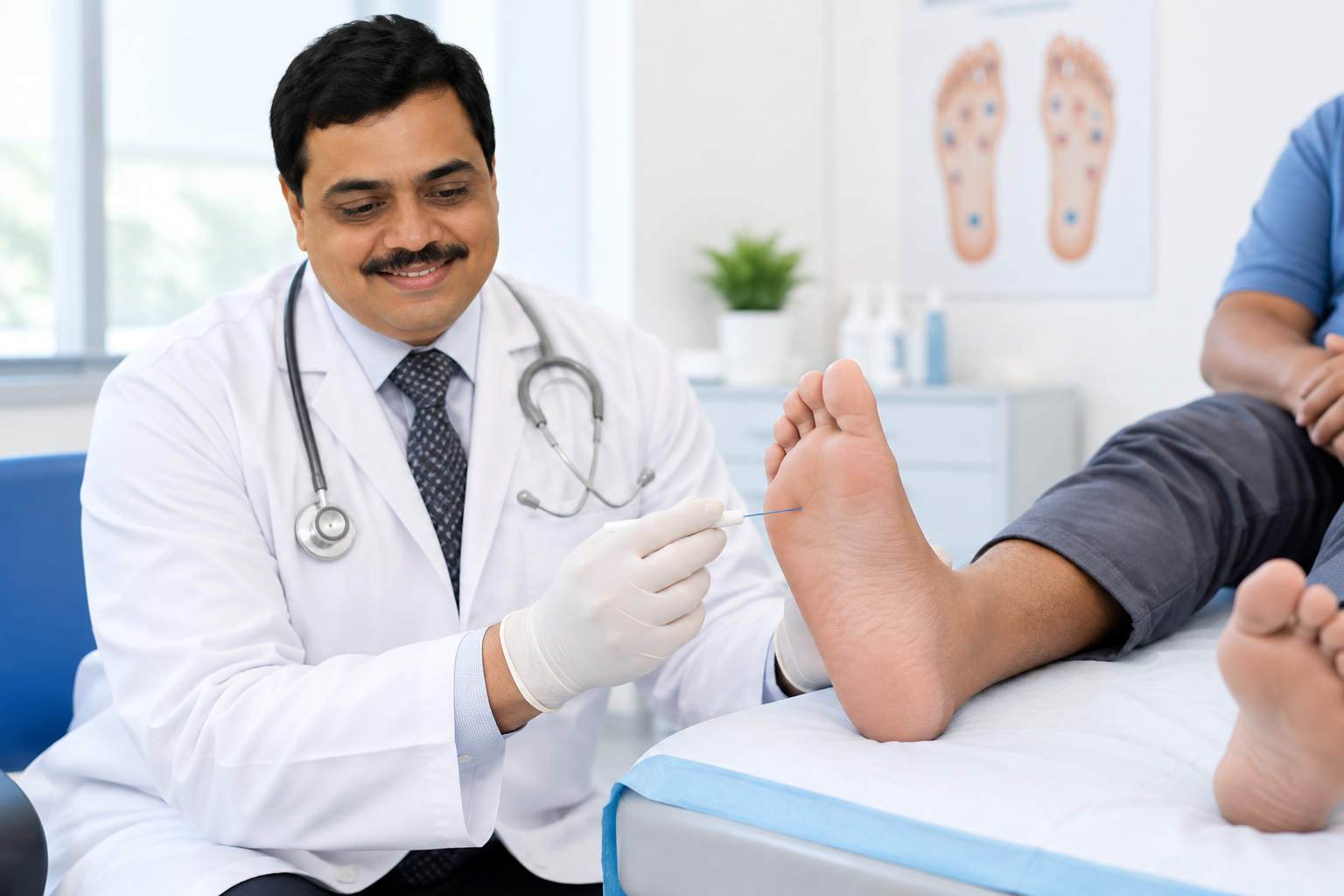
A diabetic foot fellowship for general practitioners can be worth it if you already see diabetic patients weekly and have space for a dressing room. A fellowship can equip a GP to screen, grade, offload, dress, and perform appropriate superficial debridement. Deep debridement, revascularisation and reconstruction, however, still require specialist referral.
Diabetes is commonly managed in general and family practice, which means GPs may be among the first clinicians to notice loss of protective sensation, callus formation, skin breakdown, infection or a developing foot ulcer.
For doctors considering a fellowship after MBBS, diabetic foot training can therefore be a practical way to strengthen clinical skills that complement routine diabetes care. Its value, however, depends on the quality of training, the patients you see, your clinical setup, and a clear understanding of what remains outside your scope. This guide looks at what a GP may gain from such training, when referral remains necessary, and how to decide whether the investment makes sense for your practice.
The primary value of structured diabetic foot training for a general practitioner is not learning to perform every diabetic foot procedure. It is learning how to identify risk earlier, manage suitable cases appropriately and recognise when specialist intervention is required.
Depending on prior qualifications, competence, local regulations, institutional privileges and the training completed, practical skills may include:
A GP who routinely treats patients with diabetes can incorporate many of these skills into everyday consultations. For example, instead of addressing blood glucose alone, the doctor can establish regular foot-screening protocols for patients at increased risk.
This may help identify problems before they develop into more complicated wounds. A fellowship should also teach doctors their limits. Knowing which patient not to treat independently can be as important as learning a new procedure.
Doctors specifically interested in more advanced surgical management can explore diabetic foot surgery training for surgeons, while GPs should choose programmes appropriate to their qualifications and intended clinical role.
The following is a practical framework rather than a universal legal scope-of-practice rule. Actual practice depends on the doctor’s qualifications, demonstrated competence, applicable regulations, clinical privileges, and patient circumstances.
| Procedure / Skill | Can perform after training | Needs supervision | Must refer | Equipment and consent required |
|---|---|---|---|---|
| Screening and risk grading | Generally appropriate with adequate training | Usually not for routine screening | Refer abnormal vascular, neurological or complex findings as indicated | Monofilament, examination equipment and proper clinical documentation |
| Offloading and footwear prescribing | Basic offloading and footwear advice may be provided | Complex offloading may require specialist input | Refer complex deformity, recurrent ulceration or specialised footwear needs | Appropriate assessment, measurement and documentation |
| Sharp debridement of superficial slough | May be appropriate when trained, competent and permitted | Recommended while developing competency | Refer deep, extensive, ischemic or complicated wounds | Sterile instruments, suitable clinical environment, consent and documentation |
| Nail and callus procedures | Selected low-risk cases may be managed after appropriate training | Higher-risk cases may need supervision | Refer complicated, ischemic, infected or technically difficult cases | Appropriate instruments, infection-control measures and consent |
| Deep debridement | Not a routine GP procedure solely because of fellowship training | Specialist/surgical setting required | Yes | Surgical facility, anaesthesia where required, consent and appropriate surgical expertise |
| Revascularisation | No | Specialist vascular training required | Yes | Hospital/endovascular or vascular surgical infrastructure |
| Flap reconstruction | No | Specialist reconstructive surgical training required | Yes | Operating theatre, anaesthesia, reconstructive expertise and formal surgical consent |
Completing a fellowship does not automatically change a doctor’s legal scope of practice or convert a GP into a vascular, orthopaedic, reconstructive or other specialist surgeon.
Cases requiring advanced investigation or intervention should be referred appropriately.
Examples can include:
A good diabetic foot fellowship should make these referral thresholds clearer.
The objective should not be to encourage participants to undertake procedures beyond their competence. Instead, training should improve early recognition and help establish a reliable referral pathway.
This can create a practical model in which the GP handles prevention, screening and suitable routine care while working with diabetologists, vascular specialists, surgeons, podiatry or foot-care professionals and reconstructive teams when advanced treatment is required.
For a GP already seeing a substantial number of patients with diabetes, adding structured foot screening and preventive care can broaden the services offered within the same practice.
A patient who comes for routine diabetes management may also require periodic:
This can support continuity of care.
Patients do not necessarily need to wait until they develop an ulcer before receiving foot care. High-risk patients can be identified and followed more closely.
However, a fellowship should not be viewed simply as a way to generate additional procedures.
The clinical benefit comes from better integration of diabetic foot prevention into routine diabetes management.
Whether it increases patient volume depends heavily on the location of the practice, existing diabetic patient load, referral relationships, availability of specialised foot services nearby and awareness among patients.
There is no guarantee that completing a fellowship will result in a specific increase in patient numbers or revenue.
Doctors comparing different postgraduate training options can also review all fellowships and identify which programme best matches their existing patient profile and long-term clinical goals.
There is no universal payback period for a diabetic foot fellowship.
The financial value depends on factors such as:
A GP who already manages a large number of patients with diabetes and has a suitable clinical setup may be able to use the training sooner than a doctor starting without an established diabetic patient base.
Consider the total investment, rather than course fees alone.
For example:
Total training investment = programme fees + travel + accommodation + income lost during training + initial equipment costs
Doctors can then compare this with the realistic additional clinical services they expect to provide.
Avoid choosing a fellowship based solely on claims of high income, rapid returns, or guaranteed patient numbers. These outcomes depend heavily on individual circumstances.
Clinical usefulness should remain the primary consideration.
A skill course for family physicians or a diabetic foot fellowship is not automatically useful for every GP.
It may not be the right investment if you:
The question “Is a foot fellowship useful for a GP?” therefore depends largely on the doctor’s existing practice.
A GP who regularly manages diabetes, wants to introduce systematic foot screening and can maintain proper follow-up is more likely to use the skills regularly.
Someone whose practice has little exposure to diabetic patients may gain knowledge but find fewer opportunities to apply the training.
Not all programmes offering a certified course or fellowship provide the same clinical exposure.
Before enrolling, verify exactly what is taught and how the training is delivered.
Confirm whether the programme accepts MBBS doctors/general practitioners and whether its training objectives match your professional background.
Ask how much training involves actual supervised clinical work rather than lectures alone.
Watching a procedure is different from learning how to assess a patient, select an appropriate intervention, and perform it under supervision.
Ask whether trainees encounter different stages of diabetic foot disease, including preventive screening, neuropathy, wounds, infection, offloading, and referral decisions.
Review who provides the training and their practical experience in diabetic foot management. Learning under experienced faculty can help participants understand patient assessment, treatment planning, practical techniques, complications, and appropriate referral decisions.
At Elegance Vidhyalay, training is conducted under the guidance of Dr. Ashutosh Shah, an experienced Plastic and Reconstructive Surgeon with 22+ years of clinical experience. Doctors considering the programme can review Dr. Ashutosh Shah’s profile and experience to understand his qualifications, clinical background, and areas of expertise before enrolling.
The programme should clearly distinguish between skills intended for GPs and advanced procedures requiring specialist or surgical qualifications.
A strong programme should teach not only treatment but also when not to treat independently.
Ask what equipment and clinical setup you will need to apply the skills safely after returning to your practice.
Find out how many days involve classroom learning, observation and supervised hands-on clinical exposure.
Doctors exploring several clinical upskilling opportunities can review the available programmes for doctors before deciding which training best fits their practice.
For practices where doctors want trained supporting staff to assist with routine diabetic foot-care workflows, a diabetic foot technician course may also be relevant for appropriate team members.
For the right practitioner, yes.
The strongest candidate is usually a GP who already sees patients with diabetes regularly and wants to improve screening, preventive foot care, basic wound management and referral decisions.
The value is less about becoming a diabetic foot surgeon and more about developing a structured approach to a common and potentially serious complication of diabetes.
A good programme should leave the GP better able to answer three questions:
Is this patient at risk?
What can I safely and competently manage?
When does this patient need specialist referral?
If the training provides supervised clinical exposure and the GP has sufficient patient volume to apply the skills, a diabetic foot fellowship for general practitioners can be a practical addition to general practice.
Before enrolling, compare eligibility, faculty experience, hands-on exposure, patient volume, course duration, infrastructure requirements, and the exact competencies the programme intends to teach.
A GP with appropriate training may manage selected uncomplicated diabetic foot wounds within their competence and applicable professional rules. Complex infection, ischemia, deep wounds, suspected bone involvement, gangrene, or wounds requiring advanced surgical intervention should be referred promptly to appropriately qualified specialists.
No. A fellowship certificate by itself does not automatically expand a doctor’s legally permitted scope of practice. Clinical work should remain consistent with medical qualifications, demonstrated competency, applicable regulations, and institutional privileges. Doctors should verify relevant professional and regulatory requirements before introducing new procedures.
This depends on the individual programme. Before enrolling, ask for a detailed schedule showing classroom sessions, observation and supervised clinical training. Calculate both the direct course duration and additional time required for travel so you can estimate the actual impact on your existing practice.
It depends on the programme rather than its name alone. A well-structured fellowship may offer broader clinical exposure and more supervised practice, while a short course may suit doctors seeking focused skills. Compare curriculum, hands-on cases, faculty supervision, and competency assessment instead of relying only on course duration.
Yes, if your objective is screening, prevention, risk grading, wound assessment, dressing, offloading guidance, and suitable outpatient foot care. You do not need an operating theatre for many preventive services. Procedures requiring surgical infrastructure should be referred rather than attempted in an unsuitable clinic environment.
Basic requirements may include a monofilament, examination equipment, dressing supplies, appropriate sterile instruments, infection-control facilities, and suitable documentation systems. Exact requirements depend on the services provided. Before purchasing equipment, define which procedures you can safely provide and what should remain within your referral pathway.