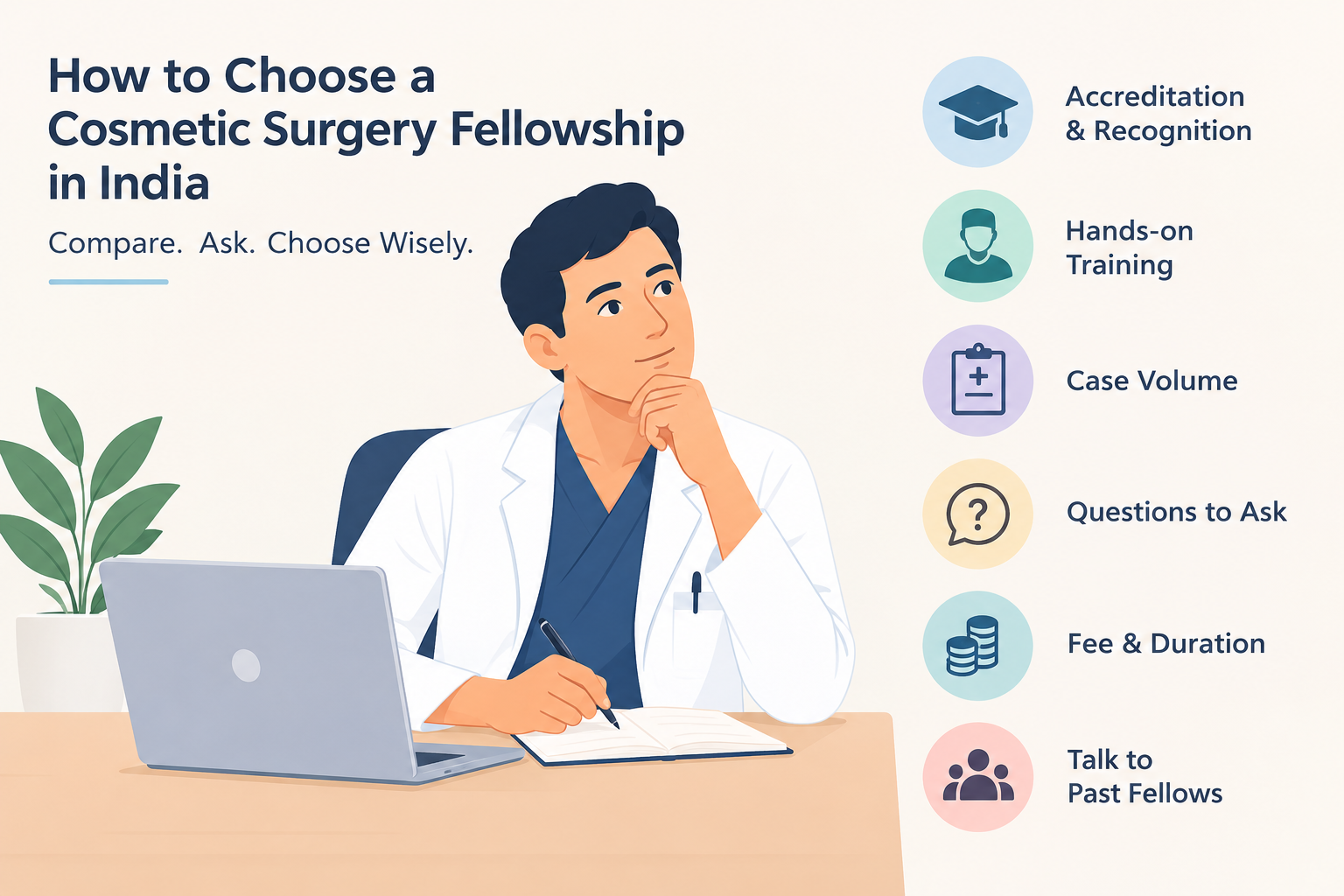
If you are wondering how to choose a cosmetic surgery fellowship India, start by looking beyond the course name and certificate. For a plastic surgeon, the quality of mentorship, clinical exposure, case volume, hands-on opportunities, academic support, and recognition can all influence the value of a fellowship.
Choosing the right fellowship requires a structured comparison. Different centres may offer different durations, procedures, teaching methods, case exposure, and levels of practical involvement. Therefore, understanding what each programme actually provides is essential before making a decision.
It is also important to understand the difference between fellowship training and a registrable medical qualification. A fellowship certificate should not automatically be assumed to be an additional qualification that can be registered with a medical council.
“Accredited” and “recognised” can mean different things depending on the organisation providing the recognition.
The Indian Association of Aesthetic Plastic Surgeons, or IAAPS, has a defined process for selecting fellowship centres. Its published criteria consider the mentor’s plastic surgery qualification, medical council registration, IAAPS membership, centre registration, licences, operating theatre facilities, aesthetic workload, and other clinical resources.
However, association recognition should not automatically be interpreted as university recognition or registration of the fellowship as an additional medical qualification.
IAAPS itself states that its fellowship may or may not be recognised by a university and may not serve as an additional qualification registrable with the local medical council where the fellow later practises.
Therefore, before enrolling, ask:
Understanding these distinctions can help a surgeon make a more informed decision.
Hands-on training can mean different things at different fellowship centres.
One programme may mainly provide observation. Another may allow assisting in procedures. A more intensive programme may provide supervised participation in selected procedures, depending on the fellow’s previous training and competence.
Therefore, do not rely on the phrase “hands-on training” alone.
Ask the centre specifically:
Patient safety should remain the primary consideration when determining how much responsibility a fellow receives.
For example, the current IAAPS listing for Elegance Clinic, Surat, describes the fellowship training level as including independent minor and major procedures and lists academic activities such as case discussions, programmed lectures, reading resources, and encouragement for research publication.
The important point for any surgeon is to understand exactly what “hands-on” means at the centre being considered.
There is no universal number of surgeries that every fellow should perform.
Case volume depends on the centre’s patient flow, procedure mix, number of fellows, fellowship duration, mentor availability, and the fellow’s previous experience.
A centre may have a high overall surgical workload, but that does not mean every fellow will personally perform the same number of procedures.
Therefore, ask for details about individual fellow exposure rather than only the centre’s total case volume.
Useful questions include:
The distinction between total centre volume and individual fellow exposure is particularly important.
A three-month fellowship can provide meaningful exposure if the clinical workload is appropriate and the fellow receives structured mentorship. A six-month programme may provide more time for repeated exposure and follow-up, but longer duration alone does not guarantee better training.
Before paying a fellowship fee, ask for clear information about the programme.
Whenever possible, obtain important financial and training terms in writing before making a substantial payment.
If you are researching how to choose a cosmetic surgery fellowship India, these questions can help you compare programmes based on their actual educational value rather than their promotional claims.
A surgeon should ask more questions when a fellowship makes broad claims without providing specific information.
Potential warning signs include:
These points do not automatically mean that a programme is unsuitable. They simply indicate that the surgeon should seek clearer information before enrolling.
This is one of the most important questions to ask.
A fellowship should not automatically be considered a registrable medical qualification.
IAAPS explicitly states that its fellowship may or may not be recognised by a university and may not serve as an additional qualification registrable with the local medical council where the fellow later practises.
Therefore, if registration status matters to your career plans, verify the specific qualification with the relevant authority rather than relying on the words “fellowship”, “accredited”, or “certified”.
This does not mean that a fellowship has no professional value.
A fellowship can provide:
The key is to distinguish educational value from regulatory status.
There is no single fee that can be considered fair for every cosmetic surgery fellowship.
Instead, compare the total fee with the training actually provided.
| Factor | What to Compare |
|---|---|
| Duration | One month, three months, six months, or another period |
| Faculty | Qualifications and level of involvement |
| Case exposure | Variety and availability of cases |
| Practical training | Observation, assistance, or supervised procedures |
| Academic teaching | Lectures, case discussions, and reading |
| Research | Opportunities for academic work or publication |
| Accommodation | Included, separate, or unavailable |
| Stipend | Whether one is provided |
| Certification | Who issues the certificate |
| Recognition | What organisation recognises the centre or programme |
A lower fee does not necessarily mean better value. Likewise, a higher fee does not automatically mean better training.
The more useful question is:
“What exactly am I receiving for the total amount I will pay?”
A simple comparison checklist can make the decision more objective.
☐ Check the mentor’s qualifications
☐ Review clinical experience
☐ Check the centre’s registration and facilities
☐ Understand the centre’s aesthetic workload
☐ Confirm duration
☐ Review the curriculum
☐ Check the number of fellows accepted
☐ Ask about academic sessions
☐ Ask about case discussions
☐ Clarify observation opportunities
☐ Clarify assisting opportunities
☐ Ask which procedures can be performed
☐ Understand supervision
☐ Ask about postoperative follow-up
☐ Identify the accrediting organisation
☐ Understand what is actually recognised
☐ Check whether university recognition exists
☐ Verify whether the qualification is registrable
☐ Confirm the complete fee
☐ Ask about additional charges
☐ Check payment schedule
☐ Understand refund terms
☐ Ask about accommodation
☐ Ask whether a stipend is provided
☐ Request programme details in writing
☐ Ask whether you can speak with past fellows
☐ Compare at least two centres
☐ Keep copies of payment and admission documents
This checklist is especially useful when deciding how to choose a cosmetic surgery fellowship India, because it shifts the comparison from marketing language to measurable training factors.
Yes, but it should be considered alongside the actual training.
IAAPS publishes criteria for selecting fellowship centres, including mentor qualifications, registration, association membership, centre facilities, and aesthetic workload.
APSI also has an endorsement framework for centres offering short-term observerships and fellowships. APSI describes itself as a facilitator between centres and trainees and states that the rules and regulations for the observership or fellowship are determined by the centre. It also describes trainee feedback and logbook requirements within its framework.
Therefore, accreditation can provide useful information about a centre, but surgeons should still investigate the curriculum, case exposure, supervision, and certification independently.
Yes. Speaking with previous fellows can provide practical information that may not appear in a programme brochure.
Ask former fellows:
If possible, speak with more than one former fellow. Individual experiences can differ, so several perspectives provide a more balanced picture.
Choosing a cosmetic surgery fellowship in India should involve a structured comparison of the centre, mentor, curriculum, clinical exposure, hands-on opportunities, accreditation, duration, fees, and certification.
If your search begins with how to choose a cosmetic surgery fellowship India, remember that the course name alone should not determine your decision. Look closely at the mentor, case exposure, supervision, curriculum, academic support, and practical opportunities.
Do not judge a fellowship only by its certificate or advertised case volume. Ask what you will actually observe, assist with, and perform, and understand how supervision will work.
Most importantly, distinguish between fellowship training and a registrable medical qualification. Current IAAPS information makes clear that its fellowship may not be an additional qualification registrable with the local medical council.
For surgeons considering a programme at Elegance Vidhyalay, the institute’s fellowship pathway can be evaluated using the same checklist. The current IAAPS listing identifies
Dr. Ashutosh Shah at Elegance Clinic in Surat as a recognised fellowship centre and provides specific information about the centre’s training level, duration, academic exposure, and previous fellows.
Before enrolling anywhere, ask detailed questions, verify recognition independently, speak with previous fellows when possible, and compare the actual training offered with your professional goals.
Not necessarily. Professional association recognition and medical council registration are different matters. IAAPS states that its fellowship may not serve as an additional qualification registrable with the local medical council.
There is no universal number. Ask the centre to distinguish between cases observed, assisted, and personally performed under supervision.
Before paying, understand the complete payment schedule, refund policy, cancellation conditions, and additional charges. Written confirmation is preferable.
It can be useful for focused observation or a specific learning objective. However, one month provides less time for broad clinical exposure than a longer fellowship.
Yes, but understand what the accreditation represents. Check who provides it, what standards are used, and whether it relates to the centre, training programme, or qualification.
Yes. Previous fellows can help you understand actual case exposure, teaching, supervision, fees, and the overall training experience.