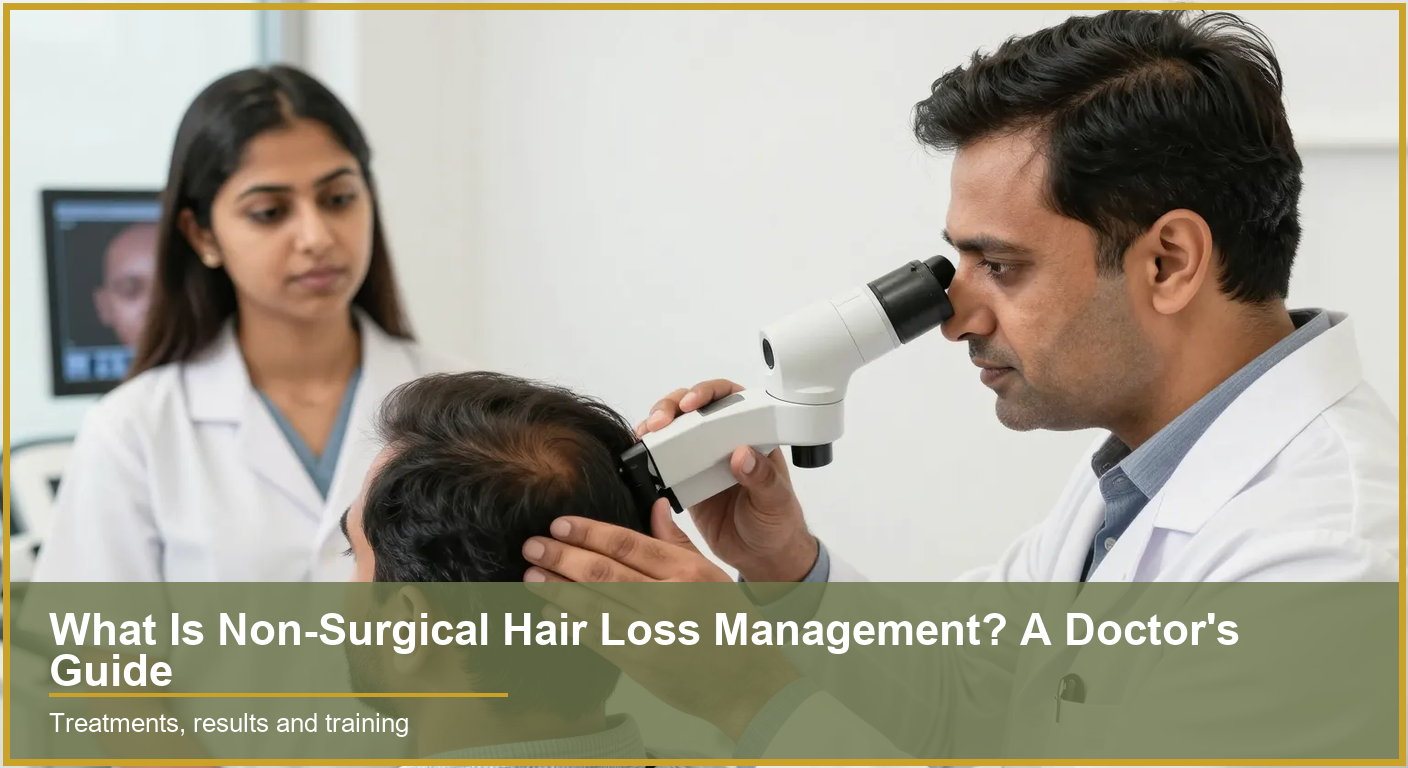
So, what is non-surgical hair loss management? It means treating thinning hair without any operation. Instead of transplant surgery, doctors use medicines, injections, laser therapy and scalp care to slow shedding and thicken existing hair. At Elegance Vidhyalay, we teach doctors that these methods work best in early to moderate hair loss, and often support surgery later. So the goal is simple, save the hair a patient still has, and improve its quality with safe, evidence based options.
Many patients fear the operating table, yet they still want visible results. Therefore nonsurgical care has become the first step in most modern hair clinics. Moreover, these treatments suit both men and women, and they need very little downtime. Because of this, understanding non-surgical hair loss management is now essential for every dermatologist, cosmetic physician and trained hair technician in India.
Non-surgical hair loss management is a group of treatments that reduce hair fall and support regrowth without cutting or grafting. In simple words, we strengthen weak follicles instead of moving them. Consequently, the patient avoids stitches, scars and long recovery. These methods target the real causes of hair loss, such as hormones, poor scalp health and nutritional gaps.
Hair loss rarely has a single cause. Genetics, stress, thyroid problems and diet all play a role. Because of this, we always assess the scalp before choosing a plan. A good clinic checks the pattern of loss, the density of hair and the health of each follicle. Only then does a doctor build a treatment that truly fits the patient.
Our faculty explain this approach in detail during the hair transplant and nonsurgical hair loss workshop, where doctors see real cases and learn how to combine methods. As a result, they leave with a clear, practical framework rather than scattered tips.
Several proven options exist, and most doctors combine two or three for the best effect. Minoxidil and finasteride remain the medical backbone, while injectable therapies like PRP and GFC add growth signals. Alongside these, lasers and mesotherapy improve scalp circulation. Together, they slow loss and gradually thicken hair.
Here are the treatments we teach and use most often:
Furthermore, good nutrition and scalp hygiene support every plan. Iron, vitamin D and protein matter far more than most patients expect. Therefore we always correct these gaps before judging any treatment. This complete view separates a trained clinic from a spa offering random services.
The best candidates have early to moderate hair loss with follicles that still work. In these cases, medicines and injections can slow shedding and regrow visible hair. However, someone with fully bald patches may need surgery, since dead follicles cannot be revived. So honest assessment protects the patient from false hope.
Women often benefit greatly from nonsurgical methods. Their hair loss is usually diffuse, and surgery suits them less than men. Meanwhile, young men in the early stages can delay or even avoid transplant with disciplined care. Because every scalp differs, we teach doctors to match the method to the person, not the other way round.
Patients who want to explore a clinical career in this field can also review our hair transplant technician course. It builds the practical skills needed to support both surgical and nonsurgical hair programs.
Most patients see real change after three to six months of steady treatment. Hair grows slowly, so early weeks may even show more shedding before improvement begins. Patience, therefore, becomes the most important instruction we give. Consistent use, not shortcuts, decides the final result.
We always set clear expectations at the first visit. Nonsurgical care controls and improves hair, yet it needs ongoing maintenance. If a patient stops treatment, the original loss usually returns over time. For this reason, we frame these methods as a long term plan rather than a quick fix. Honest communication keeps patients happy and loyal.
Doctors who understand this timeline counsel patients better. Moreover, clear counselling reduces complaints and builds trust. Our trainers stress this soft skill as much as the clinical protocol, because success in hair care is medical and emotional together.
The fastest way is a structured, hands on workshop with live patients. Reading alone cannot teach injection technique or scalp assessment. Instead, doctors need supervised practice under an experienced trainer. That is exactly how we run our programs at Elegance Vidhyalay in Surat.
Our institute was founded by Dr. Ashutosh Shah, who brings over 22 years of surgical and cosmetic experience. Under his direct observation, trainees learn on the latest equipment with real patient exposure. Consequently, they gain confidence they could never build from videos or notes.
You can explore all our practical programs on the crash courses and workshops overview page. Whether you are a dermatologist, a cosmetic physician or a fresh MBBS doctor, there is a clear pathway for you. To join or ask questions, simply reach our team through the contact and admissions enquiry page.
It is the treatment of thinning hair without surgery. Doctors use medicines, PRP, GFC, lasers and scalp care to slow hair fall and thicken existing hair. It suits early and moderate hair loss and needs almost no recovery time.
These treatments control and improve hair loss, but they are not a one time cure. Hair benefits continue only while the plan is maintained. If a patient stops completely, the original pattern of loss usually returns gradually over the following months.
PRP uses growth factors from the patient’s own blood to stimulate tired follicles. It works best on active follicles in early to moderate loss. Results improve density and thickness over several sessions, though it cannot regrow hair from fully dead follicles.
Yes, women respond very well to nonsurgical care. Their hair loss is often diffuse, so medicines, PRP and mesotherapy suit them better than surgery. A proper scalp and blood assessment first ensures the plan matches the real cause of their thinning.
Costs vary widely by city, clinic and the number of sessions. Injectable therapies usually run across several sittings, so pricing is a package rather than a single figure. Patients should consult a trained clinic directly for an accurate, personalised estimate.
Surgery suits advanced hair loss where follicles are already dead. In such cases nonsurgical methods cannot regrow hair on bald areas. A trained doctor assesses the scalp honestly and recommends transplant only when medical management can no longer deliver a good result.
Yes, doctors can learn full protocols through hands on workshops at Elegance Vidhyalay. Training includes scalp assessment, injections, laser use and patient counselling, all under expert supervision with live cases, so you can start offering safe hair care with confidence.
Non-surgical hair loss management is now a core skill for modern clinics. It protects hair, builds patient trust and creates a strong, ethical practice. If you want to master these protocols with real cases and expert guidance, we are ready to help. Contact Elegance Vidhyalay today and take the next step in your cosmetic career.
Elegance Vidhyalay is a medical education and professional training institute in Surat, founded by Dr. Ashutosh Shah under Elegance Clinic. We offer fellowships, crash courses, certified cosmetic courses and paramedical courses in cosmetic and reconstructive medicine. Our training is hands on, uses the latest equipment and includes live patient exposure under expert observation. Paramedical courses are offered in collaboration with Vidhyadeep University.