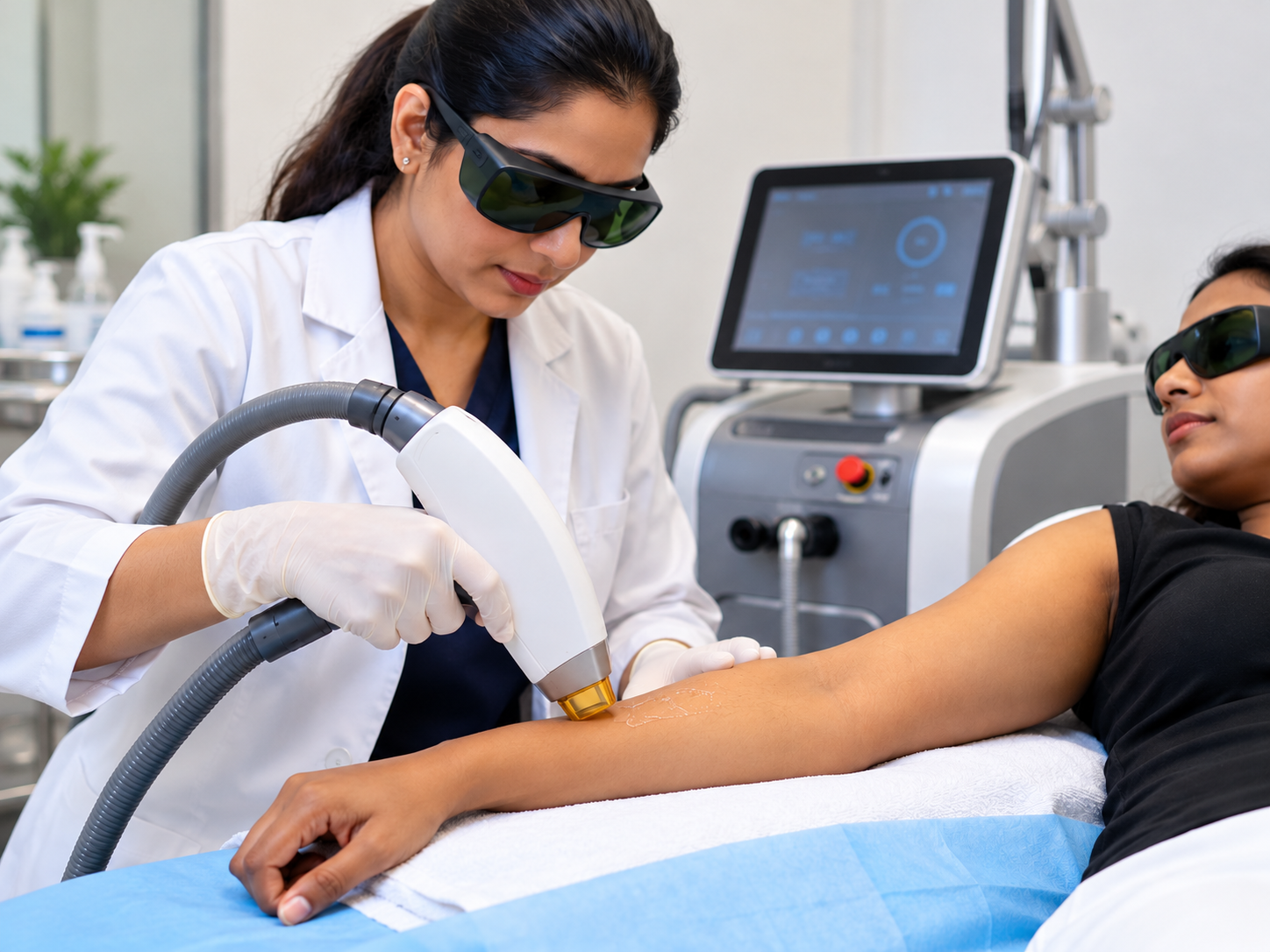
Laser hair removal training for doctors should cover Fitzpatrick skin-type assessment, appropriate laser wavelength selection, safe treatment parameters, test patches, epidermal cooling, and complication prevention. Indian patients commonly have skin types III–V, which may carry a greater risk of post-inflammatory pigmentation. Doctors must also plan sessions carefully because wedding-season patients often expect visible results within a limited time.
Laser hair removal has become a popular cosmetic procedure among patients preparing for weddings and other important occasions. However, effective treatment requires more than operating a laser device.
Doctors must understand how skin pigmentation, hair thickness, treatment area, and device settings influence safety and results.
Incorrect parameter selection can cause burns, blistering, pigmentation changes, or inadequate hair reduction.
At Elegance Vidhyalay, medical professionals exploring cosmetic laser education can develop a stronger understanding of treatment planning, patient assessment, and safe laser practice.
Laser hair removal works through selective photothermolysis. Laser energy targets melanin within the hair shaft and follicular structures, producing heat that damages hair-producing tissue.
However, melanin is also present in the epidermis.
Darker skin contains more epidermal melanin, which can absorb laser energy and increase the risk of unwanted heating.
This makes accurate skin assessment essential.
The Fitzpatrick classification describes how skin typically responds to ultraviolet exposure.
| Skin type | Typical response to sun exposure | Laser treatment consideration |
|---|---|---|
| Type I | Almost always burns, rarely tans | Assess sensitivity and hair contrast |
| Type II | Burns easily, tans minimally | Appropriate wavelength and cooling |
| Type III | Sometimes burns, gradually tans | Monitor pigmentation and epidermal response |
| Type IV | Rarely burns, tans readily | Greater attention to epidermal protection |
| Type V | Very rarely burns, tans deeply | Prefer suitable longer wavelengths and cautious parameters |
| Type VI | Rarely or never burns | Requires particular attention to wavelength, cooling and operator experience |
Indian patients may have a wide range of skin phototypes. Doctors should never assume skin type based only on ethnicity or appearance.
A proper assessment also considers recent tanning, medications, treatment history, and the patient’s response to previous procedures.
Different laser wavelengths interact differently with melanin.
Doctors should understand these differences before selecting treatment parameters.
Alexandrite lasers strongly target melanin and can provide effective hair reduction in appropriately selected patients.
However, greater epidermal melanin absorption can increase pigmentation and burn risks in darker or recently tanned skin.
Doctors should exercise particular caution when considering this wavelength for higher skin phototypes.
Diode lasers are widely used for hair reduction.
The wavelength provides follicular melanin targeting and can suit a range of skin types when the device and parameters are appropriate.
For diode laser settings indian skin, doctors must consider fluence, pulse duration, spot size, cooling and hair characteristics together.
A preset labelled for a particular skin type does not replace clinical assessment.
The long-pulsed 1064 nm Nd laser has lower epidermal melanin absorption than shorter wavelengths.
This makes it a commonly preferred option for darker skin types, including Fitzpatrick V and VI.
Doctors evaluating nd yag for dark skin should understand that the longer wavelength does not eliminate the possibility of burns or pigment changes.
Safe use still requires suitable parameters, cooling, and monitoring.
The following table presents general training principles rather than numerical treatment prescriptions.
| Fitzpatrick type | Preferred wavelength considerations | Fluence direction | Pulse duration | Cooling | Test patch rule |
|---|---|---|---|---|---|
| III | Alexandrite, diode, or Nd depending on hair and skin assessment | Device-specific, based on clinical response | Match skin and hair characteristics | Appropriate epidermal cooling | Recommended before initial treatment |
| IV | Long-pulsed diode or Nd often suitable | Conservative initial approach | Adjust according to epidermal risk | Consistent cooling | Important before full treatment |
| V | Long-pulsed Nd often preferred | Carefully individualised | Longer pulse durations may help protect epidermis when appropriately selected | Effective cooling essential | Strongly recommended |
| VI | Long-pulsed Nd generally preferred | Specialist, device-specific selection | Carefully selected for skin and hair characteristics | Effective cooling essential | Strongly recommended |
Clinical safety note: No universal numerical fluence or pulse-duration setting is safe for every device or patient. Parameter selection must follow the specific manufacturer’s instructions, clinical training, and patient assessment. Excessively low fluence can also reduce efficacy without guaranteeing safety.
A test patch helps doctors evaluate how a patient’s skin responds to a proposed treatment.
It becomes particularly important when treating darker skin, recently exposed skin, or patients with a history of pigmentation problems.
Before treatment, review:
Doctors should also identify contraindications and factors that may require postponement.
Choose a representative area with comparable skin and hair characteristics.
Use appropriate protective eyewear, device preparation, and skin cooling.
Select parameters according to the device protocol and clinical assessment.
The operator should recognise appropriate treatment endpoints and warning signs.
Possible concerning findings include excessive pain, epidermal whitening, blistering, charring, or unexpected skin changes.
Stop treatment if signs of epidermal injury appear.
Some adverse reactions develop after the patient leaves the clinic.
Doctors should review the test area after an appropriate interval, particularly when treating darker skin types.
A delayed assessment may identify pigmentation changes or irritation that were not apparent immediately.
The observation interval should follow the device protocol and individual clinical risk.
Record the device, wavelength, spot size, fluence, pulse duration, cooling method, treatment area, and observed response.
Clinical photographs may support documentation when the patient provides appropriate consent.
A successful test patch reduces uncertainty but does not guarantee that the full treatment will be complication-free.
Doctors searching for a laser hair removal course in Rajkot should prioritise practical safety training and qualified supervision rather than simply selecting a course that offers access to laser equipment.
A suitable curriculum should cover:
Doctors should confirm who provides clinical supervision, whether the programme includes practical assessments, and what responsibilities the qualification actually permits.
Elegance Vidhyalay provides information about educational pathways such as cosmetic laser training and the laser and cosmetic procedure assistant course.
The eligibility requirements and scope of practice for each programme should be verified before enrolment.
Wedding-season patients often expect complete hair removal within a few weeks.
Doctors must explain that laser hair reduction requires multiple sessions because follicles pass through different growth phases.
Laser treatment is most effective when suitable hair follicles contain enough pigment and are in a responsive growth phase.
Treatment intervals commonly range from approximately four to eight weeks, depending on the body area, device, and individual hair growth pattern.
Facial areas may require different scheduling from the legs, back, or other body regions.
A patient who begins treatment 12 weeks before a wedding may fit approximately two or three sessions, depending on the treatment area and recommended interval.
| Time before wedding | Suggested planning approach |
|---|---|
| 12 weeks | Consultation, skin assessment, test patch and first treatment if appropriate |
| 8 weeks | Review response and consider the next session if due |
| 4 weeks | Further treatment only if clinically appropriate and adequately spaced |
| Final 1–2 weeks | Avoid unnecessary new procedures or aggressive parameter changes; allow time for skin recovery |
| Wedding week | Focus on gentle skin care and management of any residual irritation |
This is an illustrative schedule, not a guaranteed treatment plan.
Patients should not expect complete permanent hair removal within 12 weeks.
A full course commonly extends over several months, and maintenance sessions may be necessary.
Doctors should explain the difference between permanent hair reduction and complete elimination of every hair follicle.
Laser burn prevention begins before the operator activates the device.
The most important safety measures include appropriate patient selection, correct wavelength choice, suitable parameters, and reliable epidermal cooling.
Burns may occur because of:
Doctors should also follow appropriate skin preparation protocols and avoid treating over unsuitable topical products or contaminated treatment surfaces.
Post-inflammatory hyperpigmentation occurs when skin inflammation triggers increased pigment production.
Patients with darker skin may face a greater risk.
Treatment planning should therefore minimise unnecessary epidermal injury.
If pigmentation develops, the clinician should assess the severity and provide appropriate management rather than continue the same settings without review.
Excessive thermal injury can damage pigment-producing cells and cause lighter skin patches.
Some changes may persist.
Early recognition and prevention are particularly important.
If a patient develops signs of a burn:
Blistering, significant pain, spreading redness, or other concerning symptoms require prompt medical evaluation.
Paradoxical hypertrichosis describes increased hair growth after laser or light-based hair reduction.
It is an uncommon but recognised complication.
It may occur in areas with fine hair, particularly on the face and neck.
Potential contributing factors include:
Doctors should avoid promising that every treated area will show the same degree of reduction.
Patient counselling and careful treatment-area selection are essential.
When unexpected hair growth occurs, reassess the diagnosis and treatment strategy before continuing.
Laser hair removal involves medical assessment, device-specific risk management, and the potential for complications.
A qualified doctor should take responsibility for patient selection, diagnosis, treatment planning, informed consent and management of adverse events.
The tasks that trained assistants or technicians may perform depend on applicable laws, professional regulations, institutional protocols and supervision requirements.
A short training course does not independently authorise someone to perform medical procedures outside their permitted professional scope.
Doctors considering additional education can review the cosmetic dermatology fellowship for broader training information.
Professionals should also understand appropriate indemnity cover before starting a new procedure.
Dr. Ashutosh Shah, M.S., M.Ch., D.N.B. (Plastic Surgery), a Plastic, Reconstructive and Cosmetic Surgeon with over 22 years of experience, brings relevant clinical expertise to discussions of procedural safety, patient selection and responsible aesthetic treatment planning. His emphasis on careful assessment and appropriate supervision is especially relevant when doctors introduce energy-based procedures into clinical practice.
Long-pulsed 1064 nm Nd is generally preferred for darker Fitzpatrick skin types because it has lower epidermal melanin absorption. Diode lasers may also be appropriate with suitable parameters and cooling. Safety depends on the device, skin assessment, and operator competence.
A patient may complete approximately two or three sessions within 12 weeks, depending on the treatment area and recommended intervals. Doctors should avoid compressing sessions simply to meet a wedding deadline.
Recent tanning can increase epidermal melanin and the risk of burns or pigmentation changes. Doctors should assess the skin and may need to postpone treatment until the tan resolves. Changing settings does not automatically make recently tanned skin safe to treat.
The treating doctor should oversee medical assessment, treatment planning, and complication management. Any technician involvement must follow applicable regulations, documented competency requirements, and appropriate medical supervision. Doctors evaluating a laser hair removal course in Rajkot should check whether it teaches these responsibilities clearly.
Common causes include excessive energy, inadequate cooling, recent tanning, unsuitable parameters, overlapping pulses, and operator error. Proper training, test patches, and monitoring help reduce these risks.
Multiple areas may be treated during one appointment when the patient’s condition, treatment duration, and device protocols allow it. However, doctors should assess each area’s skin and hair characteristics separately. Longer sessions also require attention to patient comfort, cooling, and treatment safety.
Laser hair removal training for doctors requires a strong understanding of skin phototypes, laser wavelengths, treatment parameters, test patches, and complication prevention.
Indian patients with Fitzpatrick skin types III–V may require particular attention to epidermal protection and pigmentation risks.
Long-pulsed Nd and appropriately selected diode systems can support hair reduction in darker skin, but neither technology eliminates the need for careful clinical judgment.
Wedding-season patients also need realistic treatment schedules. Multiple sessions are usually necessary, and rushing procedures can increase complications without guaranteeing better results.
At Elegance Vidhyalay, doctors exploring aesthetic laser education should prioritise structured training, qualified supervision, patient safety, and device-specific practical competence.
The goal of effective laser training is not simply to remove hair. It is to provide appropriate treatment while protecting skin health and maintaining realistic patient expectations.