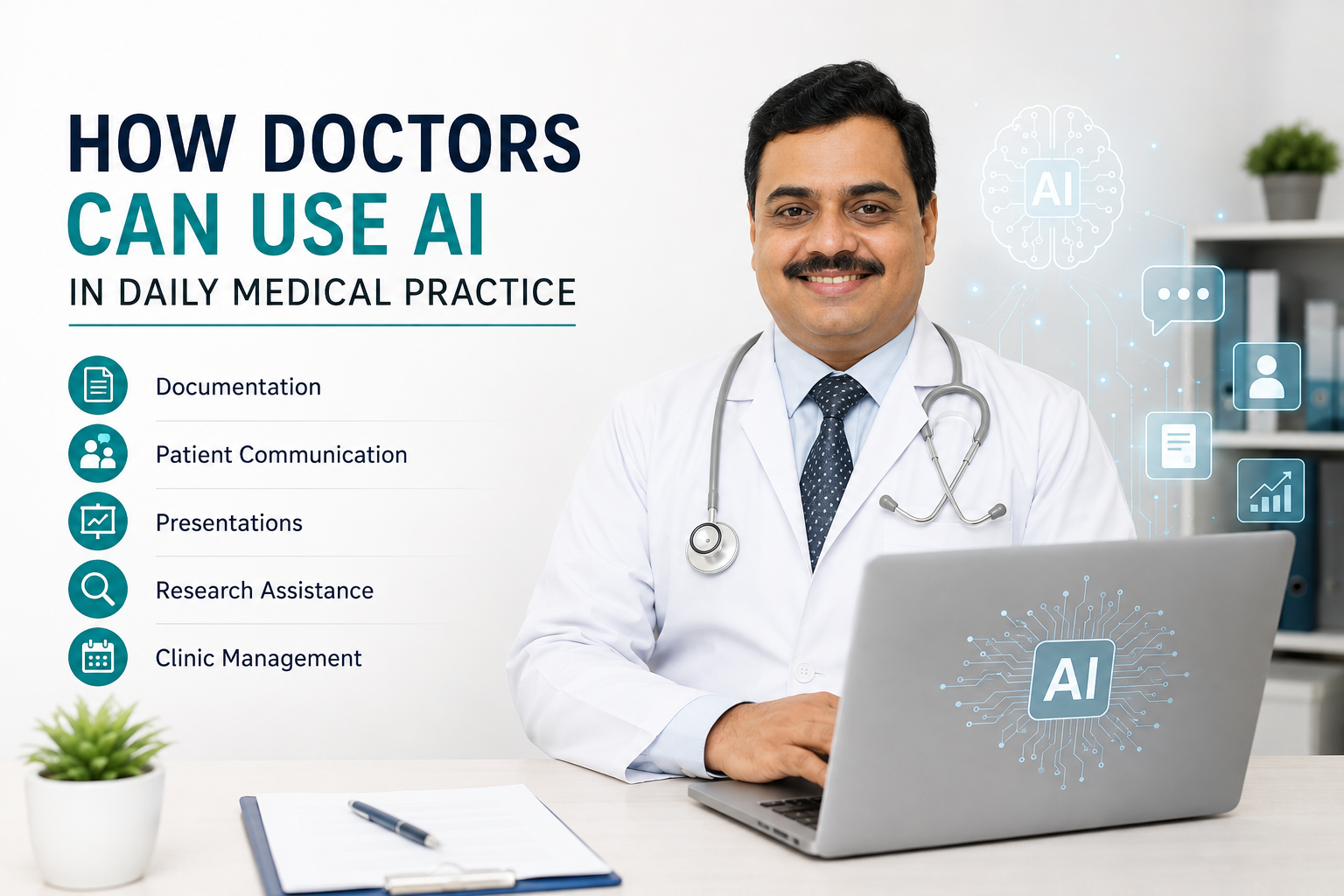
Artificial Intelligence is becoming increasingly useful in healthcare not as a replacement for doctors, but as a tool that can support everyday professional tasks. From preparing documentation to creating patient education materials, doctors can use AI to reduce repetitive work and organize information more efficiently.
Understanding how doctors can use AI responsibly can help medical professionals save time while keeping clinical judgment and patient care at the center of their practice.
Doctors handle large amounts of information every day. Patient records, reports, follow-up communication, presentations, research, educational materials, and administrative work can all require significant time.
AI tools can assist with several of these non-procedural tasks, including:
The AI for Dr Course – 7 Hours at Elegance Vidhyalay specifically focuses on these practical applications and does not require doctors to have coding or programming knowledge.
Documentation is an essential but time-consuming part of medical practice.
AI can assist doctors in organizing notes, creating initial drafts, preparing summaries, and improving documentation workflows.
The doctor must still review the final content for clinical accuracy. AI should assist documentation rather than make independent medical decisions.
Medical information can be difficult for patients to understand.
AI can help doctors prepare simpler communication materials, including:
Doctors can then review and personalize the information before sharing it with patients.
This is one practical example of how doctors can use AI to support clearer communication without replacing the doctor-patient relationship.
Doctors regularly prepare presentations for conferences, seminars, teaching sessions, and patient-awareness programs.
AI tools can help organize information, structure presentation content, and improve the preparation process.
Instead of beginning with a blank slide, a doctor can use AI to develop an initial structure and then refine it using their own expertise and verified medical information.
Continuous learning is essential in medicine.
AI can assist doctors by helping them organize research information, summarize documents, and explore medical topics more efficiently.
However, AI-generated summaries should never become the sole basis for clinical decisions. Doctors should verify important medical information using trusted and appropriate sources before applying it in patient care.
Doctors often need educational content beyond direct clinical work.
According to the Elegance Vidhyalay course curriculum, AI can support the creation of:
AI can help create a first draft, while the doctor provides the medical expertise needed to check accuracy, context, and appropriateness.
AI can also support some everyday operational activities within a clinic.
The course identifies applications such as appointment communication, administrative support, patient education, and marketing content.
Using AI for repetitive administrative tasks may allow doctors and their teams to spend more time on activities requiring direct human involvement.
No. Doctors do not necessarily need programming knowledge to start using modern generative AI tools.
The AI for Dr Course – 7 Hours is specifically designed to introduce practical AI applications without requiring technical or coding knowledge.
An important skill instead is learning effective AI prompting, giving AI clear instructions so that it produces more relevant and useful results. Prompting is one of the areas included in the course curriculum.
No. AI output should always be reviewed.
Medical information requires a high level of accuracy, and AI systems can produce incomplete or incorrect information. Elegance Vidhyalay’s course specifically emphasizes privacy, accuracy, ethical considerations, and responsible AI use in healthcare.
Doctors should therefore treat AI as an assistant rather than an independent clinical authority.
Clinical decisions must remain with appropriately qualified healthcare professionals.
For doctors who want to understand how they can use AI in practical day-to-day work, Elegance Vidhyalay offers the AI for Doctors Course – 7 Hours.
The program focuses on real-world applications including generative AI, effective prompting, documentation, patient communication, medical presentations, research assistance, content creation, clinic productivity, and responsible AI use.
The course faculty includes Dr. Ashutosh Shah (MB, MS, M.Ch, DNB), whom Elegance Vidhyalay identifies as a board-certified Cosmetic, Plastic and Hair Transplant Surgeon with experience in more than 1,500 hair transplants and mentoring 60+ plastic surgeons.
Doctors interested in integrating AI into their professional workflow can explore the course to learn practical applications without needing a technical background.
Understanding how AI can help medical professionals reduce repetitive work, organize information, improve communication, and prepare professional materials more efficiently.
The most useful approach is not to allow AI to replace medical judgment, but to learn where it can appropriately support everyday work.
Through the Dr Course, 7 Hours at Elegance Vidhyalay, doctors can learn practical AI applications, prompting techniques, documentation support, research assistance, content creation, and responsible AI use designed specifically around medical workflows.
AI can assist with documentation, patient communication, research organization, presentations, educational content, and administrative workflows.
AI can assist in organizing and drafting notes and summaries. The treating doctor remains responsible for checking the accuracy and appropriateness of the final documentation.
AI can help organize information, summarize documents, and explore research topics. Important medical information should still be verified using trusted sources.
Not necessarily. Many generative AI applications can be used without programming knowledge. Learning how to write effective prompts can be more immediately useful for everyday workflows.
The Elegance Vidhyalay course frames AI as an assistant for doctors rather than a replacement, to save time and improve efficiency while doctors retain professional judgment.