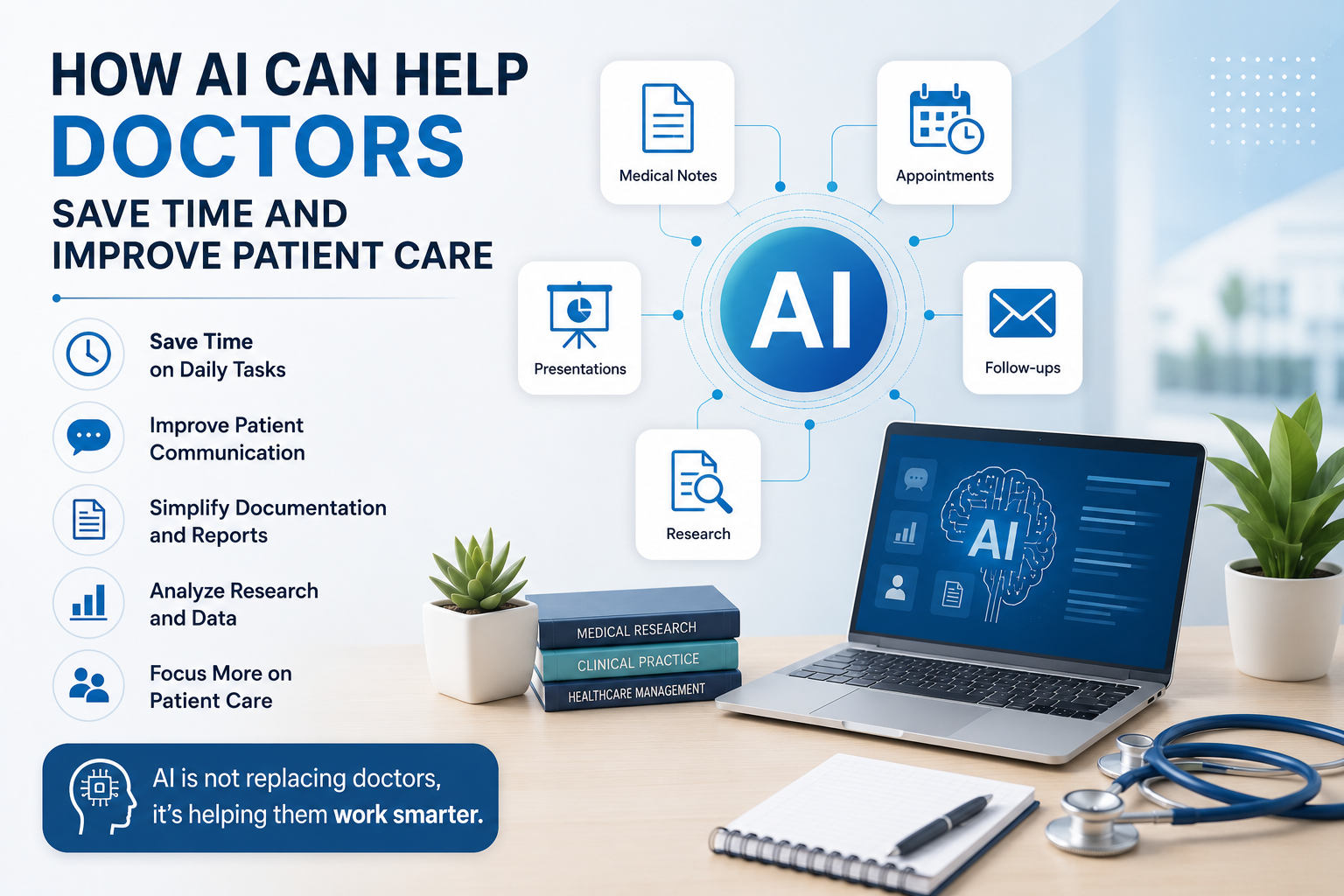
Artificial Intelligence (AI) is transforming the way doctors work. From creating presentations and educational content to simplifying administrative tasks and improving patient communication, AI helps healthcare professionals save valuable time. As Dr. Ashutosh Shah explains, AI is not meant to replace doctors; it is a practical tool that helps them work more efficiently while allowing them to focus on delivering better patient care.
Healthcare is changing rapidly.
Patients now search online before booking appointments, expect clear communication, and prefer clinics that provide educational content and digital convenience.
At the same time, doctors are spending more hours on documentation, presentations, administrative work, and practice management.
AI helps bridge this gap by assisting with everyday tasks while keeping doctors in complete control of medical decisions.
Learning AI isn’t about becoming a programmer-it’s about becoming more productive.
AI can support doctors in many aspects of their daily work.
Some practical applications include:
These tasks often consume several hours each week. AI can significantly reduce that workload when used correctly.
Time is one of the most valuable resources in healthcare.
Doctors often spend hours every week preparing reports, creating presentations, answering repetitive patient questions, and organizing documents.
AI can help speed up tasks such as:
Instead of starting from a blank page every time, doctors can use AI to generate a first draft and then review it for accuracy.
Patients appreciate simple explanations.
AI can help doctors prepare educational materials covering topics such as:
Better patient education often leads to improved understanding, greater confidence, and more meaningful conversations during consultations.
Many patients choose doctors after researching online.
AI can assist healthcare professionals by creating:
Publishing accurate, patient-friendly educational content consistently can improve online visibility while helping patients make informed decisions.
Keeping up with medical literature can be challenging.
AI tools can help doctors:
Doctors should always verify AI-generated summaries using the original scientific publications before applying information in clinical practice.
Medical professionals frequently prepare presentations for:
AI can assist with:
Instead of spending hours formatting slides, doctors can focus on delivering valuable knowledge.
Administrative work is an unavoidable part of running a clinic.
AI can help with:
Reducing repetitive administrative work allows doctors and clinic teams to work more efficiently.
No.
AI cannot replace:
AI works best as a productivity assistant that supports doctors-not as a substitute for medical knowledge or professional responsibility.
Many healthcare professionals start using AI without proper guidance.
Some common mistakes include:
Learning how to communicate with AI using the right prompts can dramatically improve the quality of results.
Watching random videos or experimenting with AI tools can be time-consuming and confusing.
A structured course helps doctors learn:
Rather than learning through trial and error, doctors can develop practical AI skills that they can use immediately in their daily practice.
The AI for Doctors – 7 Hours Course by Elegance Vidhyalay is designed specifically for healthcare professionals who want practical, real-world AI skills without needing any programming knowledge.
The course focuses on daily usability, helping doctors learn how AI can support clinical practice, education, research, presentations, communication, and productivity.
By the end of the course, participants will understand how to integrate AI into their professional workflow while maintaining ethical standards and medical accuracy.
Whether you’re an experienced consultant or just beginning your medical career, practical AI knowledge can become an important advantage in today’s healthcare environment.
No. Modern AI tools are designed for everyday users. With proper guidance, most doctors can begin using AI effectively without any programming experience.
Yes. AI can reduce the time spent on documentation, presentations, educational content, administrative work, and research summaries, allowing doctors to focus more on patient care.
AI should always be used responsibly. Doctors must review AI-generated content, protect patient confidentiality, and rely on their clinical judgment for all medical decisions.
Yes. AI can improve efficiency, patient communication, online education, digital marketing, and administrative workflow, all of which contribute to a better patient experience.
No. The course is designed specifically for medical professionals and focuses on practical AI applications rather than programming.
Artificial intelligence is becoming an important part of modern healthcare not because it replaces doctors, but because it helps them work more efficiently. From patient education and research to presentations and administrative tasks, AI can simplify many aspects of daily medical practice.
The key is learning how to use AI correctly, responsibly, and ethically. With structured training and practical guidance, doctors can adopt AI with confidence and use it to improve productivity, enhance patient communication, and support long-term professional growth.