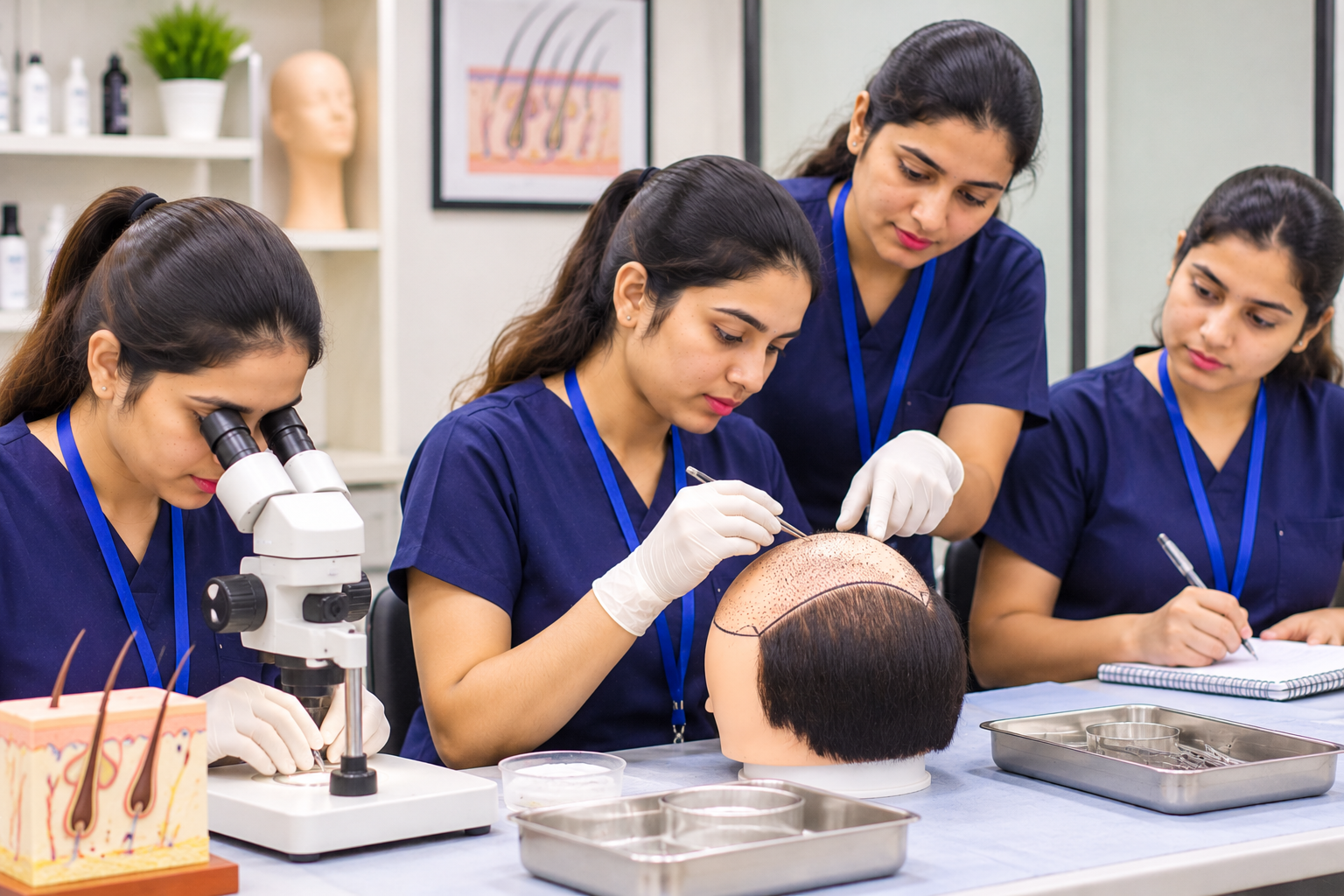
The hair transplant technician course syllabus combines theoretical knowledge with supervised practical skills. Common training topics include hair and scalp anatomy, hair restoration techniques, infection control, instrument identification, operation theatre preparation and graft handling concepts. Students develop an understanding of clinical support responsibilities through classroom learning, demonstrations and supervised exercises.
At Elegance Vidhyalay, associated with Dr. Ashutosh Shah, Plastic, Reconstructive and Cosmetic Surgeon, aspiring technicians can explore educational opportunities related to hair restoration and clinical assistance.
A well-structured course helps students understand workplace responsibilities, patient safety and professional boundaries. It also introduces the importance of teamwork when assisting qualified medical professionals.
The theoretical portion of the hair transplant technician course syllabus introduces students to the scientific and clinical principles of hair restoration.
Students learn about the basic structure of hair, hair follicles, scalp layers and the natural hair growth cycle.
Understanding these fundamentals helps students become familiar with medical terminology and communicate effectively with the clinical team.
Training may introduce common patterns of hair loss, factors affecting hair growth and the basic principles of hair restoration.
Technicians should understand these concepts without independently diagnosing hair loss or recommending medical treatments.
Theoretical modules may introduce different hair transplant approaches, including:
Students interested in understanding DHI can read what is dhi hair transplant technique.
Infection prevention is an essential part of healthcare support education.
Students may learn about hand hygiene, personal protective equipment, sterilisation principles, contamination prevention and biomedical waste management.
Training also introduces the importance of patient privacy, respectful communication, informed consent awareness and professional conduct.
Technicians must understand their responsibilities and work within their authorised scope.
The following table illustrates common learning areas and possible assessment methods.
| Module | Theory | Practical | Assessment |
|---|---|---|---|
| Hair anatomy | Hair follicles and growth cycle | Anatomical model identification | Oral or written test |
| Transplant techniques | FUE, FUT and DHI principles | Demonstrations and observation | Knowledge assessment |
| Infection control | Hygiene and sterilisation | Hand hygiene and PPE | Practical checklist |
| OT preparation | Equipment and safety protocols | Workstation preparation | Practical demonstration |
| Graft handling | Identification and preservation concepts | Model-based exercises | Supervised assessment |
| Patient care | Communication and confidentiality | Simulated interactions | Role-based assessment |
| Documentation | Clinical records and checklists | Sample record preparation | Record review |
The actual hair transplant technician course modules may vary according to the training programme.
Practical education helps students connect classroom knowledge with clinical support responsibilities.
The practical portion of the hair transplant technician course syllabus may focus on developing accuracy, organisation, hygiene and professional confidence.
Students become familiar with instruments and equipment commonly associated with hair restoration procedures.
They learn to recognise equipment categories, understand their general purpose and organise approved supplies.
Practical exercises may introduce workstation preparation, equipment organisation, supply management and safety checklists.
These activities help students understand how an organised clinical environment supports the medical team.
Students may learn about graft identification, counting, organisation and preservation principles through demonstrations and simulation exercises.
Any patient-related activity must remain within the individual’s qualifications and authorised professional responsibilities.
Training may include appropriate use of gloves, masks, protective clothing and other safety equipment.
Students also learn the importance of preventing contamination and maintaining hygiene throughout clinical activities.
Accurate documentation supports communication and continuity of care.
Students may practise preparing sample records, maintaining equipment checklists and organising non-diagnostic patient information.
For additional programme information, explore the hair transplant ot technician course india page.
Supervised training allows students to develop practical skills while understanding the importance of patient safety and professional limitations.
A structured learning approach generally includes several stages.
Students first study the theoretical principles behind each activity.
Understanding the purpose of an exercise helps them recognise potential mistakes and safety concerns.
An experienced instructor demonstrates approved activities and explains the expected standards of hygiene, organisation and accuracy.
Students observe the demonstration before attempting suitable exercises.
Anatomical models and simulation exercises provide opportunities to practise approved tasks without exposing patients to unnecessary risks.
Students can develop familiarity with equipment and clinical workflows in a controlled environment.
Where appropriate, students may observe qualified medical professionals and learn how different team members coordinate their responsibilities.
To understand the clinical setting associated with hair restoration, read hair transplant clinic gujarat surat.
Instructor feedback helps students identify areas requiring improvement.
Regular practice can strengthen accuracy, communication and confidence.
Completing technician training does not authorise independent surgical extraction, scalp incisions, graft implantation or medical decision-making.
Assessment is an important part of the hair transplant technician course syllabus because it helps evaluate theoretical understanding and practical competence.
Training programmes may use different assessment methods.
Written examinations may evaluate knowledge of hair anatomy, infection control, clinical terminology and patient safety.
Questions can include multiple-choice questions, short answers and basic clinical support scenarios.
Practical assessments may evaluate equipment identification, workstation organisation, hygiene practices and approved simulation exercises.
Students should demonstrate safe working habits rather than focusing only on speed.
Oral questions help evaluate whether students understand their responsibilities, professional limitations and workplace procedures.
This assessment may also help improve communication skills.
Regular attendance supports consistent learning, particularly when theoretical topics connect with practical sessions.
Participation, punctuality and professional behaviour may also form part of the overall evaluation.
A course completion certificate generally records successful completion of a training programme according to its requirements.
However, a certificate does not automatically replace recognised healthcare qualifications, professional registration or regulatory requirements.
Understanding the hair transplant technician course subjects helps students identify suitable career pathways based on their interests and qualifications.
Eligible graduates may explore clinical support roles involving equipment preparation, documentation, supply management and authorised assistance.
Candidates with appropriate recognised qualifications may pursue suitable operation theatre support opportunities.
A short technician course alone does not automatically qualify a person for every operation theatre position.
Students with good communication and organisational skills may explore appointment management, patient coordination and administrative support responsibilities.
Graduates may pursue additional recognised education in healthcare assistance, infection prevention or other relevant clinical support areas.
Continued learning helps students improve their knowledge and professional competence.
Career opportunities depend on qualifications, practical experience, employer requirements and applicable regulations.
For admission enquiries and programme information at Elegance Vidhyalay, visit the contact us page.
Hair and scalp anatomy are common foundational subjects in hair transplant technician training. Students may study hair follicles, scalp structure, hair growth cycles and basic hair restoration terminology. This knowledge helps technicians understand clinical discussions and support qualified medical professionals within their permitted responsibilities.
Infection control is an important component of hair transplant technician education. Common topics include hand hygiene, personal protective equipment, sterilisation principles, contamination prevention and biomedical waste management. Understanding these practices helps students develop safe working habits and recognise the importance of maintaining a clean clinical environment.
Students exploring a hair transplant technician course in katargam surat may encounter anatomical models, simulation exercises and instructor demonstrations as part of practical education. Model-based learning helps students understand equipment, improve coordination and develop familiarity with approved clinical support activities without performing independent surgical procedures.
Written examinations are one possible method of assessing theoretical knowledge during technician training. Questions may cover hair anatomy, infection prevention, equipment identification and patient safety. Some programmes also combine written examinations with oral questions, practical demonstrations and attendance-based evaluation to assess overall learning and professional competence.
Study notes, reference materials, presentations and practical checklists can support classroom learning in hair transplant technician programmes. The availability and format of these resources depend on the course structure. Students can also maintain personal notes to revise important terminology, hygiene principles and clinical support responsibilities.
The hair transplant technician course syllabus introduces students to hair anatomy, restoration techniques, infection control, equipment preparation, documentation and supervised practical learning.
A balanced combination of theoretical education and practical exercises can help students develop relevant knowledge and professional confidence.
At Elegance Vidhyalay, aspiring technicians can explore training opportunities associated with Dr. Ashutosh Shah and develop an understanding of responsible clinical assistance.