Under the NMC’s 2022 Guidelines on Aesthetic Surgery and Hair Transplant, hair transplant surgery should preferably be done by MCh/DNB plastic surgeons or MD/DNB dermatologists trained in dermatosurgery. A general BDS dentist or nurse can train for appropriate assisting roles, but a course certificate by itself does not provide authority to independently perform surgery. Interest in a hair transplant course for dentist professionals, nurses, and other healthcare workers has increased as hair restoration has become a more organised clinical field. However, there is an important difference between learning about hair transplantation, assisting a qualified surgeon, and independently performing surgical steps.
At Elegance Vidhyalay, training is guided by Dr. Ashutosh Shah, M.S., M.Ch., D.N.B. (Plastic Surgery), a board-certified Plastic, Reconstructive and Cosmetic Surgeon with 22+ years of experience and independent practice in Surat since 2004. His clinical expertise includes hair restoration as well as cosmetic, reconstructive, and microvascular surgery.
For trainees, the right question is therefore not simply, “Can I join a hair transplant course?” It is:
What can my existing professional qualification legally and professionally allow me to do after training?
The NMC guideline establishes an important starting point: hair transplantation involves surgical procedures.
In its guideline dated 20 September 2022, the NMC states:
“Such procedures must be performed by a properly trained and licensed Registered Medical Practitioner (RMP) i.e practitioner of Modern Medicine.”
The NMC further says that hair transplantation should preferably be undertaken by professionals with formal surgical training, specifically mentioning MCh/DNB Plastic Surgery and MD/DNB Dermatology with adequate training in dermatological surgical procedures. It notes that hair transplantation forms a core topic in the curricula of these specialties.
According to the guideline, the following parts of hair-restoration surgery should only be performed by an RMP:
This is why enrolling in a training programme and having professional authority to independently perform surgery are not the same thing.
A certificate demonstrates that a person completed a particular educational programme. It does not automatically expand the statutory scope of that person’s underlying professional registration.
Anyone considering a course should first understand the eligibility attached to their existing qualification. See the Elegance Vidhyalay guide to eligibility for hair transplant training.
The position of an Oral and Maxillofacial Surgeon (OMFS) needs to be distinguished from that of someone who holds only a general BDS qualification.
An OMFS has postgraduate surgical training after dentistry. The scope of aesthetic and hair-restoration procedures for OMFS professionals has also been the subject of guidance and regulatory interpretation beyond the NMC’s September 2022 document.
More recent government-reported clarification has stated that Oral and Maxillofacial Surgeons trained under the applicable dental postgraduate curriculum may perform aesthetic surgical and selected hair-restoration procedures limited to the cranio-maxillofacial region.
Therefore, a general BDS dentist and an MDS Oral and Maxillofacial Surgeon should not be treated as having identical professional scope merely because both started with dental training.
For an OMFS considering advanced training, course eligibility should be checked against:
A training institute should explain these distinctions before enrolment rather than suggesting that one certificate gives every healthcare professional the same surgical privileges.
This is one of the most important questions for anyone searching for a hair transplant course for BDS graduates or a hair transplant course for nurses.
The NMC guideline specifically describes donor hair harvesting and recipient-site creation as parts of surgery that should only be performed by an RMP.
It also states that assistants or technicians should come from a medical background, giving examples such as nurses, OT technicians, and pharmacists. These team members require structured training and should perform their assigned tasks only under the direct supervision of the treating physician.
This distinction is essential.
A nurse may form an important part of a hair-restoration team, but assisting the treating surgeon is not equivalent to independently carrying out the surgery.
Similarly, a general BDS qualification should not be presented as equivalent to the medical qualifications identified in the NMC hair-transplant guideline.
A responsible hair transplant course for dentist professionals should therefore explain the trainee’s permitted role before practical training begins.
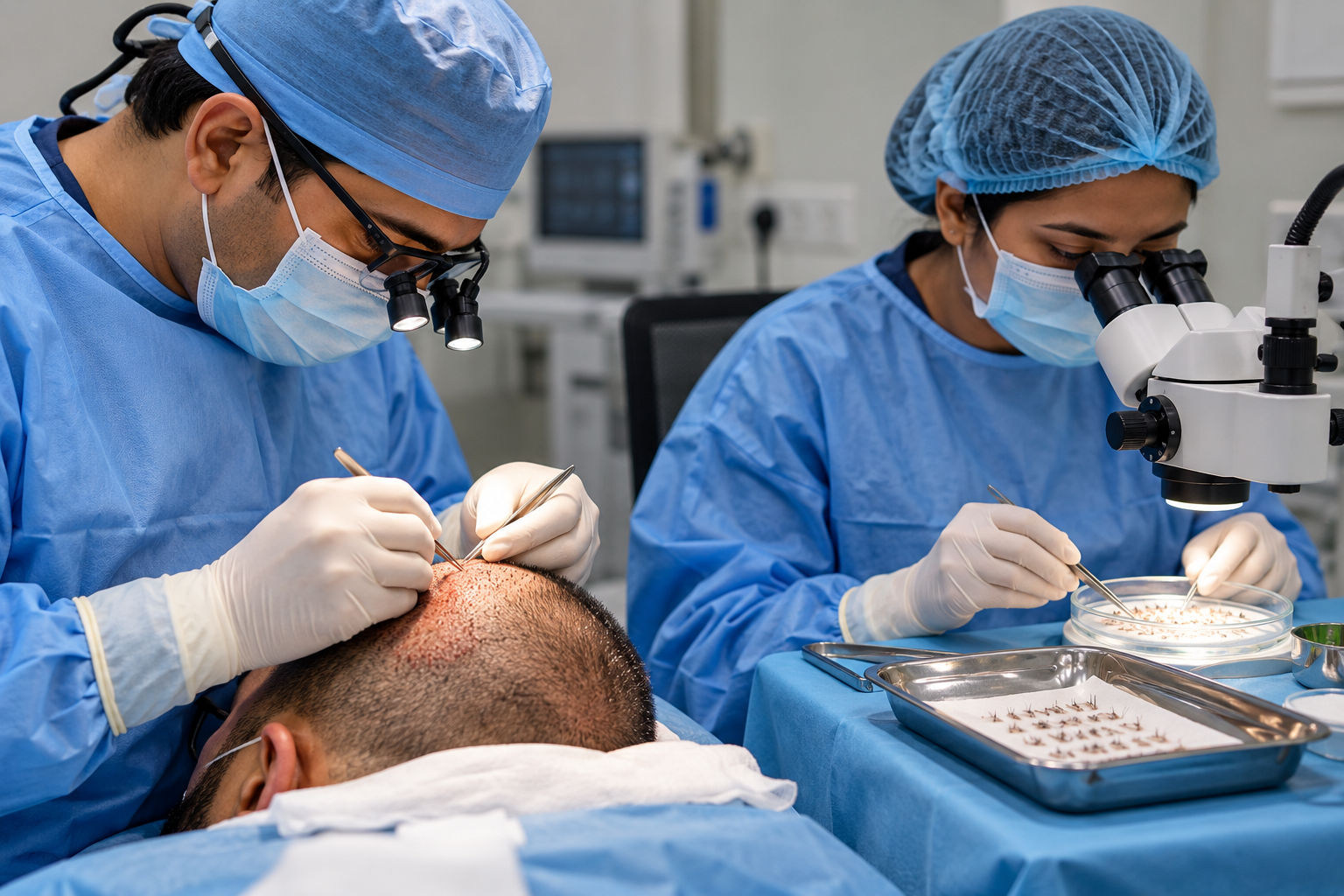
Hair transplantation is a team procedure. Not every person working in a transplant theatre performs surgery.
Qualified assistants and technicians can support multiple parts of the clinical workflow within their permitted scope and under appropriate supervision.
The NMC guideline says assistants or technicians should have a medical background, for example, nurses, OT technicians or pharmacists, and should receive structured and systematic training. It specifically refers to areas such as sterilisation, disinfection and patient communication.
Depending on professional qualification, institutional policy and applicable regulations, training for an assisting role may cover areas such as:
The exact tasks a trainee can perform must remain within the scope of their professional qualification and supervision requirements.
Elegance Vidhyalay therefore separates education intended for different professional roles. Healthcare professionals interested primarily in a supporting role can review the Hair Transplant Technician Course.
Doctors seeking procedure-focused education can instead review the Hair Transplant and Nonsurgical Hair Loss Workshop.
| Qualification/role | May perform independently? | May assist? | Course type that fits |
|---|---|---|---|
| MCh/DNB Plastic Surgery with appropriate competency | Within professional scope and applicable regulations | Yes | Advanced fellowship / hands-on workshop |
| MD/DNB Dermatology with adequate dermatosurgical training | Within professional scope and applicable regulations | Yes | Advanced fellowship / hands-on workshop |
| MDS Oral & Maxillofacial Surgery | Scope must follow current dental/regulatory guidance and applicable anatomical limits. | Yes, within professional scope | Relevant advanced training |
| General BDS dentist | A course alone does not confer independent hair-transplant surgical authority. | Only within legally permitted professional scope | Observational/theory or other role-appropriate training |
| Registered nurse | No independent hair-transplant surgery | Yes, for appropriate assigned duties under supervision | Technician/assistant training |
| OT technician / other eligible medical-background technician | No independent hair-transplant surgery | Appropriate non-surgical duties under direct supervision | Technician course |
The table is a practical interpretation of the cited guidance, not a substitute for individual regulatory advice. Professionals should verify their current registration and scope with the relevant council before undertaking clinical procedures.
A training institute should not advertise a course as though completing a few days of training converts every participant into an independently authorised hair-transplant surgeon.
The NMC guideline is particularly clear about inadequate training. It says that simply watching procedures at workshops or through online platforms is not adequate training to begin aesthetic surgery or hair transplantation.
A transparent course should therefore state:
Who can enrol: The course page should identify the educational or professional qualifications required for admission.
Who the course is designed for: A programme for surgeons is different from a programme designed for nurses or technicians.
What practical exposure is included: Observation, simulation, supervised assistance and hands-on surgical training should not be described as though they are interchangeable.
What the certificate means: The certificate should document completion of training. It should not be advertised as a replacement for a recognised professional degree, registration or statutory permission.
What participants can do afterward: This depends on their original qualification, registration, applicable professional regulations and demonstrated competency, not simply on possessing the course certificate.
Prospective trainees can also review the faculty and supervising surgeons before selecting a programme.
Before joining a clinically oriented programme, a trainee should be prepared to show the registration relevant to their profession.
For doctors, that means valid registration applicable to their practice. Dental professionals should maintain the appropriate dental registration, while nurses and other regulated professionals should maintain registration required for their role.
Training institutions should verify these credentials rather than assuming that every applicant searching for a hair transplant course for a dentist or technician programme has the same clinical scope.
Registration also helps clarify the trainee’s starting point. Training should build competency within an appropriate professional framework, rather than being used to bypass it.
This is perhaps the most useful distinction for prospective students.
Imagine two people complete the same short workshop: one is an appropriately qualified plastic surgeon and the other is a healthcare assistant.
Both may receive certificates confirming attendance or completion. But those certificates do not erase the major difference between their underlying qualifications and professional registrations.
Their permitted clinical roles therefore remain different.
The NMC guidance also states that it is unethical for an RMP to train someone to perform or assist surgery if that person is not an accredited health professional licensed to do so.
For students, this makes course selection easier: choose training that matches the role you are actually qualified to perform.
Before enrolling, ask the institute for clear answers to these questions:
These questions are more useful than choosing a programme purely because it advertises “hands-on” training.
At Elegance Vidhyalay, training should be selected according to the participant’s professional background, intended clinical role, and applicable scope of practice. The purpose of education is to develop appropriate knowledge and supervised skills, not to replace recognised medical or professional qualifications.
A general BDS qualification should not be treated as independent authority to perform hair-transplant surgery. The NMC defines key transplant steps as surgical procedures for appropriately trained and licensed RMPs. Anyone considering hair transplant training in Gujarat should separately verify clinic ownership requirements and their permitted clinical scope with the relevant regulatory authorities.
Oral and Maxillofacial Surgeons occupy a different position from general BDS dentists because they have postgraduate surgical training. Government-reported clarification has recognised selected hair-restoration procedures for appropriately trained OMFS professionals within the cranio-maxillofacial region. Individual practitioners should still verify current council rules, registration requirements and the precise procedure involved.
A nurse may work as part of a trained hair-transplant team, but supervision does not automatically make every surgical step permissible. The NMC reserves surgery execution, including donor harvesting and recipient-site creation, for an RMP and says assistants or technicians should perform their appropriate tasks under direct supervision of the treating physician.
No. A course certificate documents training or course completion; it does not replace a recognised medical qualification, professional registration or applicable scope-of-practice rules. The participant’s underlying qualification and registration remain crucial when determining which procedures they can independently perform after completing a hair-transplant training programme.
A technician programme may teach hair-transplant workflow, follicular-unit basics, graft handling principles, counting and sorting, theatre preparation, sterilisation, infection control, documentation and patient communication. The objective is to prepare suitable healthcare personnel for an assisting role under appropriate supervision, rather than qualify them as independent hair-transplant surgeons.
The appropriate registration depends on the trainee’s profession. Medical doctors should provide their applicable medical registration, dental professionals their dental registration, and nurses or other regulated healthcare professionals the registration required for their profession. The institute should verify eligibility before assigning any clinical or hands-on component.
A hair transplant course for dental professionals, nurses or technicians should always be matched to the participant’s existing qualification. Learning a technique and being professionally authorised to perform it independently are two different matters.
The NMC’s guideline dated 20 September 2022 treats incision-based hair-transplant steps as surgery, reserves core diagnostic, planning, surgical and postoperative responsibilities for appropriately qualified RMPs, and requires trained assistants to work within suitable roles under direct supervision.
At Elegance Vidhyalay, prospective trainees should select a fellowship, workshop or technician programme according to their recognised qualification and intended role. Training can develop knowledge and skills, but it should never be presented as a shortcut around professional registration or regulatory scope.