Graft cutter training hair transplant India clinics depend on is a focused, hands on programme that teaches you to dissect and prepare follicular grafts safely under a microscope. At Elegance Vidhyalay in Surat, we train you on real tissue and live cases, so you learn the exact slicing pressure, angle and trimming that a surgeon expects. A skilled graft cutter protects every follicle, therefore the density and survival of a transplant often rest in your hands. Throughout this guide, we explain what a graft cutter does, who can train for the role, how our course runs, and why this quiet skill sits at the heart of every successful hair restoration.
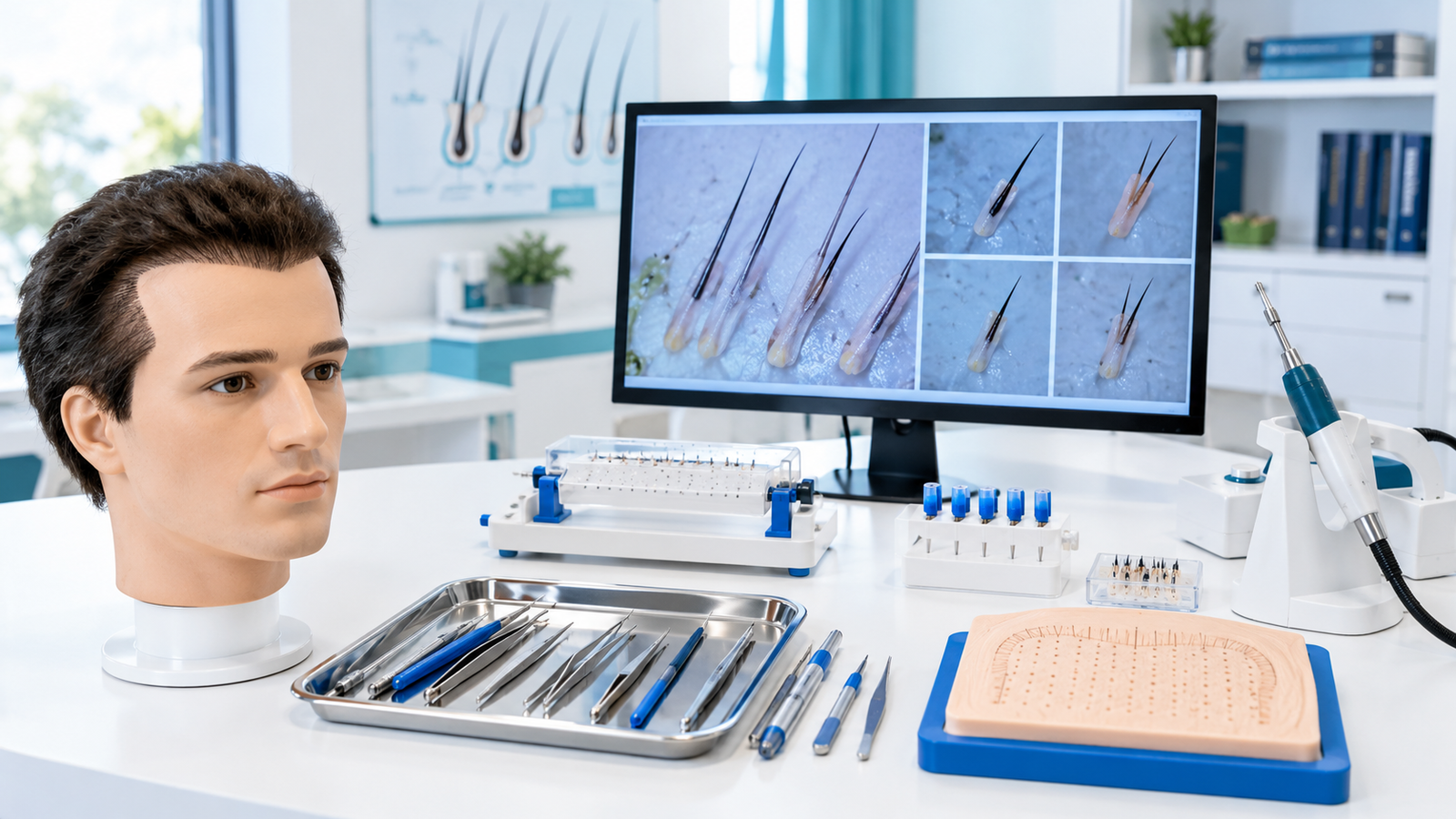
A graft cutter is the trained person who slivers a donor strip and dissects it into individual follicular units under a microscope. In simple terms, the surgeon removes tissue, while the graft cutter shapes that tissue into clean, usable grafts. Because each follicle is fragile, this step decides how many grafts survive the transplant.
During a hair transplant, the team works against time. Grafts sit outside the body, therefore they must be cut quickly, kept cool and stay moist. A confident graft cutter keeps this rhythm steady, so the surgeon can implant fresh, healthy units without delay. This is why clinics treat graft cutting as a specialised skill rather than a casual task.
Graft cutter training in India welcomes a wide range of learners, not only doctors. If you have steady hands, patience and genuine interest, you can build this skill. Many trainees come from paramedical or clinic backgrounds and grow into trusted members of a hair transplant team.
Typically, the following people find this course a strong fit:
Aspiring technicians often pair this learning with our structured hair transplant technician course, so they gain a complete view of the procedure. Meanwhile, students who are new to the field can explore our wider paramedical courses to see where graft cutting fits.
Graft cutter training hair transplant India programmes focus on precision, speed and graft safety. You learn to read tissue under magnification, then dissect it without crushing or transecting the follicle. Alongside technique, you also learn handling, storage and teamwork, since every second and every movement affects the final result.
At Elegance Vidhyalay, the core skills we build include:
Because hair restoration uses several methods, we also explain how cutting supports different techniques. Trainees who want the bigger picture study our hair transplant and nonsurgical hair loss workshop, which covers FUE, FUT, DHI, PRP and GFC together. As a result, you understand not just how to cut, but why each graft matters for the chosen method.
Hands on graft cutter training works best when you practise on real tissue under a trainer’s eye. At Elegance Vidhyalay, we avoid long theory lectures. Instead, we place you at the microscope early, so your hands learn the feel of the blade, the tissue and the follicle from day one.
Our training usually moves through clear stages. First, you observe live cases and watch experienced cutters at the station. Next, you practise slivering and simple cuts under supervision, while a mentor corrects your grip and angle. After that, you dissect grafts on real cases, with the surgeon nearby to guide difficult sections. Because feedback stays constant, mistakes get fixed early, and your confidence grows steadily.
All of this happens under Dr. Ashutosh Shah, our founder and lead trainer, whose surgical experience shapes every session. You can read more about his background on the Dr. Ashutosh Shah profile, and see how our approach reflects that expertise. Since real patients are involved, supervision stays close and safety always comes first.
A trained graft cutter enjoys steady demand, because hair transplant clinics keep opening across India. Every busy centre needs reliable cutters who protect grafts and keep cases moving. Consequently, a skilled cutter becomes a valued team member rather than a replaceable helper.
Career paths often grow in stages. Many cutters start on the dissection bench, then move into wider technician roles, and later mentor new trainees. Some also assist in extraction and implantation once they master cutting. Because the skill is practical and portable, experienced cutters can work in different cities and clinics with ease.
Earnings depend on skill, speed and reliability, so trainees who practise seriously tend to progress faster. If you want to broaden your value further, our certified cosmetic courses overview shows related paths that pair well with graft cutting. In short, the role opens a stable door into the growing hair restoration field.
Elegance Vidhyalay offers graft cutter training built on real cases, close mentoring and modern instruments. Founded by Dr. Ashutosh Shah under Elegance Clinic in Surat, our institute brings over 22 years of surgical experience in cosmetic, hair transplant and reconstructive procedures into every class. Therefore, you learn from a working clinic, not a classroom demo.
Several things set our training apart:
If you are ready to start, our team will happily explain schedules, eligibility and current fees. You can reach out to our admissions team, and we will guide your next step. Ultimately, we want you to leave as a confident, careful graft cutter that any hair transplant team would trust.
A graft cutter dissects donor tissue into individual follicular units under a microscope. This person protects each follicle, keeps grafts moist and cool, and hands them to the surgeon for implantation, so graft survival stays high.
No, you do not need a full medical degree. Paramedical students, clinic staff and motivated 12th pass learners can train as graft cutters. Steady hands, patience and careful practice matter far more than any single qualification.
Training length varies with your background and practice speed. Most learners build core dissection skills over a focused hands on programme, then sharpen speed with repeated live cases. Elegance Vidhyalay guides each trainee until the technique feels natural.
At Elegance Vidhyalay, the training stays firmly hands on. You practise on real tissue and live cases under supervision, rather than sitting through long lectures. This practical focus helps your hands learn the correct pressure and angle quickly.
We offer graft cutter training at Elegance Vidhyalay in Surat, Gujarat, under Dr. Ashutosh Shah. Trainees work inside a real hair transplant setting, so they experience clinic conditions, teamwork and case pressure from the very start.
Yes, graft cutting often opens the door to a wider role. Many cutters move into extraction, implantation or technician positions over time. With steady skill and reliability, you can build a lasting career in hair restoration.
Graft cutters use a stereo microscope, fine blades, forceps and a chilled holding solution. These tools help them slice tissue precisely and keep grafts safe. Learning correct tool handling forms a key part of our training programme.
If you want serious, hands on graft cutter training under an experienced surgeon, we would love to guide you. Speak with our admissions team, ask your questions and find the batch that fits you. Simply reach us through the Contact Us page, and take your first step toward a rewarding hair transplant career.
Elegance Vidhyalay is a medical education and professional training institute founded by Dr. Ashutosh Shah under Elegance Clinic in Surat. We offer fellowships, crash courses, certified cosmetic courses and paramedical courses in cosmetic and reconstructive medicine. Our training stays practical, ethical and hands on, with live patient exposure under direct expert observation. Paramedical courses are offered in collaboration with Vidhyadeep University.