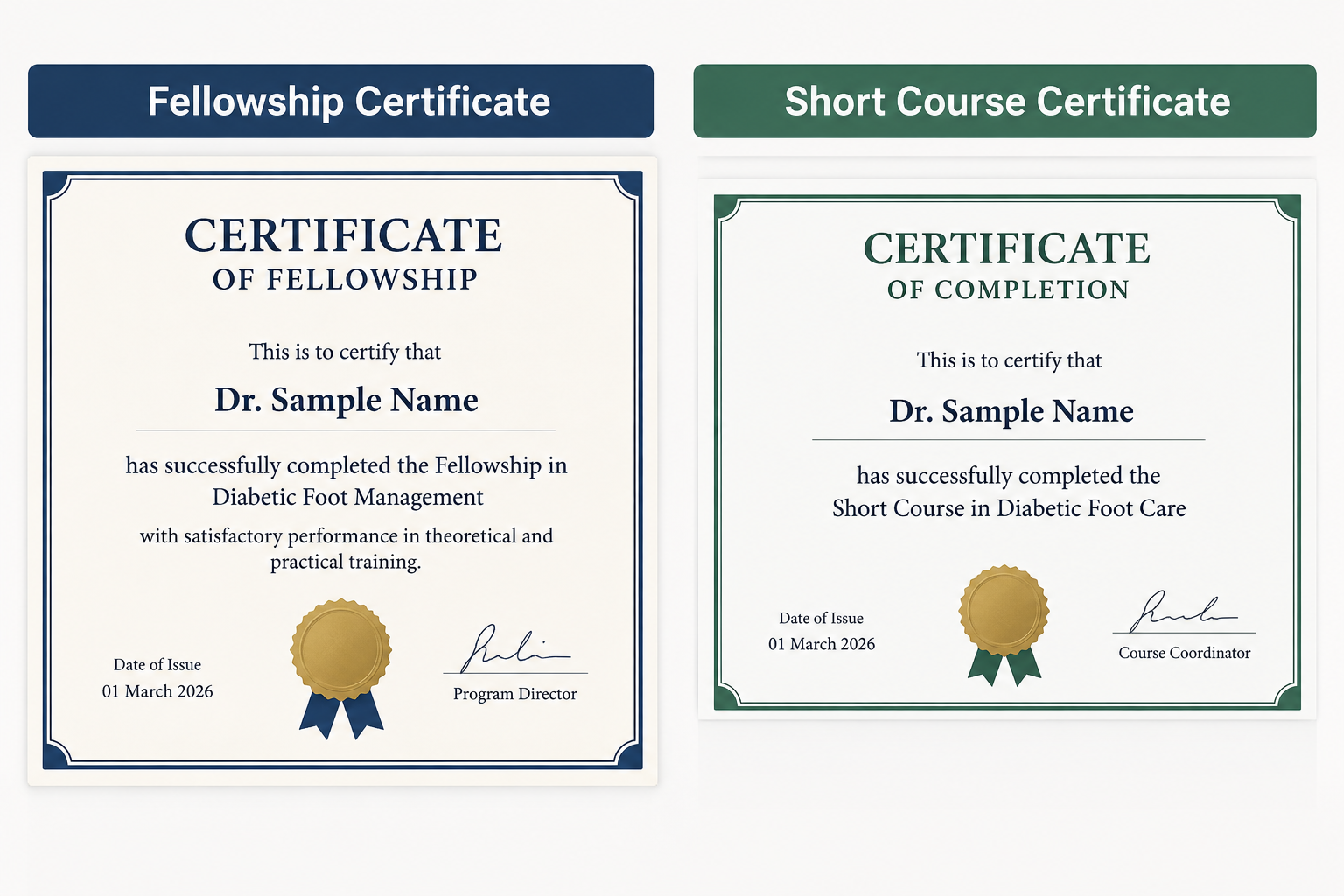
When comparing a fellowship vs certificate course for doctors, the difference goes beyond the certificate you receive. A fellowship typically runs for months, with supervised clinical exposure, a case log, and formal assessment. A certificate course may run for days to weeks and usually focuses on defined skills or knowledge. What doctors can appropriately claim afterwards also depends on the actual training completed.
For a practising doctor, choosing between the two can be difficult. Taking time away from an established OPD has a cost, but choosing a programme that is too short or does not provide enough practical exposure may also limit its usefulness.
The right choice depends on what you want to learn, how much supervised experience you need, your current qualifications, and how you plan to apply the training in clinical practice.
This guide explains the difference between fellowship and certification so doctors can evaluate both options more carefully.
At Elegance Vidhyalay, doctors can explore structured medical training designed to combine theoretical understanding with practical clinical exposure. Training under
Dr. Ashutosh Shah, with 22+ years of clinical experience, allows participants to learn through experienced faculty guidance while understanding how clinical knowledge is applied in real-world practice.
Doctors interested in longer structured training can review the available all fellowships to understand the different training options.
There is no universal format followed by every private medical training provider. The following table should therefore be used as a practical comparison rather than as a regulatory definition.
| Factor | Fellowship | Certificate Course |
|---|---|---|
| Duration | Often longer, potentially weeks to months depending on programme | Commonly shorter, from a few days to several weeks |
| Supervised case count | Usually expected to provide broader clinical exposure; exact numbers should be verified. | May involve limited or focused case exposure depending on the course |
| Assessment method | May include case logs, practical evaluation, written/oral assessment or competency review | May involve attendance, quizzes, assignments or skill assessment depending on programme |
| Documentation received | Fellowship completion document/certificate according to programme structure | Course/certificate of completion according to provider |
| Public claim permitted | Must accurately describe the fellowship completed without implying an unearned recognised specialty qualification | Must accurately state the course completed without implying specialist status |
| Typical fee band | Usually higher because of longer duration and greater resource requirements; verify actual programme fees. | Often lower because of shorter duration, but varies considerably |
| Lost-income estimate | Potentially higher because more time may be spent away from independent practice | Potentially lower because the programme usually requires less time away |
| Employer recognition | Depends on provider, curriculum, accreditation/affiliation where applicable, hospital policy and role requirements | Depends on provider, course content, employer policy and relevance to the position |
This is one of the most important issues doctors should understand before enrolling.
Completing a fellowship or certificate course does not automatically create a new formally recognised medical specialty qualification.
A doctor should accurately describe the education and training actually completed.
For example, completing a training programme in a particular clinical area may allow you to truthfully state that you have completed that named programme. It should not be presented in a way that falsely implies specialist registration, a recognised postgraduate degree or another credential that has not actually been awarded.
The same principle applies to certificate courses.
A certificate of completion confirms whatever the issuing organisation states it confirms. Doctors should not assume that every certificate carries identical professional, academic or regulatory standing.
Before using a qualification on a website, clinic board, social-media profile, prescription material or professional directory, check the applicable medical advertising and professional rules.
Doctors evaluating programmes should also understand what IAAPS accreditation means and, where relevant, distinguish professional association accreditation or endorsement from university degrees, statutory qualifications and other forms of recognition.
Accurate representation protects both doctors and patients.
Hospitals and employers do not necessarily evaluate every fellowship or certificate course in the same way.
They may consider several factors, including:
A longer fellowship may provide stronger evidence of structured clinical exposure than a very short course, but this does not mean every fellowship will automatically be accepted by every hospital.
Likewise, a focused certificate course from a credible training provider may be valuable when it teaches a relevant skill, even if it does not carry the same depth as a longer programme.
If hospital credentialing matters to you, ask the hospital or prospective employer what documentation it requires before paying for the programme.
Do not rely solely on a training provider’s general statement that a certificate is “accepted” or “recognised.”
Course fees are only one part of the cost.
For a doctor already running an independent OPD, time away from practice can be a significant expense.
A more realistic calculation is:
Total training cost = course fees + travel + accommodation + lost practice income + additional setup/equipment costs
Consider a doctor who must close or reduce consultations while attending training. Even if the course fee appears affordable, several weeks away from practice can substantially increase the real investment.
A shorter certificate course may reduce this opportunity cost.
However, selecting a short programme only because it requires fewer days away may be a poor decision if your objective requires extensive supervised clinical exposure.
Doctors should therefore compare cost against learning objective, rather than simply choosing the least expensive programme.
Before enrolling, ask for:
This gives you a more realistic picture of the investment.
The answer depends on what is missing from your current practice.
A doctor who already has substantial experience and wants exposure to one specific technique may find a focused certificate or short course more practical.
For example, if the objective is to understand a particular technology, refine an existing technique, or gain structured exposure to a narrowly defined skill, taking months away from practice may not be necessary.
Doctors looking for such focused formats can explore available certified courses or crash courses for doctors.
A fellowship may make more sense when the objective is broader.
You might prefer a fellowship if you want:
Ask yourself what you should be able to do at the end of the programme that you cannot confidently do today.
If the answer involves multiple competencies that require repeated supervised exposure, a fellowship may be more appropriate.
If the answer is one focused skill or a knowledge update, a shorter course may be sufficient.
The word “certificate” by itself tells you very little.
Before enrolling, investigate the organisation issuing it and exactly what the document represents.
Review the institution’s history, faculty, clinical setup, and the programmes it regularly conducts.
Find out who actually teaches and supervises participants.
Faculty should have relevant qualifications and clinical experience in the subject being taught.
Does it certify attendance, successful completion, assessment, supervised training, or demonstrated competency?
These are not necessarily the same thing.
Request a detailed syllabus rather than relying only on the programme title.
Ask for realistic information about patient and procedure exposure. A programme should not promise identical case numbers if actual clinical opportunities depend on patient availability.
If a programme advertises accreditation, affiliation, endorsement or recognition, identify the organisation providing it and what that status actually means.
Professional association accreditation should not automatically be interpreted as equivalent to a university degree or statutory postgraduate qualification.
Find out whether there is an examination, practical assessment, case-log review or another competency evaluation.
Where an external organisation is named, check information directly with that organisation where possible instead of relying exclusively on promotional material.
There is no universal winner in the fellowship vs certificate course for doctors comparison.
A fellowship is not automatically better simply because it is longer. Similarly, a certificate course is not automatically inadequate because it is short.
The question is whether the programme provides enough education, supervision and assessment for your intended objective.
If you need deeper clinical exposure, repeated supervised practice and broader training, a fellowship may be the more appropriate option.
If you already have relevant clinical experience and need focused training in a specific skill, a well-designed certificate or short course may be more efficient.
Before making a decision, compare the curriculum, faculty, supervised exposure, assessment, course documentation, cost, and time away from practice.
Most importantly, understand exactly what the programme enables you to truthfully say about your training afterwards.
No. A fellowship generally provides longer and potentially broader training, while a certificate course can be suitable for focused skill development. The better choice depends on your existing experience, learning objective, supervised exposure required, programme quality, and how you intend to use the training in practice.
You may accurately state training you have genuinely completed, subject to applicable professional and advertising rules. However, the wording should not imply a specialist qualification, degree, registration status, or professional recognition you do not hold. Verify applicable requirements before adding course credentials to public-facing materials.
There is no single case number suitable for every medical fellowship. Requirements vary according to specialty, procedure complexity, programme objectives, and trainee experience. Instead of looking only for a high number, ask how many cases are observed, assisted, performed under supervision, and formally documented or assessed.
Acceptance depends on the individual hospital, role, credentialing policy, programme provider, and doctor’s existing qualifications. A private fellowship should not be assumed to provide automatic hospital privileges. If hospital employment or procedural privileges are your goal, verify the institution’s requirements before enrolling.
This depends entirely on the programme provider. Some institutions may offer separate progressive training pathways, while others treat certificate courses and fellowships as independent programmes. Ask whether previous training receives any credit, whether additional clinical requirements apply, and what assessment is necessary before enrolling.
Check the institution, faculty qualifications, clinical facilities, curriculum, assessment process and the organisation issuing the certificate. If accreditation or external affiliation is advertised, verify what it specifically covers. Where possible, confirm claims independently with the named organisation rather than relying only on promotional material.