Diabetes can affect the feet through reduced sensation, circulation problems, wounds, infections, and delayed healing. Doctors and hospitals managing these patients often need trained support staff who understand basic diabetic foot care and can assist with routine clinical activities under appropriate medical supervision. For students interested in healthcare after school, a diabetic foot technician course India can provide a focused paramedical learning pathway. It can introduce students to diabetic foot care, patient support, wound-care assistance, foot assessment basics, hygiene, documentation, and practical clinical responsibilities.
Students after 10th or 12th can explore diabetic foot technician training if they meet the eligibility requirements of the particular institute and program.
The course is designed as a paramedical pathway rather than a medical degree. Students learn how trained technicians can support doctors and other healthcare professionals caring for people with diabetes-related foot problems.
Always check the current eligibility requirements before applying.
A diabetic foot technician works as part of a healthcare team involved in diabetic foot and wound care.
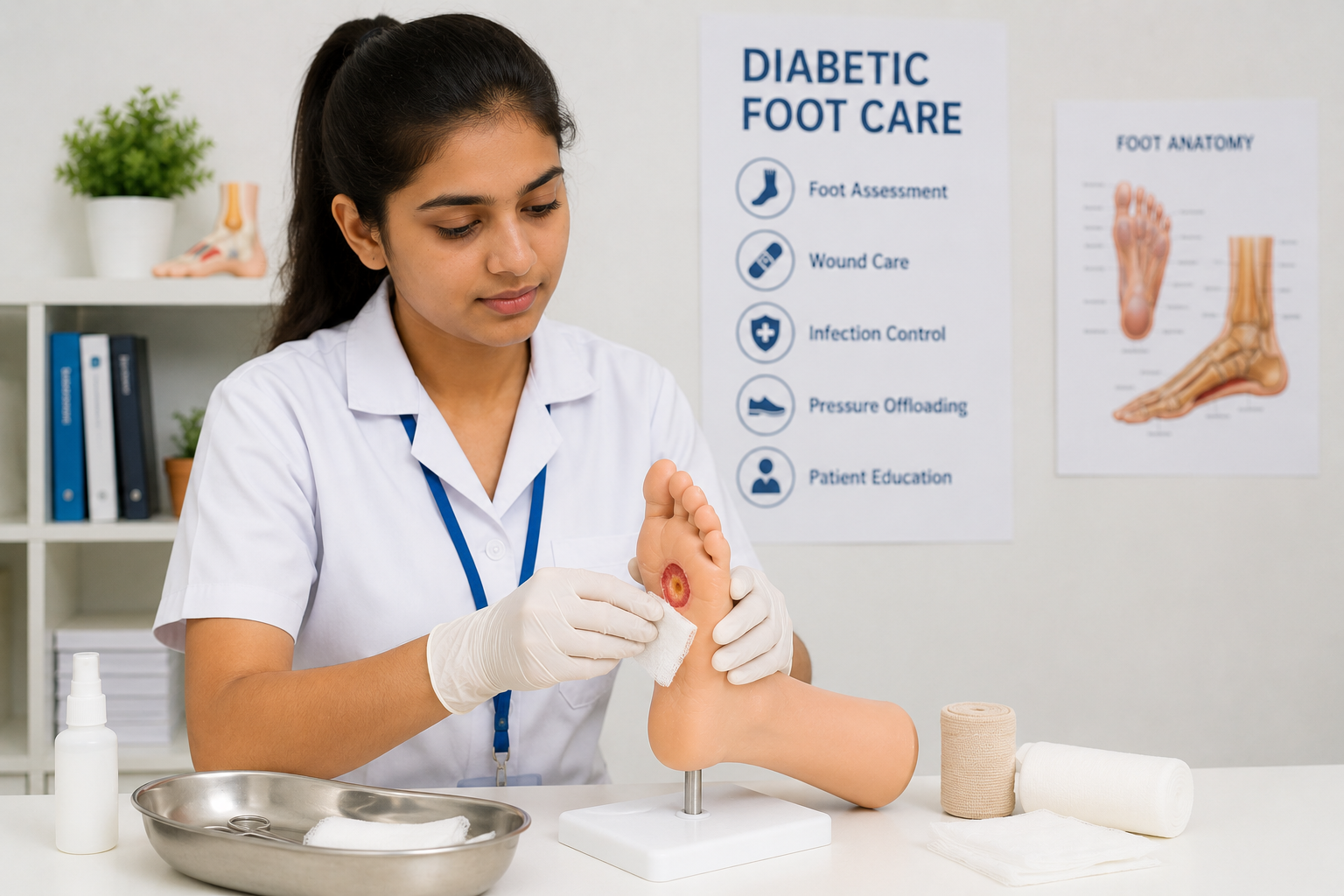
The technician’s role is supportive. Depending on training, workplace protocols, and supervision, responsibilities may involve helping with patient preparation, maintaining hygiene, assisting during foot assessment and wound-care procedures, preparing required materials, documenting information, and educating patients about routine foot-care instructions provided by the clinical team.
A technician does not replace a doctor or independently make medical or surgical decisions.
A diabetic foot technician course India should help students understand both diabetes-related foot problems and their role within the healthcare team.
Training may introduce topics such as:
The exact curriculum can vary, so students should review the current course syllabus before enrollment.
Diabetic foot care is difficult to understand through theory alone.
Students need to become familiar with a real clinical environment, including how patients are prepared, how infection-control procedures are followed, how materials are organized, and how technicians communicate with doctors and patients.
Practical exposure also teaches an important lesson: when a problem is beyond a technician’s role and needs immediate attention from a qualified clinician.
For this reason, students comparing courses should look beyond the certificate and ask about practical training and clinical exposure.
People with diabetes may sometimes lose sensation in their feet. A small injury may therefore go unnoticed. Diabetes can also be associated with circulation and healing problems.
A blister, pressure point, cut, or wound that initially appears minor can become more complicated in some patients.
Diabetic foot care consequently involves prevention, regular observation, appropriate wound management, pressure reduction, infection management, and timely medical intervention.
A trained technician can support this process while working under the direction of qualified healthcare professionals.
This course is targeted toward students after 10th or 12th who are interested in entering a healthcare-support profession.
It may appeal to students who prefer practical healthcare work and want to develop skills in a specialized area rather than pursue a conventional academic pathway immediately.
However, students should confirm the institute’s current minimum qualification, age criteria, course duration, admission requirements, practical-training structure, and certification before enrolling.
The selected course category supports both online and offline learning.
Online classes can be useful for learning theoretical subjects, terminology, basic concepts, patient-care principles, and clinical protocols.
Offline training becomes particularly valuable for practical skills because students can observe how healthcare teams manage patients and become familiar with the clinical environment.
A program combining structured theory with suitable practical exposure can therefore be useful for students entering this field.
After completing appropriate training, students may explore suitable support roles in settings such as diabetic foot clinics, wound-care centres, hospitals, diabetes clinics, multidisciplinary foot-care services, and other healthcare facilities.
Actual job titles, responsibilities, eligibility, and employment opportunities vary between organizations.
Students should therefore view the course as skill-based paramedical education, rather than a guarantee of employment or a specific salary.
Elegance Vidhyalay offers a dedicated paramedical learning pathway for students interested in diabetic foot care.
The Diabetic Foot Technician Course is aimed at helping students develop foundational knowledge along with practical understanding relevant to supporting diabetic foot-care services.
The learning environment at Elegance Vidhyalay is associated with Dr. Ashutosh Shah, Plastic, Cosmetic & Reconstructive Surgeon with more than 22 years of surgical experience. His surgical background provides students with exposure to the clinical importance of wound care, patient safety, timely intervention, and structured diabetic foot management.
Students considering admission should contact the institute for the latest information about eligibility, duration, fees, class format, practical exposure, certification, and admissions.
Do not choose a course based only on its name.
Check whether the program provides a clear curriculum, qualified faculty, practical exposure, appropriate supervision, defined technician responsibilities, infection-control education, and transparent information about certification.
For students entering healthcare for the first time, understanding the scope and limitations of a technician’s role is especially important.
A diabetic foot technician course India can offer students after 10th or 12th a specialized route into healthcare-support work. The course can build knowledge of diabetic foot problems, wound-care assistance, infection control, patient support, and day-to-day clinical responsibilities.
The course targets students after 10th or 12th. However, confirm the latest minimum eligibility and admission requirements directly with the institute before applying.
No. A diabetic foot technician is a paramedical support role, not a doctor. Technicians work within their training and under appropriate clinical supervision.
The selected course information lists the learning mode as both online and offline. Practical clinical skills may require suitable in-person exposure.
Depending on qualifications and employer requirements, trained candidates may explore support opportunities in hospitals, diabetic foot clinics, wound-care centres, and other relevant healthcare facilities.
No. A technician’s training should not be confused with surgical qualification. Surgical diagnosis and treatment remain the responsibility of appropriately qualified medical professionals.