A cosmetic surgery fellowship in India is designed for appropriately qualified doctors seeking structured training in aesthetic and cosmetic procedures. The programme can combine supervised hands-on work, live surgery exposure, and patient consultations, with progress assessed through a documented case log. Before enrolling, doctors should verify duration, clinical exposure, eligibility, assessment, certification, fees, and the next intake.
For doctors comparing fellowship programmes, the course name alone is not enough. The practical value depends on what happens during training: how many contact days are provided, how practical exposure is organised, what procedures are covered, how trainees are supervised, and what documentation is provided at completion.
This guide brings those details together so doctors can evaluate a programme systematically.
The programme specifications should be checked against the current official intake before enrolment. Where an exact figure is not stated in the available programme data, it should be confirmed directly rather than assumed.
| Specification | Programme Detail |
|---|---|
| Duration | Confirm from current fellowship schedule |
| Contact days | Confirm from current programme |
| Hands-on hours | Confirm from current programme |
| Trainees per station | Confirm before enrolment |
| Supervised case minimum | Confirm from current clinical schedule |
| Assessment | Structured assessment and documented case-log review, according to programme |
| Certificate awarded | Confirm exact certificate title from current programme |
| Fee band | Confirm current fellowship fee |
| Payment schedule | Confirm current payment terms |
| Eligibility | Intended for appropriately qualified doctors working in relevant aesthetic/cosmetic practice; exact criteria must be confirmed. |
| Documents required | Qualification, registration and other programme-required documents should be confirmed before application. |
| Next intake date | Confirm current intake |
| Application route | Apply through the current Elegance Vidhyalay admission/enquiry process |
Exact figures should be obtained from the current programme specification because fees, schedules, intakes and clinical exposure can change.
Doctors can review the Cosmetic surgery fellowship page for programme information.
When comparing a cosmetic surgery fellowship in India, duration should not be considered in isolation.
A programme may run over an extended period but contain relatively few clinical contact days. Another may have fewer calendar weeks but concentrate substantially more supervised training into that period.
Doctors should therefore ask for three separate figures:
Total programme duration — the calendar period from beginning to completion.
Contact days — the number of days trainees are physically involved in scheduled teaching, clinical exposure or practical sessions.
Hands-on hours — the actual time allocated to practical participation rather than lectures or observation.
These numbers should not be presented as interchangeable.
For example, watching an operation can be educational, but observation should not automatically be counted as hands-on procedural experience.
The same applies to group demonstrations. A three-hour practical session shared by several trainees does not necessarily mean each participant receives three hours of individual practical exposure.
Before paying, ask:
The answers provide a much clearer picture of the training than programme duration alone.
Eligibility is particularly important in procedural medical education because not every course is appropriate for every doctor.
The available programme description identifies the fellowship as relevant to doctors working in aesthetic and cosmetic practice, including suitable medical and surgical backgrounds. However, applicants should confirm the current formal eligibility criteria directly with Elegance Vidhyalay before applying.
A course accepting a doctor for training does not automatically change that doctor’s recognised professional qualification or scope of practice.
Applicants should be prepared to provide whatever documentation the current programme requires. This may include:
The exact document list should be confirmed before submitting an application.
Doctors should avoid assuming eligibility based only on a website headline or course advertisement.
Supervised clinical exposure is one of the most important questions to ask when evaluating fellowship training.
But a headline number can be misleading.
Suppose a programme states that participants are exposed to a large number of cases. That number could represent:
Those are very different forms of experience.
A useful programme specification should distinguish them.
Instead of asking only, “How many cases will I see?”, ask:
Which procedures are included?
Will every supervised case be entered into a logbook?
Who signs the case log?
A documented case log provides much stronger evidence of clinical exposure than a general statement that trainees were “exposed to many cases.”
The number of cases available can also depend on patient availability and clinical suitability. A responsible programme should not perform unnecessary procedures simply to satisfy trainee numbers.
Twenty identical straightforward cases do not necessarily provide broader experience than a smaller but more varied clinical mix.
Doctors should examine the type of cases available during training.
A useful fellowship may expose trainees to different:
Clinical judgement develops partly through understanding these variations.
That is why supervised case numbers should be interpreted alongside case complexity and faculty feedback.
Training should ideally include a method for determining whether the participant has understood and demonstrated the expected competencies.
Attendance and competency are not the same thing.
A participant can attend every session without necessarily becoming ready to perform every procedure independently.
Assessment may therefore consider:
Where a case log is used, faculty can review progression rather than relying solely on attendance.
Doctors interested in the programme’s accreditation context can review the IAAPS-accredited fellowship.
Before enrolling, ask for the exact name of the certificate awarded.
You should also understand what the document certifies.
Does it confirm:
These descriptions should not be treated as interchangeable.
Doctors should describe completed training accurately.
The cost of a fellowship should be evaluated against what the programme actually provides.
The current fee should be confirmed directly because programme fees and payment arrangements can change.
Doctors can review Cosmetic surgery fellowship fees for relevant fee information.
Before making a payment, obtain a written breakdown.
Ask whether the fee includes:
Also ask about the payment schedule.
Is the full fee required before the programme starts, or is an instalment arrangement available?
Doctors should additionally check cancellation, deferment and refund conditions before making a substantial payment.
Course fees are only one part of the investment.
For a practising doctor, the complete cost may include:
Fellowship fee + travel + accommodation + meals + lost practice income + additional training expenses
Time away from an established OPD can be particularly significant.
A programme should therefore be assessed according to the value of the training rather than simply whether its headline fee appears high or low.
A lower-cost fellowship with little supervised clinical exposure may provide poor value.
Likewise, a more expensive programme should be able to explain what additional educational resources justify the cost.
A useful fellowship curriculum should progress logically rather than functioning as a collection of unrelated demonstrations.
Training may combine:
Doctors need to understand indications, contraindications, patient selection, anatomy, consent and complication risks before procedural training.
Cosmetic surgery starts before the operating room.
Trainees should understand:
Watching experienced faculty can demonstrate procedural sequence, decision-making, and management of anatomical variation.
Observation is valuable, but it should be clearly distinguished from hands-on participation.
Where appropriate for the trainee and programme, supervised practical training helps translate theoretical knowledge into technical skill.
Case-based discussion can help trainees understand why one approach is selected over another.
Training should not teach only the ideal procedure.
Doctors also need to understand warning signs, complications, escalation, and appropriate referral.
Case logs and structured assessment help demonstrate progression through the programme.
Faculty quality is one of the most important factors when choosing clinical training.
Doctors should know who actually teaches the course—not simply whose name appears in promotional material.
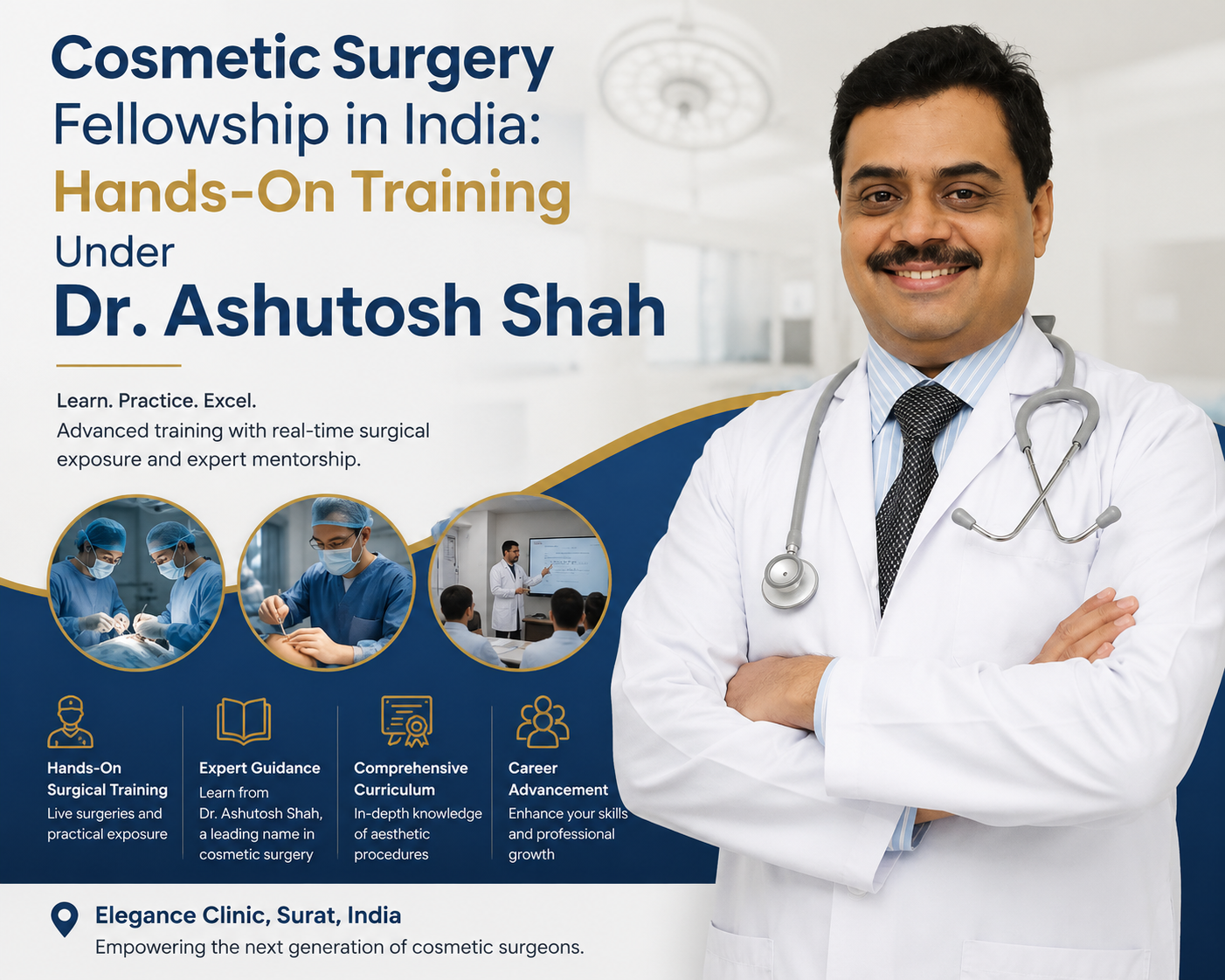
At Elegance Vidhyalay, training is associated with Dr. Ashutosh Shah, a plastic and Reconstructive Surgeon with 22+ years of clinical experience.
Faculty involvement matters particularly during supervised training because useful feedback should go beyond whether a trainee completed a procedural step.
An experienced trainer can discuss:
Doctors should ask how much direct faculty interaction is included rather than assuming senior faculty will supervise every session.
Before enrolling in a cosmetic surgery fellowship in India, perform basic due diligence.
Request a detailed syllabus.
A programme title alone does not explain what will actually be taught.
Check who teaches and supervises practical sessions.
Ask exactly what “hands-on” means.
Does it mean simulation, assisting, supervised patient procedures, or something else?
The number of participants can affect individual practical exposure.
Find out what cases are recorded and who signs them.
Ask how competency is evaluated.
Know the exact document awarded and what it represents.
Ask about additional charges before paying.
These should ideally be available in writing.
If accreditation, affiliation, or recognition is advertised, understand precisely what the claim means.
Doctors can also review How to choose a fellowship before making an enrolment decision.
This depends on the programme schedule and the doctor’s existing clinical commitments.
Doctors running their own practice should ask for the complete timetable before enrolling.
Important questions include:
Do not assume that a programme described as flexible can automatically fit around a full OPD schedule.
A realistic plan should account for travel and recovery time as well as teaching hours.
The current application process and next intake date should be confirmed directly with Elegance Vidhyalay, as intake schedules can change.
Before applying, prepare the required professional and registration documents and confirm:
Getting these details in writing can prevent misunderstandings later.
Doctors researching a fellowship usually need several pieces of information before making a decision.
They should not have to move between separate pages to find duration on one page, eligibility on another, fees somewhere else, and curriculum on a fourth.
A complete programme resource should bring together:
Duration → Eligibility → Curriculum → Hands-on exposure → Supervised cases → Assessment → Certificate → Fees → Documents → Intake → Application
This makes it easier to compare programmes on meaningful criteria.
It also reduces the risk of choosing a fellowship because of one attractive headline while missing an important limitation elsewhere.
Eligibility depends on the specific programme. Appropriately qualified doctors working in relevant aesthetic or cosmetic practice may be considered, but applicants should confirm current qualification and registration requirements before applying.
The exact duration should be confirmed from the current programme schedule. Ask separately about total duration, contact days, and clinical training days rather than relying on one headline figure.
Confirm the current number directly with the programme. Ask whether the stated figure represents individual hands-on participation, group demonstrations, simulation, assisting, or supervised patient procedures.
The exact certificate title should be confirmed before enrolment. Doctors should also understand whether it documents attendance, completion, assessment, or supervised clinical training.
Fees can change between intakes. Confirm the current fee, payment schedule and whether training, clinical exposure, materials, assessment, certification and other charges are included.
Potentially, depending on the programme timetable and your practice commitments. Review contact days, attendance requirements, clinical schedules, and assessment dates before enrolling.
Confirm the current application route and next intake directly with Elegance Vidhyalay. Check eligibility, required documents, available seats, programme dates, and fees before submitting your application.
Choosing a cosmetic surgery fellowship in India requires more than comparing course names or certificates.
Doctors should examine the complete specification: duration, contact days, hands-on hours, trainee numbers, supervised cases, curriculum, assessment, certification, fees, eligibility, documents, intake, and application process.
The strongest programme for an individual doctor is one that matches their existing qualifications and learning needs while providing clearly defined supervision and transparent documentation.
Before enrolling, ask for the programme specifications in writing and clarify any missing figures rather than assuming what terms such as “hands-on,” “fellowship” or “clinical exposure” mean.