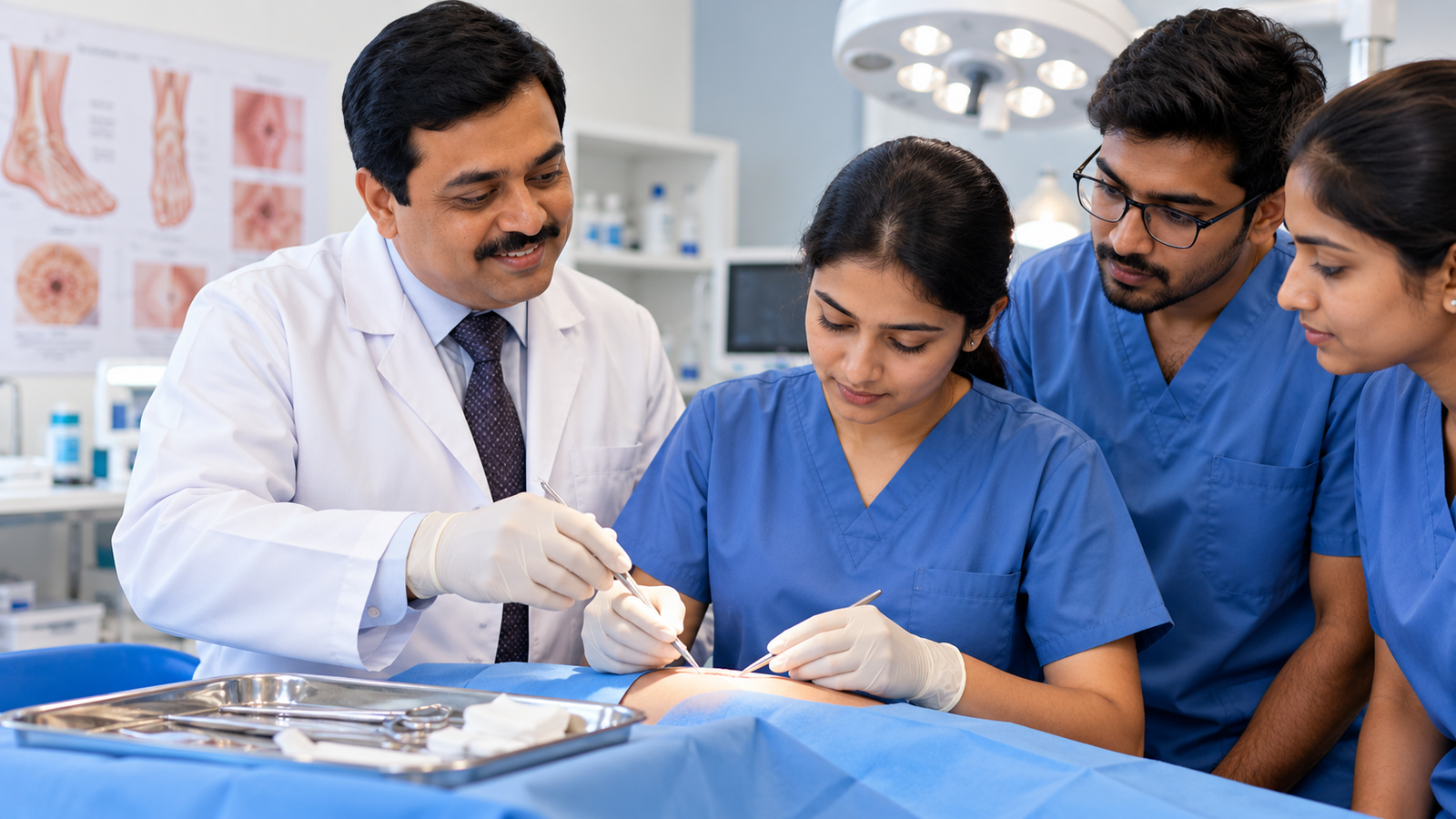
For MBBS doctors exploring career options after MBBS without PG, practical skill-based training can provide additional clinical capabilities without replacing an MD, MS, DNB, or another recognised postgraduate qualification. According to the supplied plan, wound and diabetic foot care, minor nail and skin surgery, aesthetic injectables, laser procedures, and hair restoration assistance are potential post-MBBS learning pathways. Each pathway has its own training requirements, equipment needs, limitations, and professional boundaries.
The key is to distinguish between learning a procedural skill and gaining a specialist qualification. A short course or supervised training programme may improve a doctor’s practical abilities, but it does not automatically confer specialist status or unrestricted procedural scope.
Which Procedural Skill Sets Are Realistically Learnable Post-MBBS?
The supplied plan identifies five broad skill areas:
Wound and diabetic foot care
Minor nail and skin surgery
Aesthetic injectables
Laser procedures
Hair restoration assistance
These areas differ significantly in complexity, equipment, patient selection, complication management, and the level of supervision needed during training.
Before enrolling, an MBBS doctor should ask:
What exactly will I learn?
How much supervised practical exposure does the programme provide?
What will remain outside my scope after training?
Who supervises the practical component?
How does the programme assess competence?
What equipment will I need afterward?
What complications must I recognise and manage or refer?
What professional, regulatory, institutional, insurance, or indemnity requirements apply?
Wound and diabetic foot care can add useful assessment and management skills to a general medical practice.
Training may focus on areas such as wound assessment, documentation, dressing principles, diabetic foot screening, offloading concepts, infection recognition, referral criteria, and selected procedures within the doctor’s competence.
This pathway may particularly suit doctors who already see patients with diabetes, chronic wounds, or high-risk feet.
However, training does not mean every diabetic foot problem should remain in a general clinic. Complex infection, vascular compromise, extensive tissue loss, or cases requiring specialist surgical management need an appropriate referral pathway.
2. Minor Nail and Skin Surgery
Minor procedural training can help doctors develop selected office-based skills.
The important issue is not simply learning the mechanical steps of a procedure. Doctors also need to understand:
Patient selection
Indications
Contraindications
Consent
Local anaesthesia where appropriate
Aseptic technique
Complication recognition
Documentation
Post-procedure care
Referral thresholds
A course should clearly state which procedures it teaches and what level of supervised experience participants receive.
3. Aesthetic Injectables
Aesthetic injectables require much more than learning an injection technique.
Doctors need knowledge of relevant anatomy, patient assessment, product selection, treatment planning, consent, contraindications, adverse events, emergency recognition, and follow-up.
The ability to perform an injection does not automatically establish competence in managing every aesthetic indication or complication.
Doctors considering this pathway should therefore evaluate practical supervision and complication-management teaching carefully.
Laser training combines clinical decision-making with device-specific knowledge.
A doctor needs to understand:
Indications
Patient selection
Relevant skin assessment
Device principles
Treatment parameters
Eye and procedural safety
Contraindications
Expected reactions
Complication recognition
Follow-up
Equipment requirements may also make this pathway more capital-intensive than skills that need only basic clinic infrastructure.
Doctors should therefore evaluate both the training investment and the equipment requirements before choosing this route.
5. Hair Restoration Assistance
Hair restoration is another possible skill area identified in the supplied plan.
Training may expose doctors to patient assessment, hair-loss evaluation, procedural workflow, graft handling concepts, postoperative care, and the roles of different team members.
However, hair restoration assistance should not be confused with unrestricted independent surgical practice. The doctor’s role must remain consistent with training, competence, applicable professional requirements, and the procedure being performed.
The supplied plan requests a comparison based on training duration, fee band, scope, equipment, and time to steady case volume. It does not provide actual figures for duration, fees, equipment costs, or case-volume timelines, so these should be confirmed from the specific programme rather than invented.
Pathway
Training Duration
Fee Band
Scope Gained
Scope Still Out of Reach
Equipment Needed
Time to Steady Case Volume
Wound & diabetic foot care
Confirm with programme
Confirm current fee
Selected wound and foot-care skills taught by programme
Complex cases beyond training/competence
Depends on services offered
Depends on practice and referral base
Minor nail & skin surgery
Confirm with programme
Confirm current fee
Selected minor procedural skills
Procedures beyond demonstrated competence
Procedure-specific instruments
Depends on existing patient base
Injectables
Confirm with programme
Confirm current fee
Selected injectable techniques taught
Treatments beyond training and competence
Products, emergency preparedness and procedure setup
Depends on demand and practice setting
Laser procedures
Confirm with programme
Confirm current fee
Selected device-based procedures
Devices/indications outside training
Appropriate laser/device and safety equipment
Depends on equipment and patient demand
Hair restoration assistance
Confirm with programme
Confirm current fee
Defined hair-restoration workflow skills
Independent procedures beyond role/competence
Depends on assigned procedural role
Depends on clinic setting and case access
This table works best when doctors replace the “confirm” fields with verified information from the programme they are evaluating.
What Scope Does Each Skill Add and What Stays Out of Reach?
This is one of the most important questions when evaluating career options after MBBS without PG.
Training can add skills. It does not automatically change a doctor’s formal qualification.
A doctor should distinguish among:
Knowledge gained: What the course teaches theoretically.
Supervised skill gained: What the doctor repeatedly performs under appropriate supervision.
Demonstrated competence: What the trainer has actually assessed.
Independent practice: What the doctor can appropriately perform after considering competence, professional requirements, facility standards, indemnity, and patient safety.
Specialist status: A short skill course does not replace a recognised postgraduate specialist qualification.
This distinction helps prevent a common mistake: assuming that course completion automatically means unrestricted procedural practice.
What Does Each Pathway Cost in Time and Money?
Do not compare courses by tuition fee alone.
The real investment may include:
Course fees
Travel and accommodation
Time away from practice
Equipment
Consumables
Staff training
Clinic modifications
Insurance or indemnity considerations
Follow-up training
Supervised case exposure
A relatively inexpensive course may require substantial equipment afterward. Another pathway may require less equipment but more supervised training.
The supplied plan does not specify actual fee bands, so current figures should come directly from the relevant programme.
How Do These Compare With Waiting Another Year for a PG Seat?
This should not be framed as “skill course versus PG” as though they provide equivalent qualifications.
They serve different purposes.
A recognised postgraduate pathway provides structured specialist education and qualification. A focused skill programme develops a narrower practical capability.
For a doctor deciding what to do next, useful questions include:
What is my long-term career goal?
Do I want specialist qualification?
Am I still actively pursuing PG admission?
Which patients do I currently see?
Would this skill complement my existing practice?
Can I obtain adequate supervised experience?
Can I maintain the skill after training?
Do I understand its professional limitations?
A doctor can pursue practical training while still planning for postgraduate education. One does not automatically have to replace the other.
How Do You Get Supervised Cases After a Course?
Completing a classroom component or workshop is only one stage of procedural learning.
Before enrolling, ask the training provider:
How many opportunities for supervised practice are available?
Does the programme use simulation, observation, supervised patient work, or a combination?
Who assesses competence?
Is there a logbook?
Can participants return for further supervised exposure?
What happens if the trainee has not demonstrated competence by the end of the programme?
After training, doctors should avoid using independent patients as substitutes for missing supervised experience.
A structured pathway should move from:
Theory → demonstration → supervised practice → assessment → documented competence → appropriately scoped practice
How Do You Build Case Volume Once Trained?
Do not begin by trying to perform as many procedures as possible.
First establish a safe service.
Define:
Cases you accept
Cases you exclude
Referral criteria
Consent process
Documentation
Emergency arrangements
Follow-up
Complication pathway
Then introduce the service to relevant existing patients and professional referral contacts without overstating your qualifications.
Case volume should develop around appropriate patient selection rather than aggressive procedure promotion.
Which Skill Course Gives the Fastest Return?
There is no reliable universal answer in the supplied plan.
Return depends on factors such as:
Existing patient population
Local demand
Course cost
Equipment investment
Consumable costs
Procedure pricing
Competition
Referral network
Number of appropriate patients
Ongoing training requirements
A skill that fits an existing general practice may reach regular use sooner than one requiring an entirely new patient base and expensive equipment.
Therefore, doctors should evaluate practice fit, not simply choose whichever procedure appears commercially attractive.
Honest Limits of Practising a New Skill Without a PG Qualification
Every skill has a ceiling.
The doctor needs to know where that ceiling lies before treating independently.
A responsible approach includes:
Do not claim a specialist qualification you do not hold.
Do not perform procedures simply because you observed them once.
Do not treat beyond demonstrated competence.
Maintain clear patient-selection criteria.
Obtain appropriate consent.
Keep complete records.
Maintain a referral pathway for complications.
Ensure the facility and equipment suit the procedure.
Keep emergency arrangements appropriate to the service.
Verify current professional and regulatory requirements.
Training expands knowledge and practical ability, but it does not eliminate professional boundaries.
Training Pathways at Elegance Vidhyalay
Elegance Vidhyalay offers training options for doctors interested in developing additional practical skills. Doctors should choose programmes according to their existing qualifications, clinical goals, required supervised exposure, and intended practice setting.
Dr. Ashutosh Shah, a Plastic and Reconstructive Surgeon with 22+ years of clinical experience, contributes clinical experience relevant to procedural training, patient selection, complication awareness, and understanding the limits of a newly acquired skill.
Before joining any programme, doctors should review the curriculum, faculty, hands-on format, assessment method, eligibility criteria, and the exact skills taught.
Frequently Asked Questions
Can an MBBS Doctor Perform Minor Surgery?
An MBBS doctor should consider training, demonstrated competence, the specific procedure, applicable professional requirements, facility standards, and indemnity before adding any procedure to practice.
Which Skill Course Gives the Fastest Return?
No single course guarantees the fastest return. Consider your existing patient base, local demand, training costs, equipment investment, referral network, and whether the skill fits your current practice.
Is It Better to Keep Attempting PG Entrance?
A skill course and postgraduate qualification serve different purposes. Doctors should base this decision on their long-term career goals rather than treating a short course as a replacement for PG training.
How Do I Get Supervised Cases After a Course?
Choose programmes that provide supervised practical exposure, assessment, case documentation, or opportunities for additional mentorship. Do not rely solely on classroom attendance.
Do Insurers Empanel Non-PG Doctors for Procedures?
The supplied plan does not specify insurer rules. Empanelment can vary by insurer, procedure, qualification, facility, and current policy, so doctors should verify requirements directly.
What Are the Medico-Legal Risks of Practising a New Skill?
Risks increase when doctors work beyond competence, use inadequate consent or documentation, lack appropriate facilities, make misleading qualification claims, or fail to recognise and refer complications.
Conclusion
For doctors researching career options after MBBS without PG, focused procedural training can provide a way to develop additional practical capabilities while continuing clinical practice.
Wound and diabetic foot care, selected minor procedures, injectables, laser procedures, and hair restoration assistance represent different pathways in the supplied plan. Each comes with its own training needs, investment, equipment requirements, and limits.
A skill course should therefore complement, not be presented as replacing a postgraduate qualification. The safest progression is to choose a relevant skill, obtain structured training and supervised exposure, demonstrate competence, understand the limits of practice, and maintain appropriate referral pathways as clinical experience grows.