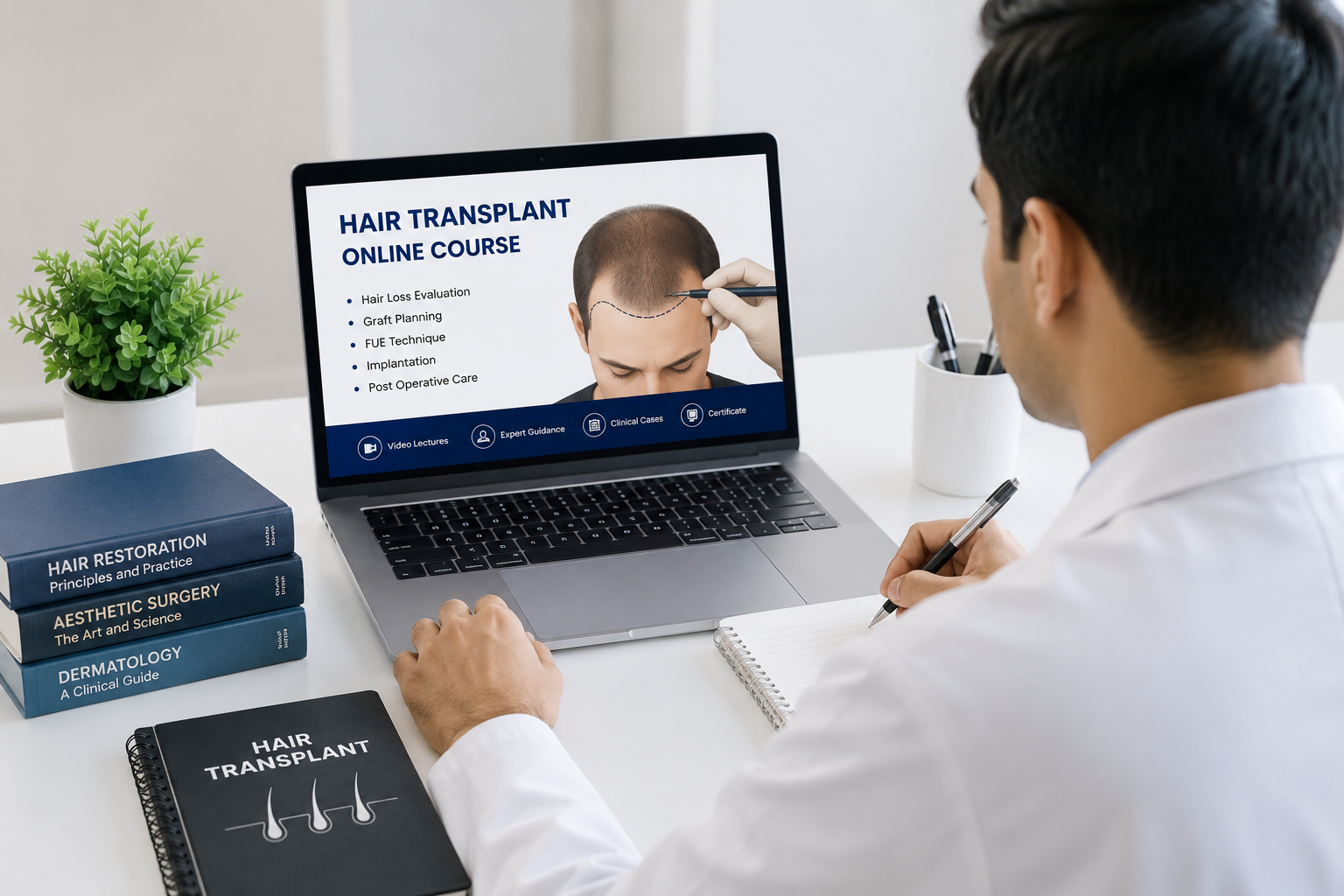
Hair transplantation is a procedure-based field, so doctors often assume that meaningful learning can happen only inside an operating room. Practical training certainly matters, but online education can provide doctors with a structured foundation before they move into supervised clinical exposure. An online hair transplant course India can help doctors and surgeons understand hair-loss assessment, patient selection, hairline planning, graft concepts, hair transplant techniques, safety, and postoperative considerations. The key is understanding what online education can teach effectively and where hands-on training becomes necessary.
Doctors can learn the theoretical and planning aspects of hair transplantation online, but an online course alone should not replace supervised practical training. Online learning can help doctors understand the complete workflow of hair transplantation, including consultation, diagnosis, procedure planning, technique selection, and aftercare. Actual procedural competency requires appropriate practical training, supervision, and experience.
A structured course can help participants understand hair transplantation as a complete clinical process rather than simply focusing on graft extraction and implantation.
Depending on the current course curriculum, learning may cover areas such as:
Doctors should check the current Elegance Vidhyalay curriculum to confirm the exact topics included before enrolling.
Not every person experiencing hair loss automatically needs a hair transplant.
Doctors need to assess the patient’s pattern of hair loss, donor area, age, progression, medical history, previous treatments, expectations, and long-term hair restoration needs.
A technically well-performed procedure may still produce an unsatisfactory long-term result if the treatment plan does not account for future hair loss.
Therefore, good hair transplant education should begin with clinical assessment and planning, not simply surgical technique.
Online education can explain the principles and workflow of commonly used hair transplantation approaches, including FUE and FUT.
Doctors can study differences in donor harvesting, graft handling, treatment planning, indications, advantages, limitations, and patient selection.
However, watching or studying a technique does not automatically create procedural competency.
Doctors who plan to perform hair transplantation should complement theoretical education with appropriate supervised hands-on clinical training.
Hairline design is one of the most important planning elements in hair transplantation.
The goal is not simply to place as many grafts as possible at the front of the scalp. Doctors need to consider facial proportions, existing hair, expected future hair loss, available donor supply, age, and the patient’s individual characteristics.
Online case discussions and planning demonstrations can help doctors develop a better understanding of these principles before applying them in a clinical environment.
The two formats serve different purposes.
| Online Hair Transplant Training | Hands-On Training |
|---|---|
| Builds theoretical foundation | Develops practical familiarity |
| Flexible learning for doctors | Requires physical attendance |
| Explains assessment and planning | Provides supervised clinical exposure |
| Useful for technique demonstrations | Helps understand instruments and workflow |
| Supports case-based learning | Builds procedure-based experience |
For doctors starting in hair restoration, combining structured theoretical education with supervised practical exposure can provide a more complete learning pathway.
The selected online hair transplant course India targets doctors and surgeons interested in developing their knowledge of hair restoration.
It may particularly suit medical professionals who want to begin with structured theoretical learning before committing to practical training or those who cannot immediately travel for regular classroom sessions.
Course enrollment does not itself determine whether someone can independently perform a procedure. Doctors should practise according to their qualifications, competency, professional scope, and applicable regulations.
Elegance Vidhyalay provides an online crash course focused on hair transplantation for doctors and surgeons.
The online format allows medical professionals to learn important hair restoration concepts without requiring continuous physical attendance in Surat.
The learning environment includes guidance from Dr. Ashutosh Shah, Plastic, Cosmetic & Reconstructive Surgeon with more than 22 years of surgical experience.
His extensive surgical and aesthetic experience can help participants understand hair transplantation from a broader clinical perspective, including patient assessment, treatment planning, aesthetic judgment, procedural considerations, safety, and follow-up.
Online training should not be treated as a substitute for appropriate practical experience.
A doctor may understand the steps of graft extraction, preparation, hairline design, and implantation after theoretical education, but performing these steps safely requires practical skill.
Doctors who want to progress from knowledge to procedural practice should look for opportunities for supervised clinical and hands-on training after establishing their theoretical foundation.
This distinction is especially important when comparing online courses that make overly broad claims about becoming an expert after a short training program.
Before enrolling, check the course’s eligibility criteria, curriculum, faculty credentials, learning format, access period, topics covered, case discussions, certification, fees, and opportunities for further practical education.
Also ask whether the course focuses only on procedural steps or teaches the broader decision-making required for responsible hair restoration practice.
An online hair transplant course India can provide doctors and surgeons with a convenient way to develop their theoretical foundation in hair restoration. It can help them understand patient assessment, hairline planning, graft concepts, FUE and FUT principles, safety, clinical decision-making, and aftercare before progressing to practical training.
For doctors considering the online Hair Transplant Crash Course at Elegance Vidhyalay, the next step is to confirm the latest curriculum, eligibility, course duration, fees, online learning structure, certification, and opportunities for practical training directly with the institute.
Yes. Doctors can study hair-loss assessment, treatment planning, hairline design, technique principles, safety, and other theoretical concepts online. Practical competency requires appropriate supervised experience.
The selected course information lists the Hair Transplant Crash Course as an online program for doctors and surgeons.
An online course can teach FUE concepts, planning, indications, and workflow. Doctors should obtain appropriate supervised practical training before independently performing procedure-based techniques.
Doctors beginning their hair restoration education may benefit from structured theoretical learning. Applicants should confirm current eligibility requirements directly with Elegance Vidhyalay.