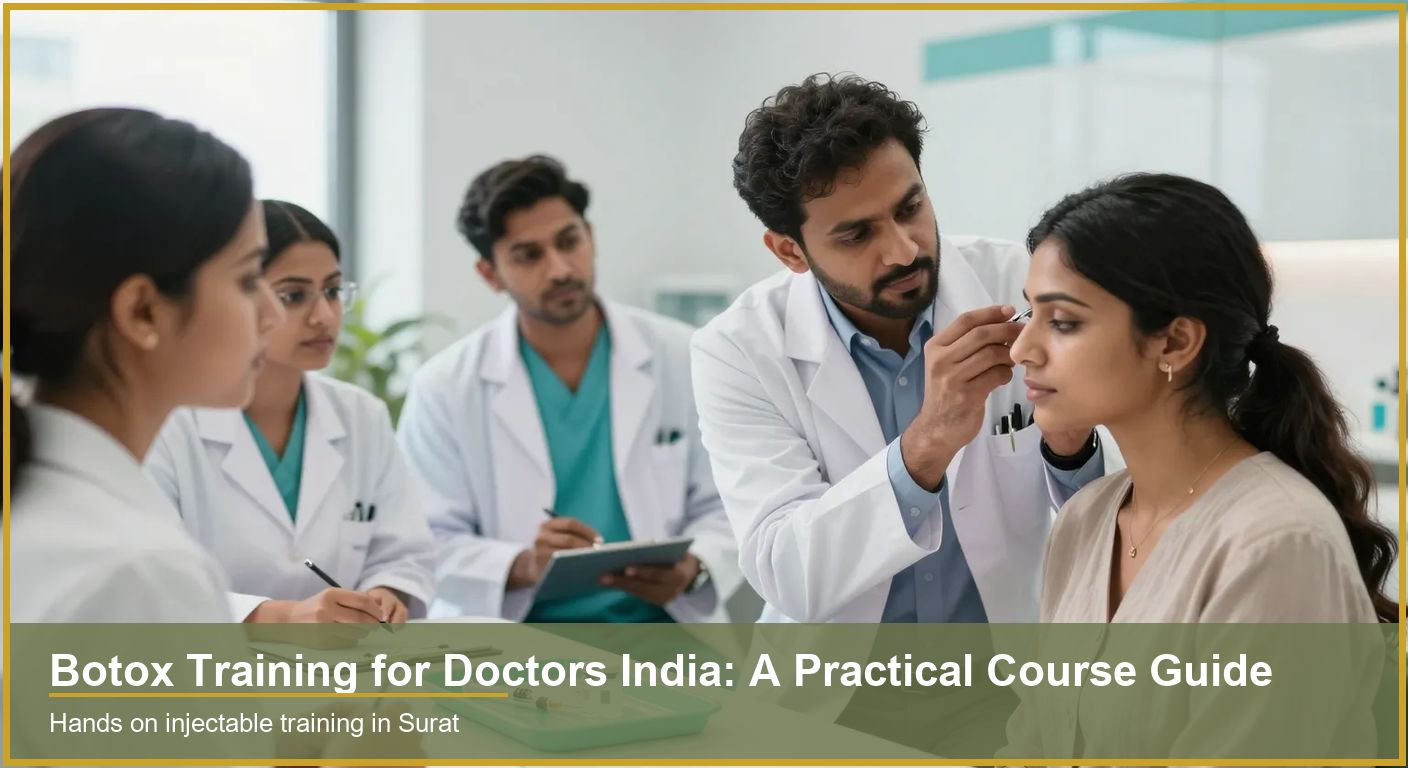
Botox training for doctors India wide is best learned in a short, hands on workshop where you inject real patients under expert supervision. At Elegance Vidhyalay in Surat, we teach facial anatomy, dosing, dilution, injection technique and complication management across a focused program. You practise on live cases rather than mannequins, so you leave with the confidence to treat in your own clinic. Most doctors start seeing patients within weeks of finishing.
We built this course because we kept meeting skilled physicians who were nervous about their first syringe. They had read the literature and watched hours of video, yet nobody had stood beside them while they injected the glabella. That gap between theory and the treatment chair is exactly what a good workshop closes.
A complete program covers facial muscle anatomy, patient assessment, botulinum toxin pharmacology, reconstitution and dilution, unit dosing by area, injection depth and angle, documentation, consent, and complication management. Alongside this, you learn consultation skills and realistic expectation setting. The practical portion should always involve treating live patients under direct faculty observation.
In our workshop we move area by area. Upper face comes first, since the glabella, forehead and crow’s feet are where most doctors begin their practice. After that, we cover the bunny lines, the lip flip, gummy smile correction, masseter reduction for jawline slimming, and hyperhidrosis of the axilla. Each area has its own dosing logic, and we make you write it down rather than memorise it loosely.
Product handling is another practical piece that rarely appears in textbooks. Storage temperature, reconstitution volume, syringe choice and needle gauge all influence how smoothly your session runs. Small habits here separate a calm clinic from a stressful one.
Any registered medical practitioner can train in aesthetic injectables. MBBS doctors, MD and DVD dermatologists, plastic surgeons, gynecologists, dentists with facial scope and general practitioners all join our batches. There is no requirement for prior aesthetic experience. What matters is a valid medical registration and a genuine willingness to practise carefully on live cases.
Doctors typically come to us from three directions:
Since backgrounds differ, we keep batches small. That way a first time injector and an experienced dermatologist both get attention suited to their level. If you are exploring the wider aesthetic field, our crash courses and workshops page shows how the short programs fit together.
Injecting a real face teaches what no video can. You feel tissue resistance, see muscle movement before and after, and learn to adjust when anatomy differs from the textbook. Live practice also builds the calm that patients notice immediately. Doctors who train only on models often hesitate on their first real case, and hesitation shows.
Our sessions run inside a working clinic, so you also observe the parts nobody films. You see how consent is taken, how photographs are standardised, how a nervous patient is reassured, and how a follow up review at two weeks is documented. These operational details decide whether your aesthetic practice grows or stalls.
Faculty supervision is the other half of it. Every injection you give is watched, corrected in the moment, and discussed afterwards. Our comprehensive botox, fillers and anti aging workshop is built around this format, because feedback delayed until the end of the day is feedback wasted.
You need working knowledge of the facial mimetic muscles, their origins, insertions and actions, plus the course of the facial artery, the angular artery and the supratrochlear vessels. Understanding depth planes matters equally. Most poor outcomes, including brow ptosis and asymmetric smiles, trace back to a needle placed in the wrong plane rather than the wrong dose.
We teach anatomy on the face itself, using surface marking and palpation. Trainees mark the frontalis, corrugator, procerus, orbicularis oculi and masseter on each other before touching a syringe. This exercise takes time, and it is the part doctors thank us for months later.
Anatomy knowledge also protects you commercially. When you can explain to a patient exactly why you are placing four units here and two there, your consultation converts far better than a price list ever will.
Complication management is taught as a core module, not a footnote. You learn to recognise eyelid ptosis, brow asymmetry, bruising, headache and, rarely, vascular compromise when fillers are involved. For each, we cover prevention, early recognition and the exact steps to take. Every trainee also builds an emergency protocol sheet for their own clinic.
Practical safeguards we insist on include aspiration habits where relevant, slow injection, small aliquots, good lighting and proper patient positioning. Additionally, we teach how to document a baseline so that a pre existing asymmetry is never mistaken for your result.
Honest counselling is a safety tool too. Doctors who explain the onset time, the duration of three to four months, and the possibility of a touch up at two weeks face far fewer unhappy conversations later.
Training is the start rather than the finish. Most doctors need a handful of supervised style cases before injecting feels routine, so we encourage trainees to stay in touch and send case photographs for review. Beyond that, adding complementary skills makes the practice sustainable, since one procedure alone rarely fills a clinic calendar.
Many of our alumni pair injectables with skin and laser work. For that route, our cosmetic dermatology fellowship offers a longer, structured pathway. Doctors aiming for a surgical career instead move towards a cosmetic surgery fellowship, which builds on the same anatomical foundation.
All of our training runs under the direct observation of Dr. Ashutosh Shah, who brings over 22 years of surgical experience in Cosmetic Plastic Surgery, Hair Transplant Surgery and Reconstructive Procedures. You can read more about his background and teaching approach on the Dr. Ashutosh Shah profile page.
Yes. Any doctor with a valid medical registration can enrol, including MBBS graduates with no prior aesthetic experience. The syllabus starts from facial anatomy and builds up to live injection, so beginners are not left behind in a batch.
Focused workshops run over a short, intensive schedule of a few days. That is enough to cover anatomy, dosing and supervised live practice. Doctors wanting broader aesthetic skills usually follow up with a longer fellowship rather than repeating short courses.
Yes, live patient injection under faculty supervision is central to the program. Demonstrations alone do not build confidence. Every trainee injects, receives immediate correction, and discusses the case afterwards with the observing faculty member.
Trainees receive a course completion certificate from Elegance Vidhyalay. However, we tell doctors plainly that the certificate matters far less than the supervised cases behind it. Skill, not paperwork, is what your patients will judge.
A clean treatment room, good lighting, a reclining chair, cold storage for the product, fine gauge needles, sterile supplies and an emergency kit cover the basics. Photography with consistent lighting is strongly recommended for documenting before and after results.
Yes, and we recommend it. Most aesthetic concerns need both a muscle relaxant and volume correction. Our comprehensive workshop teaches botox, fillers and anti aging protocols together, so you learn to plan a full face rather than isolated areas.
Many doctors begin within a few weeks of finishing, starting with straightforward upper face cases. Building gradually is wiser than taking on complex requests immediately. Confidence grows quickly once your first several cases heal well and patients return.
All programs run at Elegance Vidhyalay in Surat, Gujarat, inside a working cosmetic practice. Doctors travel from across India for our batches. Seats are limited to keep supervision close, so confirming batch dates early is advisable.
If you have been putting off your first injectable case, structured training is the fastest way past that hesitation. Tell us your specialty and how you plan to use the skill, and we will recommend the right batch for you. Send an enquiry through the Elegance Vidhyalay contact page and our team will share upcoming dates.
Elegance Vidhyalay is a medical education and professional training institute in Surat, founded by Dr. Ashutosh Shah under Elegance Clinic. We offer fellowships, crash courses, certified cosmetic courses and paramedical courses across cosmetic and reconstructive medicine. Our paramedical programs run in collaboration with Vidhyadeep University. Training is hands on, uses the latest equipment, and gives every trainee live patient exposure under Dr. Shah’s direct observation.