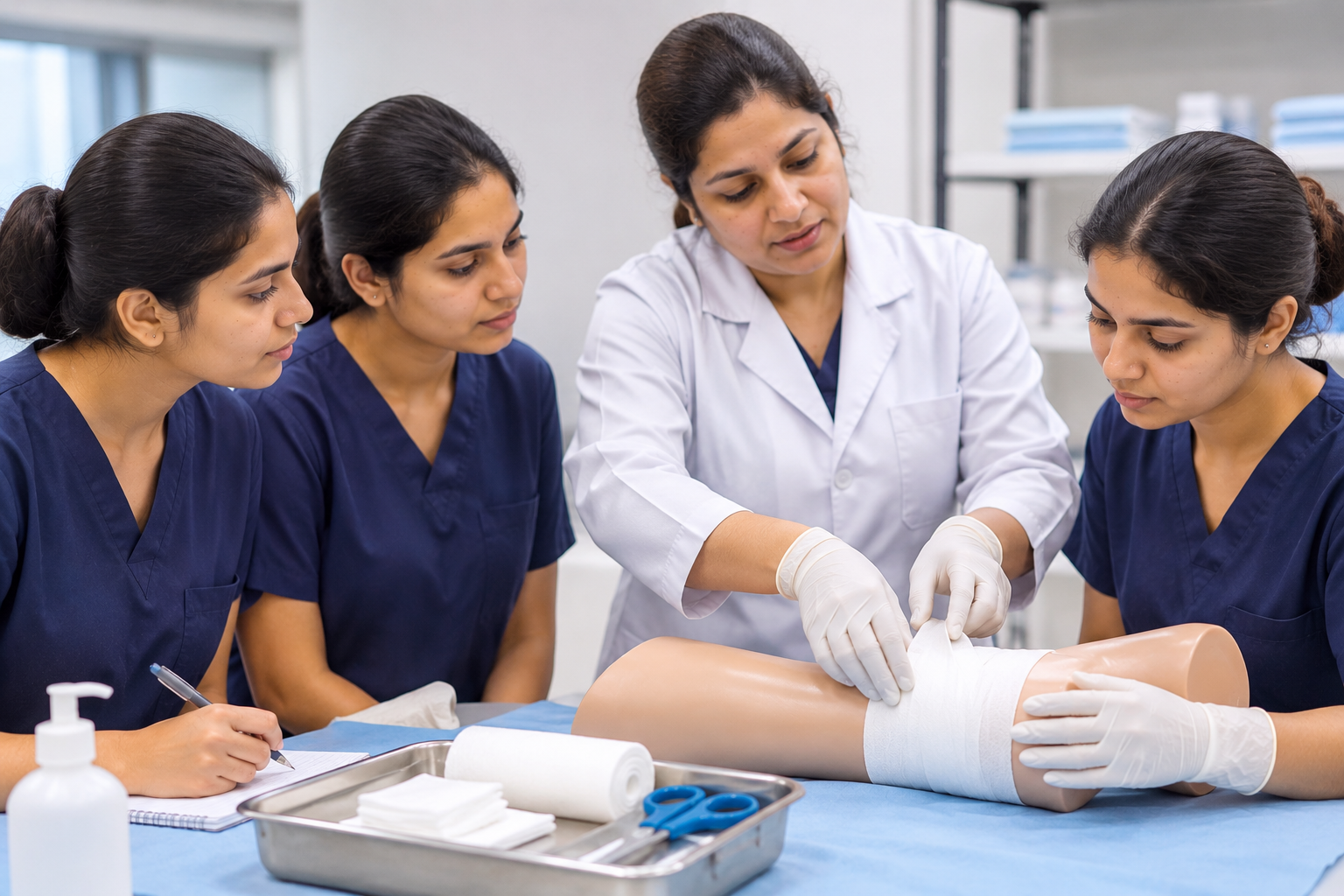
The wound care nursing course syllabus combines core theory with supervised practical skills. Students should look for clear learning outcomes, opportunities to practise on simulation models or under appropriate clinical supervision, and assessments that evaluate both knowledge and practical competence before completing the programme.
Wound care is an important part of nursing practice, particularly for patients with surgical wounds, pressure injuries, diabetic foot ulcers and other conditions requiring regular monitoring.
A structured training programme can help nursing professionals strengthen their understanding of wound healing, dressing principles, infection prevention and patient education.
At Elegance Vidhyalay, prospective students can enquire about available wound care education programmes, practical learning arrangements and admission requirements.
The theoretical component of wound care education helps students understand how wounds develop, why healing may be delayed and how nursing care supports recovery.
The exact subjects depend on the approved course curriculum.
Students may study the basic structure of the skin, including the epidermis, dermis and underlying tissues.
Understanding skin anatomy helps nursing professionals recognise tissue damage and appreciate the importance of protecting surrounding skin.
Common topics may include:
Students should understand that different wound types require different assessment and management approaches.
The course may introduce the major phases of healing, including haemostasis, inflammation, proliferation and remodelling.
Students may also examine factors that delay healing, such as infection, inadequate blood supply, pressure and poor nutritional status.
Wound assessment is an important nursing responsibility within the appropriate clinical setting.
Teaching may cover wound location, size, tissue appearance, drainage, surrounding skin and warning signs requiring medical review.
Accurate records support continuity of care.
For related information, explore documentation and photography protocol for wound cases.
Theoretical education should introduce infection-control principles, including hand hygiene, personal protective equipment, environmental cleanliness and safe disposal of used dressing materials.
Students should also understand when suspected infection requires urgent clinical attention.
Confirmed theory modules: [Course coordinator to provide the approved list.]
Practical learning helps students apply classroom concepts in a supervised environment.
However, the activities offered depend on the programme, the student’s qualifications and the availability of appropriate training facilities.
Students may practise preparing a clean workspace, arranging dressing supplies and following appropriate hygiene procedures.
Simulation exercises can help reinforce correct sequencing and safe handling of materials.
Bandaging practice may introduce methods for securing dressings and protecting affected areas.
Students should understand that compression and specialised bandaging require appropriate assessment, training and clinical authorisation.
Practical exercises may involve recording observations from simulation cases.
Students can practise identifying relevant information and communicating findings to the supervising clinician.
Training may include demonstrations of hand hygiene, glove use, personal protective equipment and disposal procedures.
These skills are essential for reducing avoidable contamination.
Students may practise explaining prescribed dressing schedules, hygiene precautions and follow-up instructions.
They should also recognise when patient concerns require referral to a qualified clinician.
The following is an illustrative educational framework, not a confirmed institute syllabus.
| Module | Theory | Practical | |
|---|---|---|---|
| 1. Wound fundamentals | Skin anatomy and wound healing | Simulation-based observation | |
| 2. Wound assessment | Wound types and warning signs | Documentation exercises | |
| 3. Infection prevention | Hygiene and aseptic principles | PPE and hand hygiene | |
| 4. Dressing principles | Dressing materials and selection | Bandaging on models | |
| 5. Patient education | Follow-up and referral | Communication exercises | |
| 6. Final evaluation | Theory revision | Supervised skills review |
Important: [Course coordinator to replace the illustrative modules with the approved curriculum, practical hours and assessment details.]
For additional information about teaching dressing skills, read teaching your nursing staff dressing technique a six session in clinic curriculum.
Students exploring a wound care nursing course in piplod surat should confirm how practical training is organised and supervised.
Hands-on experience is valuable, but safe clinical education requires appropriate teaching methods, qualified supervision and clear professional boundaries.
Simulation models allow students to practise basic techniques without exposing patients to unnecessary risks.
Depending on the approved programme, models may be used for dressing preparation, bandaging and wound assessment exercises.
A qualified instructor may demonstrate appropriate clinical procedures and explain the reasoning behind each step.
Students can observe techniques, ask questions and receive feedback.
Where patient-based practical training is included, it should occur only with appropriate consent, clinical oversight and institutional approval.
Students must work within the responsibilities permitted by their qualifications and professional registration.
Supervision helps students recognise errors, understand infection-control requirements and develop safe working habits.
It also reinforces the importance of asking for assistance when a task exceeds their competence.
Practical attendance alone does not establish independent proficiency.
Assessment helps determine whether participants understand the course material and can demonstrate relevant skills.
The exact evaluation process depends on the institute’s approved training structure.
A written examination may assess knowledge of anatomy, wound healing, infection prevention, dressing principles and patient safety.
A practical evaluation may involve demonstrating hand hygiene, dressing preparation, bandaging or documentation using simulation models.
Assessments should be appropriate to the student’s qualification and course objectives.
Some programmes require students to attend a minimum number of classroom and practical sessions.
Students should verify the exact certificate name, issuing organisation and requirements for successful completion.
A short course certificate does not replace recognised nursing qualifications, professional registration or additional competency requirements.
Students may receive notes, presentations or other educational resources depending on the programme.
Before enrolling, applicants should request a written description of the teaching and assessment arrangements.
Completing wound care training may help eligible nursing professionals strengthen their knowledge and pursue further supervised skill development.
However, employment opportunities and clinical responsibilities depend on recognised qualifications, professional registration and demonstrated competence.
Participants may develop a better understanding of wound observation, documentation and warning signs requiring medical attention.
These skills can support nursing practice within established clinical protocols.
Supervised training may help students become more familiar with dressing preparation, hygiene and bandaging principles.
However, independent performance of specialised procedures requires appropriate authorisation and competence.
Nursing professionals can help patients understand prescribed wound care routines, follow-up appointments and precautions.
They should follow the treating clinician’s instructions and avoid making treatment decisions outside their scope.
Wound care involves appropriate recordkeeping, patient communication and informed consent.
Students interested in these responsibilities can read consent and billing for wound procedures in private practice.
Participants may explore additional recognised education in wound management, diabetic foot care or related nursing specialties.
Further clinical supervision may be necessary before undertaking advanced responsibilities.
Elegance Vidhyalay provides information about training opportunities in medical, paramedical and aesthetic education.
Dr. Ashutosh Shah, a Plastic, Reconstructive and Cosmetic Surgeon, is associated with the institute.
Prospective students should verify the faculty assigned to the wound care nursing programme, the approved curriculum and the available practical training facilities.
The National Skill Development Corporation (NSDC) provides general information about vocational education and skills development.
For nursing-specific professional standards, students should also consult the applicable nursing council and regulatory requirements.
The NSDC reference does not establish accreditation or affiliation for the course.
Skin anatomy and physiology are relevant subjects in wound care education because they help students understand tissue damage and healing. However, inclusion in the approved syllabus must be confirmed. Applicants should request the official module list and check whether anatomy is taught through lectures, diagrams or practical demonstrations.
Infection prevention is an important part of safe wound care practice. Students considering a wound care nursing course in piplod surat should confirm whether the syllabus includes hand hygiene, personal protective equipment, aseptic principles and safe waste disposal. The institute should also clarify how these skills are demonstrated and assessed.
Simulation models help students practise dressing preparation, bandaging and wound observation without involving patients. However, the course coordinator must confirm the exact practical arrangements. Applicants should ask whether the course includes model-based practice, how many hours instructors dedicate to supervised training and how instructors evaluate student performance.
The final assessment format depends on the approved programme. Some courses may include written tests, practical demonstrations or both. Students should request details about examination topics, passing requirements, reassessment opportunities and whether successful completion of all assessments is necessary to receive the course certificate.
Study materials may include lecture notes, presentations, practical checklists or recommended reading resources, depending on the programme. The course coordinator must confirm their availability. Before admission, students should ask whether the course fees cover these materials, whether instructors share them digitally or whether students receive them separately during classroom sessions.
The wound care nursing course syllabus should combine relevant theoretical knowledge with appropriate supervised practical learning.
Important subjects may include skin anatomy, wound healing, assessment, dressing principles, infection prevention and patient education.
Before enrolling, students should verify the approved modules, practical training hours, assessment format, instructor qualifications and certificate details.
For updated course information, eligibility requirements and admission guidance, contact Elegance Vidhyalay.
Request the approved syllabus and written confirmation of all course details before admission.