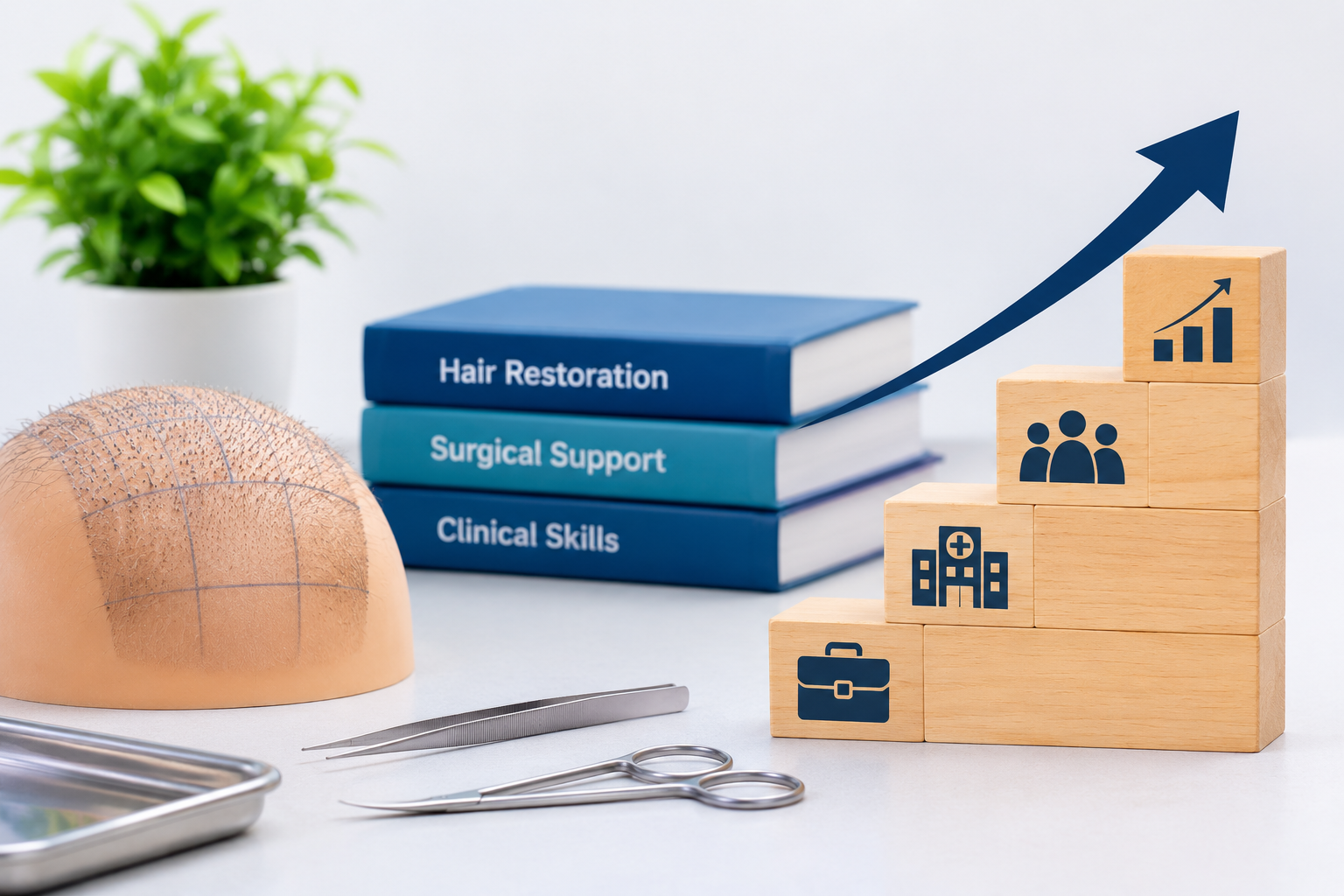
Completing a hair transplant technician course can open opportunities for individuals interested in working in the hair restoration and healthcare support industry. However, many students have an important question before enrolling: what jobs after hair transplant technician course can they actually pursue after completing the training?
Hair transplant technicians support medical professionals during hair restoration procedures. Their responsibilities may include preparing the operating room, arranging instruments, maintaining hygiene and assisting the clinical team with permitted technical tasks.
The career opportunities after completing the course depend on several factors, including the candidate’s educational background, practical skills, training experience and employer requirements. Graduates may explore opportunities in hair transplant clinics, hospitals, operating theatres and aesthetic centres.
At Elegance Vidhyalay, students can explore specialised hair transplant technician training under the guidance of experienced medical professionals. Dr. Ashutosh Shah, Director of Elegance Clinic, is a qualified plastic, reconstructive and cosmetic surgeon with more than 22 years of experience. His professional experience in plastic surgery and hair restoration provides valuable clinical context for understanding this specialised field.
| Career factor | Details |
|---|---|
| Main field | Hair restoration and clinical support |
| Possible job roles | Hair transplant OT technician, clinical assistant, operating room support staff |
| Work settings | Hair transplant clinics, hospitals and aesthetic centres |
| Important skills | Instrument handling, hygiene, teamwork and procedural knowledge |
| Starting salary | Depends on skills, qualifications and employer |
| Career growth | Experience, additional training and specialised skills |
| Placement support | [Admissions team to confirm] |
Hair transplant procedures involve a team of trained professionals. Technicians support this team by performing assigned technical and operational responsibilities under appropriate medical supervision.
The following are possible career paths, depending on the candidate’s qualifications and the employer’s requirements.
A hair transplant OT technician supports the medical team during hair restoration procedures.
Typical responsibilities may include:
Preparing the operating room.
Arranging instruments and equipment.
Maintaining hygiene and cleanliness.
Following sterilisation and infection prevention protocols.
Supporting the clinical team during assigned tasks.
Maintaining an organised working environment.
This role requires attention to detail, discipline and an understanding of operating room procedures.
Clinical assistants support the day-to-day activities of hair restoration facilities.
Their responsibilities may include preparing the treatment area, organising supplies, supporting patient preparation protocols and coordinating with the medical team.
Good communication and organisational skills are important for this position.
Candidates with the required qualifications and additional training may explore operating theatre support positions.
These professionals help maintain the clinical environment, prepare equipment and follow established safety procedures.
Employers may require recognised qualifications or additional operating theatre training, so a hair transplant technician certificate alone may not meet every vacancy’s requirements.
Some employers recruit technicians to support specific stages of hair restoration procedures.
Depending on their training and permitted responsibilities, these technicians may assist with equipment preparation, instrument organisation and procedural workflow.
They must follow the instructions of qualified medical professionals and must not independently perform surgical duties.
Another possible direction is supporting the preparation, organisation and maintenance of clinical instruments and equipment.
This role suits individuals who are careful with equipment handling and understand hygiene, storage and workplace safety requirements.
After completing suitable training, candidates can explore opportunities in different healthcare and hair restoration settings.
Common workplaces include:
Hair transplant clinics: Supporting doctors and clinical teams during hair restoration procedures.
Hospitals: Applying relevant operating theatre support skills where qualifications meet employer requirements.
Aesthetic centres: Assisting with permitted clinical support activities related to hair restoration services.
Specialised surgical facilities: Supporting equipment preparation, hygiene and operating room organisation.
The actual responsibilities vary between employers. Candidates should check job descriptions carefully before applying.
| Job role | Work setting | Important skills | Possible next step |
|---|---|---|---|
| Hair transplant OT technician | Hair restoration clinic | Instrument handling, hygiene | Advanced technical training |
| Clinical assistant | Clinical facility | Communication, organisation | Additional clinical skills |
| OT support staff | Hospital or surgical facility | Safety, equipment preparation | Recognised OT qualifications |
| Procedure support technician | Hair restoration facility | Teamwork, procedural knowledge | More supervised experience |
| Equipment support staff | Clinical facility | Equipment care, cleanliness | Specialised equipment training |
This career map shows possible directions rather than guaranteed job placements. Eligibility depends on the employer and the candidate’s qualifications.
The hair transplant technician course salary depends on several factors. There is no single starting salary that applies to every graduate.
Employers generally consider the following:
Candidates who demonstrate good instrument handling, operating room preparation and hygiene practices may have an advantage during recruitment.
An applicant’s previous education and relevant healthcare qualifications can influence the positions available to them.
A specialised hair restoration facility may have different salary structures from a general healthcare employer. Responsibilities, working hours and experience requirements also affect compensation.
Salary levels vary according to the employer, local recruitment market and availability of suitable candidates.
Communication, teamwork, equipment knowledge and the ability to follow clinical protocols can improve a candidate’s professional value.
What should students expect?
Instead of relying on an advertised average salary, ask the admissions team whether it has verified information about recent placements, starting salary ranges and employer requirements.
[Admissions team to add placement support details and verified salary information, if available.]
Completing a course is only one part of preparing for employment. Candidates must also demonstrate that they can perform their assigned responsibilities carefully.
Important skills include:
Instrument handling: Understanding common instruments and following correct handling procedures.
Infection prevention: Maintaining hygiene and following established sterilisation and safety protocols.
Operating room preparation: Organising equipment and preparing the clinical environment.
Team coordination: Communicating clearly and following instructions from qualified medical professionals.
Attention to detail: Checking equipment, maintaining organisation and avoiding careless mistakes.
Professional behaviour: Respecting patient privacy, maintaining discipline and following workplace policies.
Students should focus on developing these skills during practical training rather than relying only on their course certificate.
Students exploring professional training should evaluate the programme carefully before making an admission decision.
A good training programme should explain its syllabus, practical sessions, trainer qualifications, assessment process and certificate details.
Elegance Vidhyalay offers a specialised hair transplant technician training programme with classroom teaching and supervised practical learning.
Before enrolling, prospective students should ask:
How much time is allocated to practical training?
What instruments and equipment will students learn about?
Are demonstrations included?
Who supervises practical sessions?
What certificate is awarded after completion?
Does the institute provide placement assistance?
Are employment opportunities discussed during training?
Students can also explore the Hair Transplant OT Technician Course in India to understand the training programme in greater detail.
The hair transplant workshop gallery can also help prospective students understand the learning environment and practical training activities.
Career development requires continuous learning and practical experience.
After gaining relevant experience, technicians may consider:
Advanced technical training: Develop a deeper understanding of hair restoration equipment and procedural workflows.
Additional healthcare qualifications: Pursue recognised qualifications that support broader clinical career opportunities.
Specialised workshops: Attend relevant workshops to improve technical knowledge.
Professional experience: Learn from experienced medical teams and follow established clinical protocols.
Further professional education: Explore advanced educational opportunities where eligibility requirements are met.
Students interested in advanced learning can explore the Hair Transplant Fellowship Programme. Fellowship eligibility and scope should be checked separately.
Completing a hair transplant technician course does not qualify someone to diagnose patients, prescribe treatment or perform surgery independently. The jobs after hair transplant technician course are generally limited to permitted technical and clinical support responsibilities.
Technicians must work within their training, qualifications and permitted duties under appropriate medical supervision.
To build a long-term career in this field, focus on developing technical competence, professional discipline and a clear understanding of your responsibilities within the medical team.
Placement support depends on the institute’s current arrangements. Students should ask Elegance Vidhyalay whether it provides job assistance, employer introductions, interview guidance or placement support. Confirm the details before admission.
Yes, you can explore employment opportunities in other states, subject to the employer’s qualification requirements, relevant regulations and acceptance of your training certificate.
International employment may be possible, but requirements vary between countries. Employers may ask for additional qualifications, recognised certifications, work experience and language proficiency. Check the relevant country’s healthcare employment requirements before applying.
Practical competence is important. Good instrument handling, infection prevention, operating room preparation, teamwork and knowledge of clinical protocols can improve your employability. Salary growth also depends on experience and employer requirements.
A technician cannot independently establish or operate a surgical practice as a hair transplant surgeon based on technician training alone. Hair transplant surgery must be performed by appropriately qualified medical professionals. Technicians can explore permitted support or business-related roles within applicable regulations.
Students considering a hair transplant technician course in bharuch can explore training opportunities at Elegance Vidhyalay. After suitable training, they may pursue relevant technical support positions, depending on their qualifications, practical skills and employer requirements.
A hair transplant technician course can provide a starting point for individuals interested in the hair restoration industry. The jobs after hair transplant technician course may include roles such as hair transplant OT technician, clinical assistant and other permitted healthcare support positions.
However, employment opportunities depend on more than completing a course. Practical knowledge, instrument handling, hygiene, communication and professional experience all contribute to career development.
If you are considering this career, explore the course structure, practical training, certification and placement support before enrolling.
For admission details and programme information, contact Elegance Vidhyalay.