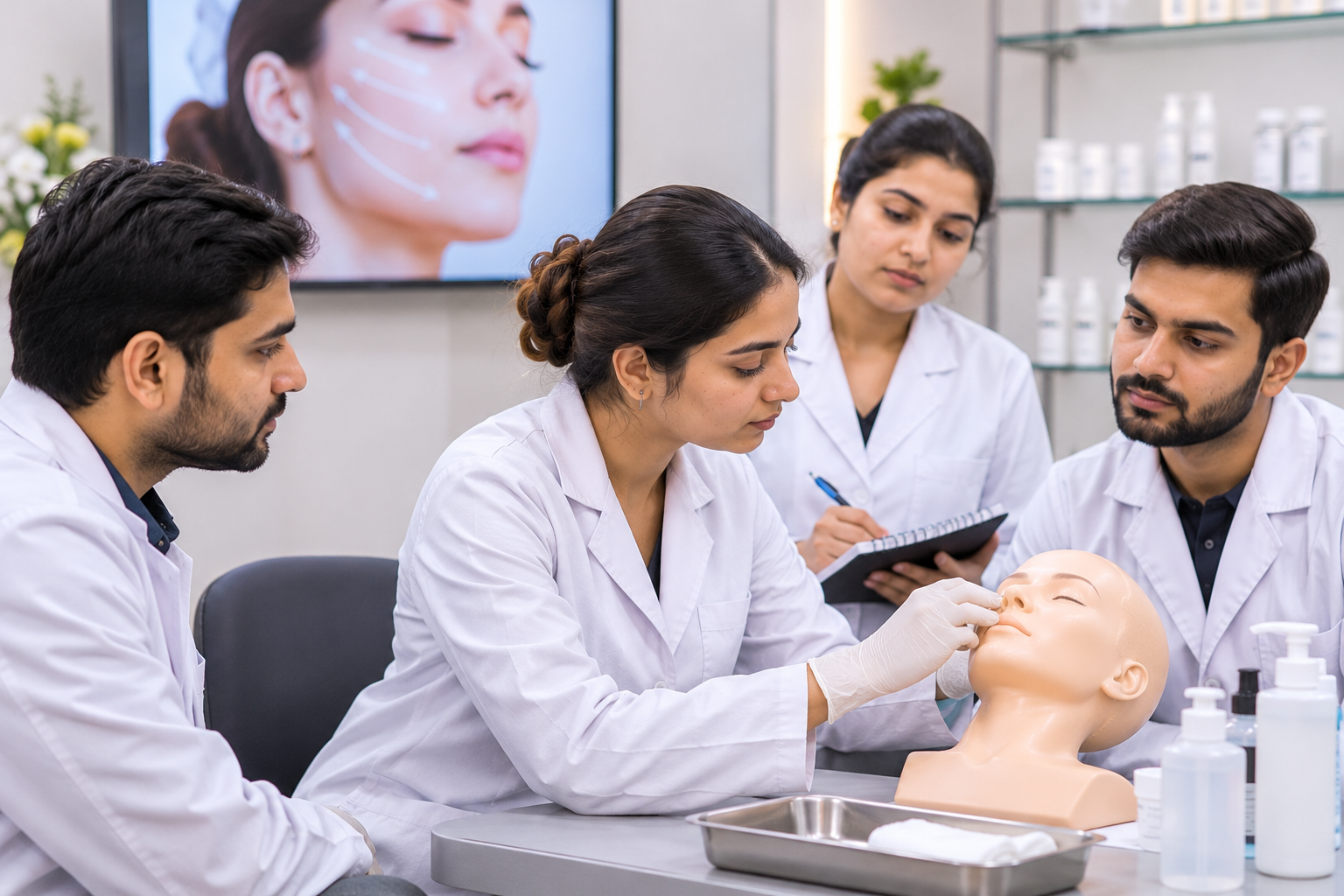
Doctors from aesthetic medicine course for doctors near adajan surat can explore aesthetic medicine training in Surat through classroom teaching and supervised hands-on practice. Before enrolling, compare eligibility requirements, practical training hours, certification details, batch timings, and travel arrangements to choose a programme that supports your professional goals.
Aesthetic medicine is a specialised field involving cosmetic treatments, skin assessment, patient consultation and procedure-related safety. For qualified doctors interested in developing additional aesthetic skills, structured education can provide a foundation for further supervised clinical training.
At Elegance Vidhyalay, doctors can enquire about available aesthetic medicine training programmes, practical learning opportunities and admission requirements.
An aesthetic medicine course generally combines theoretical knowledge with practical demonstrations and supervised clinical skills training.
However, the exact curriculum varies according to the course level, duration, and professional eligibility requirements.
Understanding facial anatomy is important before performing aesthetic procedures.
Training may cover facial structures, skin types, common aesthetic concerns, and the principles of patient assessment.
Doctors may also study how individual anatomy influences treatment planning.
Aesthetic medicine involves more than performing cosmetic procedures.
Doctors must understand patient expectations, medical history, contraindications and informed consent.
Training may include consultation methods, patient selection and realistic treatment planning.
Depending on the programme, teaching may introduce topics such as:
Important: The inclusion of a procedure in a course curriculum does not automatically authorise every participant to perform it independently. Doctors must follow applicable professional regulations, competency requirements and scope-of-practice rules.
Recognising complications is an essential part of medical aesthetic education.
Training should address infection prevention, contraindications, adverse reactions, emergency preparedness and appropriate referral.
Hands-on sessions may help eligible doctors understand clinical equipment, treatment preparation and safe procedural techniques.
Students should confirm whether the programme includes demonstrations, simulation-based training or supervised practice with appropriately consenting patients.
Aesthetic medicine courses for doctors generally require a recognised medical qualification.
However, the exact eligibility criteria depend on the procedures taught and the institute’s admission policy.
Some aesthetic medicine programmes are designed for MBBS-qualified doctors interested in developing additional knowledge of cosmetic and aesthetic treatments.
Applicants should verify whether their medical qualification and registration meet the requirements of the selected programme.
For related information, explore the aesthetic medicine course for MBBS doctors.
Qualified specialists may pursue additional aesthetic education relevant to their professional practice.
The appropriate training depends on their existing qualifications, experience and clinical responsibilities.
Doctors seeking additional professional training may also enquire about suitable programmes.
However, course admission and the ability to perform specific procedures depend on professional registration, competency, and applicable rules.
Before applying, confirm:
Course duration is one of the most important considerations for working doctors.
Aesthetic medicine training programmes may differ in their classroom hours, practical sessions, assessment requirements and overall schedule.
Some programmes focus on introductory theoretical knowledge, while others include extended supervised training.
Practical exposure helps doctors connect theoretical knowledge with clinical decision-making.
For example, supervised training may involve patient assessment, procedural preparation, equipment familiarisation and discussion of treatment safety.
However, students should distinguish between watching demonstrations, practising on simulation models and performing supervised procedures.
These activities provide different levels of practical experience.
Weekend batches can be useful for doctors managing hospital duties or private practice.
However, availability depends on the institute’s current teaching schedule.
Before enrolling, ask whether weekend participants receive the same curriculum, practical hours and assessment opportunities as regular-batch students.
The cost of an aesthetic medicine course depends on its curriculum, duration, faculty, equipment and practical training arrangements.
A programme involving specialised devices and supervised clinical sessions may have different expenses from a theory-focused course.
Depending on the programme, course fees may cover:
However, these items should not be assumed to be included without written confirmation.
Students should ask whether the following require separate payment:
Request a written fee breakdown before making any payment.
Doctors exploring an aesthetic medicine course for doctors near Adajan, Surat should consider training schedules, commuting requirements and practical attendance before enrolling.
For some participants, travelling to scheduled sessions may be manageable. Others may prefer temporary accommodation during intensive practical training.
Before admission, confirm the institute’s exact training location and class timings.
Also ask whether practical sessions take place at the same location as classroom teaching.
If training involves multiple sessions, calculate the time required for travel and attendance.
Doctors attending consecutive training days may consider nearby hotels, hostels or paying-guest accommodation.
However, accommodation assistance should not be assumed.
A batch should fit both professional responsibilities and training requirements.
Doctors should consider whether they can attend all mandatory practical sessions, assessments and supervised activities.
Missing important clinical training may affect course completion requirements.
A pre-admission visit may help prospective participants understand the learning environment.
During the visit, ask about faculty qualifications, training equipment, student supervision and course documentation.
After completing an aesthetic medicine programme, doctors may use their training to strengthen knowledge and pursue further supervised skill development.
However, completing a short course does not automatically establish specialist qualifications or guarantee independent procedural competence.
Doctors may improve their understanding of aesthetic consultations, treatment planning and patient safety.
This knowledge can support appropriate clinical decision-making within their professional scope.
Some participants may require additional practical experience, mentoring or recognised qualifications before undertaking particular procedures.
Continuing education is especially important when using specialised equipment or performing higher-risk treatments.
Aesthetic medicine involves careful discussion of treatment goals, expected outcomes, risks and alternatives.
Training may help doctors communicate these considerations more effectively.
Depending on qualifications and experience, doctors may explore roles involving aesthetic consultations, appropriately authorised clinical services or further specialist training.
Employment and practice opportunities depend on regulatory requirements and demonstrated competence.
Digital tools are increasingly used for documentation, education and clinical workflow support.
Doctors interested in this subject can read how AI helps doctors to explore potential applications and limitations.
Clinical decisions must remain under appropriate professional supervision and responsibility.
Elegance Vidhyalay offers education-related information and training opportunities in medical, paramedical and aesthetic fields.
Dr. Ashutosh Shah, a Plastic, Reconstructive and Cosmetic Surgeon, is associated with the institute.
Prospective participants should verify the faculty assigned to their chosen programme, rather than assuming that a particular doctor personally teaches every session.
Before enrolling, request information about:
You can also explore the institute’s doctors page for information about its listed medical professionals.
Doctors should verify whether a qualification has any formal recognition relevant to their intended purpose.
For general information about skills education and training systems, the National Skill Development Corporation (NSDC) provides useful background resources.
However, NSDC is not a substitute for checking medical education recognition or professional licensing requirements. This reference does not establish NSDC affiliation or accreditation for the course.
Prospective participants can use the following admission checklist:
| Step | What to Do | What to Verify |
|---|---|---|
| 1. Course enquiry | Request programme details | Current availability |
| 2. Eligibility check | Submit qualifications | Accepted degrees and registration |
| 3. Curriculum review | Examine the syllabus | Theory and practical content |
| 4. Schedule planning | Review batch timings | Attendance requirements |
| 5. Fee confirmation | Request a written quotation | Total fees and extra charges |
| 6. Admission | Complete the required process | Payment receipt and confirmation |
| 7. Training | Attend scheduled sessions | Assessments and completion criteria |
For course enquiries, visit the Elegance Vidhyalay contact us page.
Weekend batch availability depends on the current training schedule. Doctors should contact Elegance Vidhyalay to confirm upcoming dates, class timings and mandatory practical attendance. It is also important to check whether weekend batches provide the same curriculum, supervised practical hours and assessment opportunities as other available batches.
Accommodation support has not been confirmed. Doctors considering an aesthetic medicine course for doctors near adajan surat should ask the admissions team whether hostel or PG guidance is provided. They should also verify the training venue, travel requirements, accommodation costs and class schedule before making any bookings.
The number of practical hours depends on the selected programme. Elegance Vidhyalay’s confirmed practical training duration is [Admissions team to add hours]. Applicants should request a breakdown of demonstrations, simulation activities and supervised clinical practice, along with information about faculty supervision and required attendance.
Prospective participants can request a pre-admission visit, subject to the institute’s availability and permission. Before travelling, contact the admissions team to arrange an appointment. During the visit, ask about the syllabus, faculty, practical facilities, certification and any restrictions on observing ongoing training sessions.
Doctors should contact Elegance Vidhyalay to verify application deadlines, available seats, eligibility requirements and the complete training schedule. They should avoid making travel or accommodation commitments until the institute confirms their admission and batch details.
Choosing an aesthetic medicine course requires more than comparing fees or course duration.
Qualified doctors should evaluate eligibility, faculty experience, supervised practical hours, certification, patient safety education and the professional relevance of the programme.
Working doctors should also consider class timings, travel arrangements and attendance requirements before committing to a batch.
Elegance Vidhyalay can provide information about its available aesthetic medicine training options and admission process.
For updated course fees, eligibility requirements and batch availability, contact Elegance Vidhyalay.
Request written confirmation of the course details before enrolling.