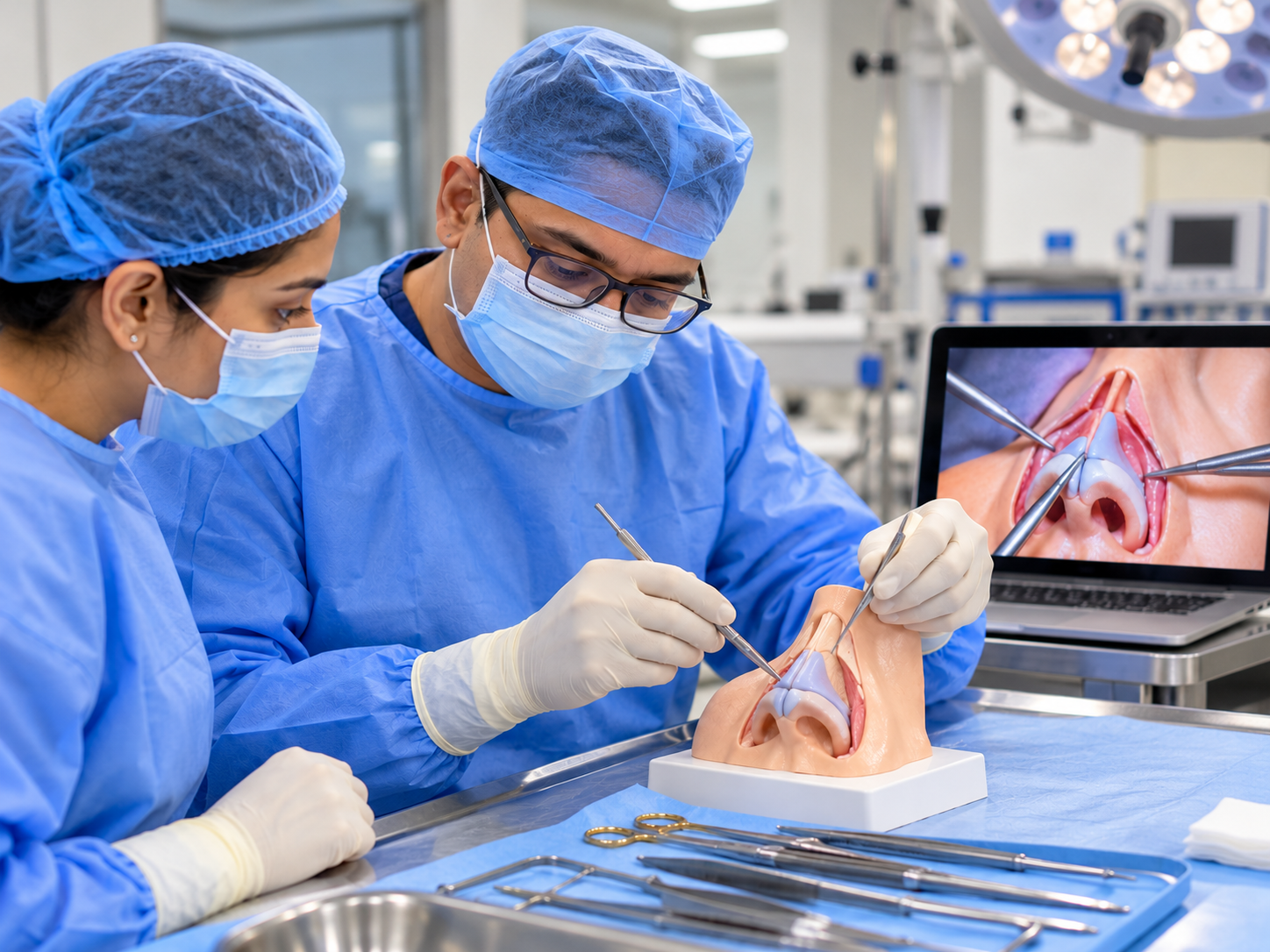
Rhinoplasty training for surgeons often begins with the open approach because it provides direct exposure to nasal anatomy and allows mentors to demonstrate cartilage techniques. Closed rhinoplasty becomes useful as surgeons gain experience with selected cases. Septoplasty, cartilage preservation, nasal tip assessment, and supervised primary procedures form the foundation. Complex revision, cleft, and major post-traumatic cases require advanced expertise.
Rhinoplasty is among the most technically demanding facial plastic surgery procedures because small anatomical changes can affect both nasal appearance and breathing.
For ENT and plastic surgeons entering rhinoplasty practice, choosing between open and closed approaches is an important early training decision.
The challenge is not simply learning where to place an incision. Surgeons must understand nasal support, cartilage behaviour, airway function, skin thickness and long-term healing.
An effective training programme introduces these principles progressively through anatomical study, simulation, supervised procedures and structured outcome assessment.
At Elegance Vidhyalay, doctors exploring advanced surgical education should evaluate programmes according to faculty supervision, case selection, practical exposure and competency assessment.
Open rhinoplasty uses a transcolumellar incision connected to marginal incisions, allowing the surgeon to elevate the soft-tissue envelope and expose the underlying nasal framework.
This approach provides direct visual access to important anatomical structures.
For surgeons beginning rhinoplasty training, visibility can make anatomical orientation and supervised teaching easier.
1. Direct anatomical exposure
The surgeon can examine the lower lateral cartilages, upper lateral cartilages, and relevant structural relationships.
This helps trainees connect textbook anatomy with operative findings.
2. Easier demonstration of structural techniques
Mentors can demonstrate cartilage positioning, suturing, and graft placement under direct vision.
3. Improved understanding of nasal asymmetry
Direct exposure allows the trainee to assess differences between the two sides of the nasal framework.
4. Structured faculty supervision
An experienced surgeon can observe operative steps and provide immediate guidance.
The open approach also has disadvantages.
These may include:
The open approach is not automatically superior for every patient.
Technique selection should depend on anatomy, functional requirements, operative goals, and the surgeon’s expertise.
Closed rhinoplasty, also called endonasal rhinoplasty, uses incisions inside the nostrils without a routine external columellar incision.
It can provide effective access for appropriately selected procedures while limiting external incisions.
However, some manoeuvres require working through a more restricted operative field.
| Training factor | Open rhinoplasty | Closed rhinoplasty |
|---|---|---|
| Anatomical visibility | Broad direct exposure | More limited or indirect exposure |
| External incision | Usually present | Usually absent |
| Tip cartilage access | Direct | Technique-dependent |
| Structural graft placement | Often easier to demonstrate | May require advanced endonasal skills |
| Teaching visibility | Often advantageous | Can be more challenging |
| Soft-tissue dissection | May be more extensive | May be less extensive |
| Early learning curve | Often suitable for structured teaching | Depends on existing endonasal experience |
| Ideal case selection | Selected primary and complex cases | Selected primary cases and suitable anatomical problems |
Important: Open and closed rhinoplasty are complementary approaches rather than competing standards.
An ENT surgeon with extensive endonasal experience may already possess useful skills for closed rhinoplasty.
A plastic surgeon experienced in open facial dissection may find the open approach more intuitive.
Neither background eliminates the need for rhinoplasty-specific training.
A strong septoplasty foundation for rhinoplasty is essential because the nasal septum contributes to both breathing and structural support.
Trainees should understand septal anatomy before performing aesthetic changes that may influence nasal function.
Surgeons must recognise:
Understanding these structures helps surgeons preserve essential nasal stability.
Careful elevation of septal flaps requires controlled tissue handling.
Unnecessary trauma can increase the risk of mucosal tears and septal complications.
Trainees should develop these skills under direct supervision.
The dorsal and caudal septal framework contributes to nasal shape and stability.
Excessive cartilage removal can lead to deformity or functional problems.
Surgeons must understand support-preserving principles before attempting advanced reconstruction.
Septal cartilage frequently provides graft material for structural rhinoplasty.
Trainees should understand appropriate graft selection, preservation of support, and donor-site risks.
Ear or rib cartilage may be considered when septal cartilage is insufficient, but these donor sites require additional expertise.
Before aesthetic rhinoplasty, surgeons should assess nasal obstruction, septal deviation, turbinate abnormalities, and nasal valve function.
Cosmetic planning must not overlook breathing problems.
Nasal tip surgery is technically demanding because small changes in cartilage position can significantly affect projection, rotation, symmetry and support.
A safe tip plasty technique requires understanding the relationship between the lower lateral cartilages, septum and surrounding soft tissues.
Trainees should identify the medial, intermediate and lateral crura of the lower lateral cartilages.
They must also understand how skin thickness and cartilage strength influence the final appearance.
Surgeons should evaluate the existing support mechanisms before modifying cartilage.
Over-resection or excessive weakening can cause undesirable long-term changes.
Simulation and cadaveric workshops can help trainees understand cartilage suturing and structural positioning.
These exercises support technical development without making a patient the trainee’s first practice opportunity.
Trainees should observe how experienced surgeons select techniques for different anatomical problems.
Practical responsibility should increase only after faculty confirm the trainee’s readiness.
The objective is predictable structural control rather than simply achieving a smaller nasal tip.
Doctors preparing for anatomical training can review preparing for a cadaveric workshop.
Rhinoplasty training should progress from foundational knowledge to increasingly complex clinical responsibility.
| Stage | Cases or training exposure | Approach | Main skill focus | Supervision level |
|---|---|---|---|---|
| 1. Foundation | Anatomy models, videos, and simulation | Open and closed demonstrations | Nasal anatomy, assessment and planning | Faculty-led teaching |
| 2. Septal skills | Appropriate septoplasty cases | Endonasal | Septal dissection, support preservation and cartilage handling | Direct supervision |
| 3. Initial rhinoplasty | Carefully selected straightforward primary cases | Often open | Exposure, structural assessment and basic tip techniques | Continuous direct supervision |
| 4. Broader primary practice | Selected primary cases with varied anatomy | Open or closed | Approach selection, graft planning and functional assessment | Supervised progression |
| 5. Advanced procedures | Complex reconstruction and revision cases | Individualised | Advanced grafting, scarred anatomy and complication management | Experienced specialist supervision |
This ladder is illustrative, not an automatic credentialing pathway.
There is no universally accepted number of rhinoplasty cases that guarantees independent competence.
Surgeons should maintain a documented record of their operative participation, outcomes, and faculty assessments.
The importance of competency-based progression is discussed further in supervised case numbers before independent practice.
Doctors evaluating a rhinoplasty course in Udaipur should prioritise faculty qualifications, patient safety and structured practical training.
Before enrolling, confirm whether the programme includes:
A course should clearly distinguish observation from hands-on surgical participation.
Surgeons should also ask how the programme assesses competency and whether practical exposure depends on patient availability.
A short course may introduce essential principles, but it should not be presented as sufficient preparation for independent complex rhinoplasty.
Appropriate case selection is one of the most important elements of surgical training.
Early trainees should not select cases solely because the desired cosmetic change appears small.
Some noses involve complex anatomical or functional problems that require advanced expertise.
Revision procedures often involve scar tissue, altered anatomy, missing cartilage, and weakened support structures.
These factors can make dissection and reconstruction more difficult.
A revision rhinoplasty referral to an experienced specialist is appropriate when the surgeon lacks the necessary reconstructive expertise.
Cleft-related deformities may involve complex asymmetry, altered cartilage anatomy and previous surgical changes.
They frequently require specialised multidisciplinary experience.
Significant trauma may affect the nasal bones, septum, airway, and supporting cartilage.
Such cases may require complex functional and structural reconstruction.
Patients with significant nasal valve compromise need careful functional evaluation and an appropriate reconstructive plan.
Procedures involving major structural grafting, particularly when septal cartilage is inadequate, may require advanced donor-site and reconstructive skills.
Training principle: Beginners should progress through carefully selected primary cases under supervision before undertaking complex reconstructive procedures.
Rib cartilage may be considered when the available septal cartilage cannot provide sufficient material for reconstruction.
Potential indications include:
However, rib cartilage harvesting introduces additional donor-site considerations.
Potential risks include pain, scarring, cartilage warping, and uncommon chest-related complications.
Surgeons should receive appropriate training before independently performing rib cartilage harvest or complex graft reconstruction.
Not every revision rhinoplasty requires rib cartilage.
The decision depends on the patient’s anatomy, available graft material, and reconstructive objectives.
Outcome assessment is essential because rhinoplasty results develop gradually as swelling resolves and tissues heal.
Surgeons should document both aesthetic and functional outcomes.
Common photographic views include:
| View | What it helps assess |
|---|---|
| Frontal | Nasal alignment, symmetry and width |
| Right lateral | Dorsal profile and tip projection |
| Left lateral | Profile symmetry and contour |
| Right oblique | Dorsal-tip relationships |
| Left oblique | Three-quarter nasal contour |
| Basal | Nostril symmetry, columella and tip shape |
Photographs should use consistent lighting, camera distance, head position and framing.
Patients must provide appropriate consent for clinical photography and any educational use.
Early postoperative reviews assess wound healing, swelling, breathing, and complications.
Later reviews evaluate progressive changes in contour and nasal function.
Final aesthetic assessment may require approximately 12 months or longer, particularly after extensive surgery or revision procedures.
Surgeons should document:
Audits help surgeons identify patterns and improve case selection.
Rhinoplasty combines aesthetic judgment with functional nasal surgery.
Experienced faculty can demonstrate how operative decisions influence both appearance and breathing.
Dr. Ashutosh Shah, M.S., M.Ch., D.N.B. (Plastic Surgery), is a Plastic, Reconstructive and Cosmetic Surgeon with over 22 years of experience and is associated with Elegance Vidhyalay’s surgical education programmes. His clinical background is relevant to discussions of anatomical planning, tissue preservation, and responsible surgical training.
Surgeons considering additional education can review the institute’s cosmetic surgery fellowship and faculty information to evaluate available training pathways.
Before enrolling, confirm which faculty members teach the specific rhinoplasty sessions and what level of practical supervision the programme provides.
ENT surgeons may pursue rhinoplasty training, particularly when they have a strong foundation in nasal anatomy and functional surgery. However, independent cosmetic rhinoplasty requires appropriate qualifications, relevant surgical competence and compliance with professional regulations. ENT training alone does not establish competence in every aesthetic rhinoplasty technique.
There is no fixed duration. Training depends on previous surgical experience, case complexity, supervised exposure and demonstrated competence. A short workshop can introduce techniques, but developing independent proficiency generally requires sustained clinical training and outcome review.
Closed rhinoplasty may be more challenging for some beginners because of limited direct exposure. However, surgeons with extensive endonasal experience may adapt more readily. The appropriate learning sequence depends on the trainee’s background and faculty assessment.
Yes. Cadaveric workshops can improve anatomical understanding and provide opportunities to practise selected techniques in a controlled educational setting. They complement but do not replace supervised clinical experience. Doctors considering a rhinoplasty course in udaipur should ask whether anatomical laboratory training is included.
Rib cartilage may be needed when septal or ear cartilage cannot provide adequate material for structural reconstruction. Some complex revision, congenital and post-traumatic cases require larger or stronger grafts. The decision depends on individual anatomy and surgical planning.
Results are reviewed using standardised photographs, nasal breathing assessments, complication records, patient-reported outcomes and revision rates. Surgeons should compare findings over appropriate follow-up intervals and use the results to improve future treatment decisions.
Rhinoplasty training for surgeons should begin with a strong understanding of nasal anatomy, septoplasty, cartilage preservation, and functional assessment.
The open approach often provides useful anatomical visibility during early supervised training, while closed techniques can be introduced according to the surgeon’s experience and patient selection.
Neither approach is universally better.
A structured learning pathway should include simulation, carefully selected primary cases, direct supervision, and documented competency assessment.
Revision, cleft-related and major post-traumatic deformities require advanced expertise and appropriate referral when they exceed a surgeon’s experience.
At Elegance Vidhyalay, ENT and plastic surgeons exploring further training should prioritise qualified faculty, patient safety and progressive clinical responsibility.
The goal of rhinoplasty training is not simply to master an incision or technique. It is to develop the judgment and surgical competence needed to protect nasal function while achieving appropriate aesthetic outcomes.