Vitiligo surgery training should begin with patient selection before a dermatologist learns graft placement or cell preparation. A practical learning sequence can start with miniature punch grafting, progress to suction blister epidermal grafting, and then move to non-cultured epidermal cell suspension (NCES), which adds tissue processing and laboratory steps. Surgery should be reserved for appropriately selected stable vitiligo.
The techniques may all aim to restore pigmentation, but the skills required are different. Punch grafting teaches donor and recipient-site precision. Suction blister grafting adds delicate epidermal handling. NCES requires the dermatologist to combine surgical preparation with controlled processing of an epidermal cell suspension.
At Elegance Vidhyalay, this progression is approached as competency-based training. Under experienced faculty and review by Dr. Ashutosh Shah, M.S., M.Ch., D.N.B. (Plastic Surgery), trainees should first learn which patients are suitable for surgery, then develop procedural skills under appropriate supervision.
A technically excellent graft can still give a poor result if surgery is performed on actively progressing vitiligo.
The classic 2008 IADVL Dermatosurgery Task Force guideline identified stability as the most important prerequisite for patient selection and accepted one year of disease inactivity as the cut-off for defining stability.
More recent IADVL consensus continues to recommend at least 12 months of clinical stability for optimal surgical outcomes.
Stability means more than looking at one patch on the day of consultation. A dermatologist should ask:
The latest IADVL consensus specifically emphasises both lesional and global disease stability. Dermoscopy may provide useful additional information but should not replace clinical history.
This makes patient selection the first practical skill in a vitiligo surgery course.
Before learning how to harvest tissue, a trainee needs to learn when not to operate.
Unstable disease, active infection at the proposed surgical site, keloidal tendency, and unrealistic expectations are among factors that can make a patient unsuitable for surgery.
The three methods teach progressively different technical abilities.
Miniature punch grafting (MPG) is a tissue-grafting technique. Small pieces of normally pigmented donor skin are harvested and placed into prepared recipient sites within stable depigmented patches.
From a training perspective, it teaches several useful fundamentals:
One important complication is cobblestoning, where the grafts produce an uneven raised surface.
The technique can therefore be useful for teaching precision, but a trainee must learn that improper graft size, depth or placement can affect the final texture.
Suction blister epidermal grafting (SBEG) creates an epidermal blister on normally pigmented donor skin using controlled negative pressure. The epidermal roof is then transferred to the prepared vitiligo recipient site.
Compared with punch grafting, the technique introduces another level of delicate tissue handling.
The trainee must learn:
Current IADVL consensus recommends 300–500 mmHg as an optimal negative-pressure range for SBEG. Increasing the local temperature can help blisters form faster. Trainees should learn these procedural parameters through supervised practical training rather than applying them without hands-on guidance.
Non-cultured epidermal suspension, commonly abbreviated NCES, requires the most laboratory-style processing of these three approaches.
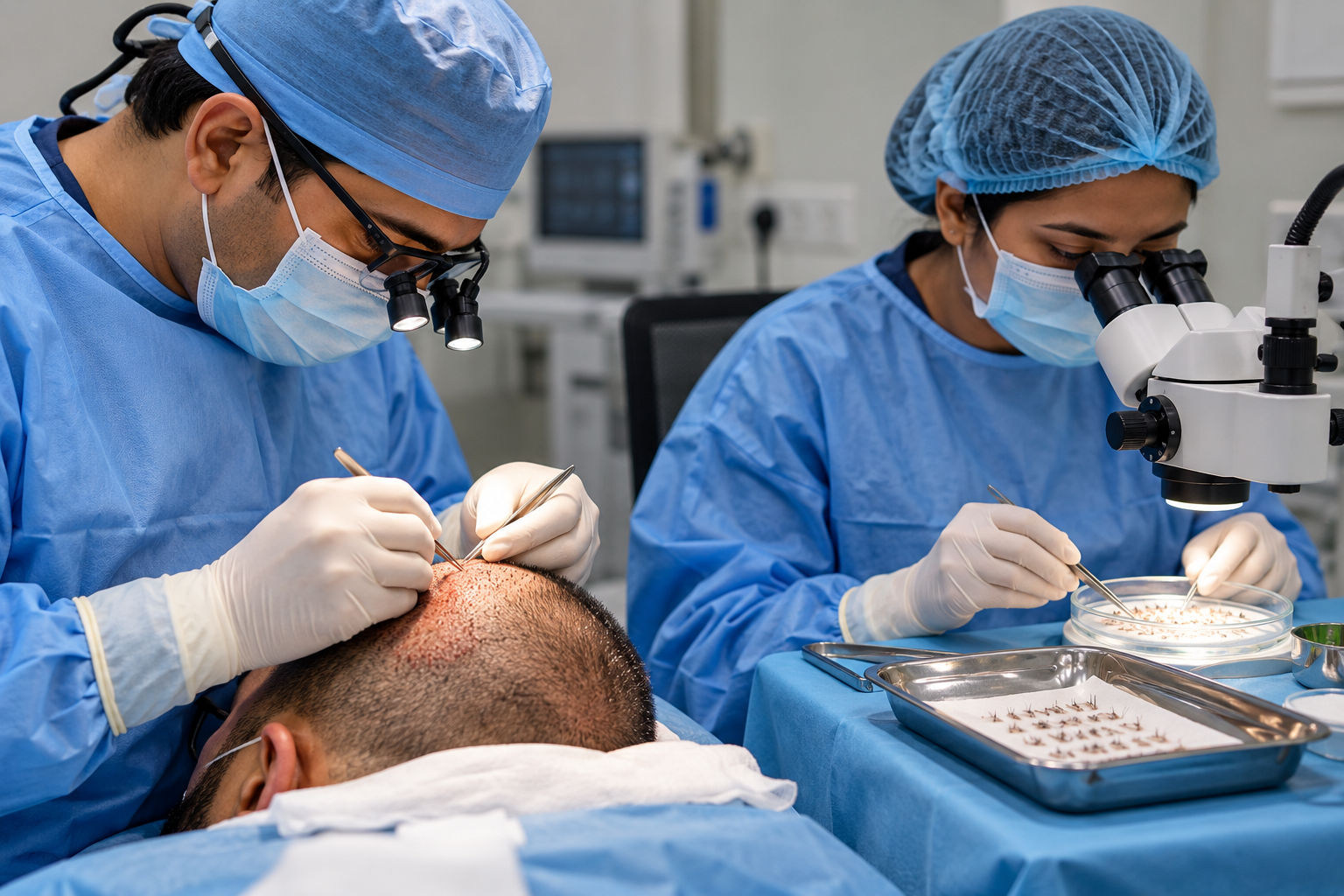
A thin donor graft is harvested and processed so melanocytes and keratinocytes can be separated into a suspension. The recipient area is prepared, and the resulting suspension is applied to it.
This means NCECS technique training requires competence in both surgical and processing stages.
The dermatologist needs to understand:
Current IADVL consensus considers NCES particularly useful for larger areas because a comparatively small donor area can be used to treat a substantially larger recipient area.
| Method | Main equipment/setup | Procedure time | Area suited to technique | Training learning curve | Common problem to recognise |
|---|---|---|---|---|---|
| Miniature punch grafting | Punches, local anaesthesia, recipient-site instruments, dressings | Depends on number and area of grafts | Often practical for smaller/localised lesions and selected special sites | Good introduction to tissue grafting but requires precise depth/spacing | Cobblestoning, graft displacement, colour/texture mismatch |
| Suction blister epidermal grafting | Suction device, controlled negative pressure, graft-transfer instruments | Blister formation adds procedural time | Selected localised lesions and anatomically suitable sites | Intermediate; delicate epidermal harvesting and transfer | Incomplete blister, graft folding/displacement, colour mismatch |
| NCES | Donor harvesting equipment, controlled cell-processing setup, centrifugation and recipient preparation equipment | Processing adds multiple procedural stages | Particularly useful for larger stable lesions | Advanced; combines surgery with tissue/cell-processing steps | Uneven repigmentation, treatment failure, halo phenomenon |
The IADVL consensus recommends individualising technique choice according to lesion site, area, resources and clinician expertise rather than selecting one method for every patient.
Someone considering vitiligo surgery training in Surat should understand that the infrastructure changes considerably as training progresses from tissue grafting to cellular techniques.
Miniature punch grafting has relatively modest equipment requirements but demands meticulous surgical technique.
Suction blister grafting needs a reliable method of creating controlled negative pressure as well as equipment for atraumatic epidermal transfer.
NCES adds the greatest processing requirement.
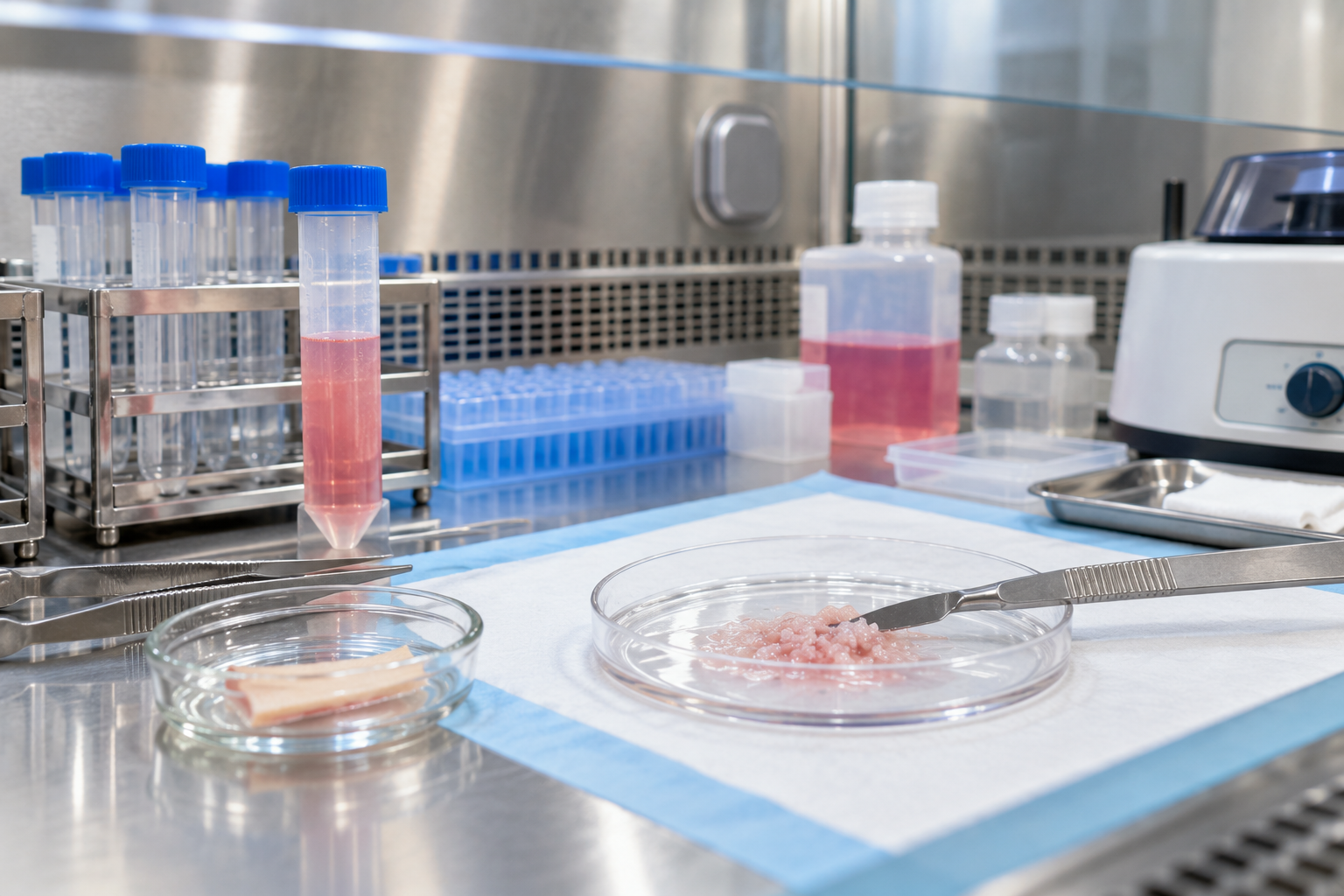
Current IADVL consensus describes controlled warm trypsinisation and low-speed centrifugation as important stages of NCES preparation. The recommendations describe warm trypsinisation at approximately 37°C for 45–60 minutes as a broadly acceptable standard while acknowledging that actual duration depends on graft thickness.
For centrifugation, the guideline recommends approximately 110–150 ×g for 5–10 minutes, with the correct RPM depending on the centrifuge’s rotor radius.
These details illustrate why NCES cannot be learned properly by memorising a procedure sheet.
A trainee needs supervised experience with:
harvesting → processing → recipient preparation → cell application → dressing → follow-up.
The exact setup should follow validated infection-control and tissue-processing protocols appropriate to the institution.
Dermatologists seeking broader procedural training can review the Cosmetic dermatology fellowship and the Cosmetic dermatology fellowship in India.
A beginner’s first supervised case should be selected for predictability rather than novelty.
Good training cases should have clearly documented stability, manageable lesion size, a suitable anatomical site, realistic expectations, and no factors likely to interfere with graft uptake or postoperative care.
The site also matters.
Acral areas such as the hands, feet, fingers and toes can be difficult because of friction, movement, irregular surfaces and difficulty immobilising the graft. Current IADVL consensus notes that technique selection varies according to anatomical site.
Special areas such as lips, eyelids, genital skin, nipple-areola complex and sites with leukotrichia may also need technique-specific planning.
Therefore, “easy technique” and “easy patient” are not necessarily the same thing.
At Elegance Vidhyalay, a sensible faculty-attributed learning sequence is:
1. Patient selection and stability assessment
First, demonstrate that you can identify appropriate surgical candidates.
2. Miniature punch grafting
Learn donor-recipient planning, graft depth, spacing, and postoperative assessment.
3. Suction blister epidermal grafting
Progress to delicate epidermal harvesting, transfer and fixation.
4. NCES
Add controlled donor harvesting, tissue processing, recipient preparation, and suspension application.
5. Complex sites and larger cases
Progress according to demonstrated competency, not simply because a fixed number of cases has been completed.
This is a training sequence, not a universal clinical hierarchy. The best technique for an individual patient should still be chosen according to lesion characteristics and current evidence.
Trainees can review the Elegance Vidhyalay faculty when assessing who provides their clinical supervision.
Vitiligo surgery training is incomplete if it teaches only successful cases.
Cobblestoning is particularly associated with punch grafting. The recipient surface develops an uneven, raised appearance around grafts.
Prevention begins with appropriate graft size, depth, and placement. Trainees should learn to identify early texture problems during follow-up rather than judging success only by whether pigment appears.
Successful repigmentation does not automatically mean a perfect cosmetic match.
The transplanted area may differ in shade from surrounding skin. Donor-site selection, anatomical location, tanning and individual pigment behaviour can influence the appearance.
Standardised photography helps distinguish real change from lighting differences.
Poor results should prompt review of the entire pathway:
Current IADVL consensus recommends waiting at least six months after vitiligo surgery to assess the outcome and similarly allowing at least six months before repeating surgery on the same lesion when the response is incomplete or unsatisfactory.
Residual depigmentation around a treated area can leave a pale peripheral halo. Current consensus describes options including topical tacrolimus, excimer treatment and selected touch-up surgical procedures depending on the case.
Learning to recognise an imperfect result and decide whether to observe, treat medically, or consider revision is an important component of a vitiligo surgery fellowship.
Vitiligo surgery outcomes cannot be judged reliably from memory.
Before-and-after photography should use consistent:
Images should be obtained with appropriate consent and handled according to privacy and clinical documentation requirements.
A trainee can then compare lesion area, pigment spread, colour match, texture and residual depigmentation.
Current IADVL consensus also recommends incorporating patient-reported satisfaction into assessment and allowing sufficient follow-up before determining the final result.
For practical documentation principles, see the Elegance Vidhyalay Clinical photography protocol.
There is no universal number of days or cases that proves competency. NCES requires patient selection, donor harvesting, controlled tissue processing, recipient-site preparation, suspension application, and postoperative management. A trainee should progress from observation to supervised performance and independent practice only after faculty confirms competency across the complete procedure.
A doctor may study the principles of vitiligo surgery, but course admission and independent clinical practice are different questions. Anyone considering vitiligo surgery training in Surat should verify course eligibility, professional scope, appropriate supervision, and competency requirements rather than assuming that a short-course certificate independently authorises specialised procedural practice.
NCES requires controlled sterile tissue processing, but the appropriate infrastructure depends on the validated protocol, institutional infection-control requirements and applicable standards. A trainee should learn the complete aseptic processing pathway rather than assuming that owning one piece of equipment by itself makes a setup suitable for cell-suspension procedures.
Acral areas can be challenging because of friction, movement, irregular surfaces and difficulties with postoperative immobilisation. Doctors should choose the technique according to each patient’s condition and treatment site. Current IADVL consensus recommends different approaches for specific anatomical sites instead of considering one surgical technique the best option for every difficult area.
Use standardised photographs with consistent lighting, camera position, distance, framing and follow-up intervals. Document repigmentation, colour match, texture and residual depigmentation. Current consensus recommends waiting at least six months before assessing the final surgical result and including patient-reported satisfaction when evaluating success.
Doctors can combine phototherapy with vitiligo surgery for appropriately selected patients. Current IADVL consensus supports narrow-band UVB, targeted phototherapy, excimer laser, and suitable home-based phototherapy after surgery to encourage better repigmentation. Doctors should select the approach according to each patient’s condition and treatment needs.
Effective vitiligo surgery training starts before the procedure.
The first skill is establishing whether the disease is genuinely stable. The IADVL’s earlier Dermatosurgery Task Force guideline and current consensus support approximately 12 months of clinical stability when selecting patients for surgery.
For training, miniature punch grafting can introduce donor and recipient-site precision. Suction blister grafting adds delicate epidermal harvesting and transfer. NCES adds tissue-processing steps and allows efficient treatment of larger stable lesions.