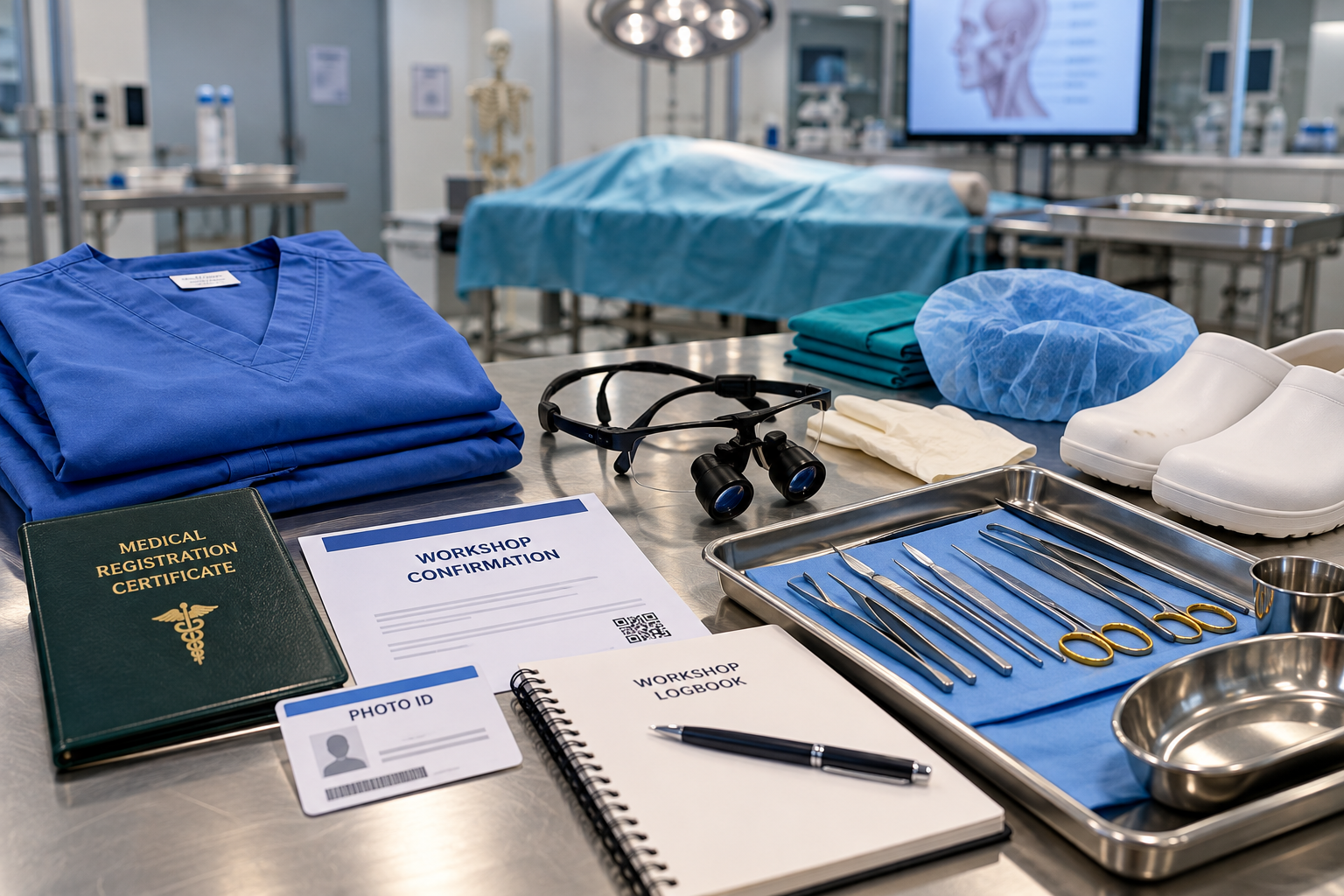
Proper preparing for a cadaveric workshop starts before you enter the laboratory. According to the supplied workshop brief, participants should carry their medical registration certificate, photo ID, and workshop confirmation, wear scrubs with closed shoes, and bring their own loupes if they normally use them. Participants should also expect strict rules regarding conduct, specimen handling, and photography.
A cadaveric workshop offers limited practical laboratory time, so preparation matters. Reviewing the relevant anatomy beforehand and arriving with the correct documents, clothing and equipment allows you to spend more of the session on structured hands-on learning.
Do not arrive assuming your workshop registration email alone will cover every entry requirement.
Based on the supplied brief, you should carry:
Keep these documents organised and easily accessible when you arrive.
Individual workshops or laboratory facilities may have additional entry requirements. Check the final joining instructions provided by the organiser before travelling.
| Item | Required or Optional | Why You Need It | What Happens If It Is Missing |
|---|---|---|---|
| Medical registration certificate | Required according to supplied brief | Confirms professional registration | Lab entry may be affected |
| Photo ID | Required | Confirms participant identity | Entry verification may not be completed |
| Workshop confirmation | Required | Confirms your workshop registration | Organiser may need to verify enrolment separately |
| Scrubs | Required | Appropriate clothing for the laboratory | You may need to change before entering |
| Closed shoes | Required | Appropriate laboratory footwear | Lab access may be restricted |
| Loupes | Optional, if you use them | Allows you to work with your familiar magnification | You may need to work without your usual magnification |
| Personal instruments | Workshop-specific | Useful only when organisers permit or request them | Use the instruments supplied by the workshop where available |
| Notebook/logbook | Recommended | Helps record learning points and procedural exposure | You may have less structured documentation of your learning |
Always prioritise the workshop’s current joining instructions if they differ from a general preparation checklist.
The supplied plan recommends:
Scrubs + closed shoes
Choose clothing suitable for a practical laboratory environment rather than ordinary clinic or conference clothing.
Avoid footwear that leaves the feet exposed.
The laboratory may provide or require additional protective equipment depending on its protocol. Follow the specific instructions you receive from the organiser.
Doctors comparing practical training formats can explore Crash courses for doctors.
Do not bring an entire surgical instrument set unless the organiser specifically asks you to.
The supplied brief specifically recommends bringing your own loupes if you use them.
For other personal instruments, confirm:
Working with familiar loupes can help when the workshop involves fine anatomical structures or detailed dissection.
Cadaveric training requires professional and respectful conduct.
The supplied brief specifically states that participants should expect a strict no-photography rule inside the laboratory unless written permission is given.
DO
DO NOT
Where the facility has stricter rules, those rules take priority.
Do not assume that you can.
According to the supplied brief, participants should expect a no-photography policy unless they receive written permission.
This restriction may cover:
If documentation matters to you, ask the organiser before the workshop whether any approved educational photographs or official workshop images will be available.
Participants can review examples of previous educational activities through the Hands-on workshop gallery.
A cadaveric session should reinforce anatomy rather than be the first time you encounter it.
Before attending, review the anatomical region relevant to the workshop.
Concentrate on:
If the organiser provides pre-course reading, videos or an anatomy list, review those resources before arriving.
A simple preparation sheet can contain four columns:
| Structure | How to Identify It | Why It Matters | Structures at Risk Nearby |
|---|---|---|---|
| Landmark 1 | Key anatomical features | Surgical relevance | Adjacent structures |
| Landmark 2 | Key anatomical features | Surgical relevance | Adjacent structures |
| Nerve | Expected course | Functional importance | Nearby vessels/tissues |
| Vessel | Expected course | Operative relevance | Adjacent structures |
Fill this table according to the specific workshop rather than attempting to revise all anatomy equally.
Good preparing for a cadaveric workshop also means deciding what you want to practise before the session begins.
Do not spend valuable laboratory time deciding what to learn.
Write down:
Watch for:
Prioritise repetition.
If you understand a step after watching it once, try to perform it rather than repeatedly watching other participants.
When several trainees share a station, rotate roles deliberately so everyone receives meaningful practical exposure.
Record your learning immediately after the session.
Useful fields include:
Do not include prohibited specimen photographs simply to make the logbook look more complete.
Written documentation can provide a useful record of what you actually practised.
The supplied brief asks this question but does not state whether additional laboratory time is available.
Ask the organiser directly about:
Do not assume that unused or additional laboratory time comes automatically with workshop registration.
Before enrolling, look beyond the course title.
Ask:
A workshop with fewer participants and meaningful supervised practice may provide a different learning experience from a large demonstration-based programme.
Elegance Vidhyalay provides practical learning opportunities for doctors through workshops and structured training programmes. Doctors should review the course format, faculty, practical exposure, station allocation, and preparation requirements before attending.
The Hair transplant hands-on workshop provides an example of a practical workshop pathway, while doctors can review the Faculty and teaching record when evaluating the teaching team.
Dr. Ashutosh Shah, Plastic and Reconstructive Surgeon with 22+ years of clinical experience, contributes clinical experience relevant to structured procedural learning, anatomical understanding and supervised skills development.
According to the supplied brief, carry your medical registration certificate, valid photo ID, and workshop confirmation. Check the organiser’s final instructions for any additional requirements.
Expect a strict no-photography rule unless the laboratory or organiser gives written permission. Never assume that workshop registration itself provides permission to photograph specimens.
It depends on the workshop. Bring your own loupes if you normally use them, and ask the organiser which personal instruments, if any, you should carry.
Wear scrubs and closed shoes according to the supplied preparation brief. Follow any additional protective-clothing requirements specified by the laboratory.
Review the relevant anatomy, surgical landmarks, tissue planes and structures at risk. Prepare specific learning objectives so you can use limited hands-on time efficiently.
The supplied information does not confirm additional lab availability. Ask the workshop organiser about extra sessions, repeat attendance, and associated charges.
Good preparing for a cadaveric workshop combines practical preparation with professional laboratory conduct.
Carry your medical registration certificate, photo ID and workshop confirmation. Wear scrubs and closed shoes, bring your own loupes if you use them, review the relevant anatomy beforehand, and arrive with specific learning goals.
Most importantly, respect the laboratory’s conduct and specimen-handling requirements. Do not take photographs unless you receive explicit permission, and use the available hands-on time for deliberate, supervised repetition rather than passive observation.