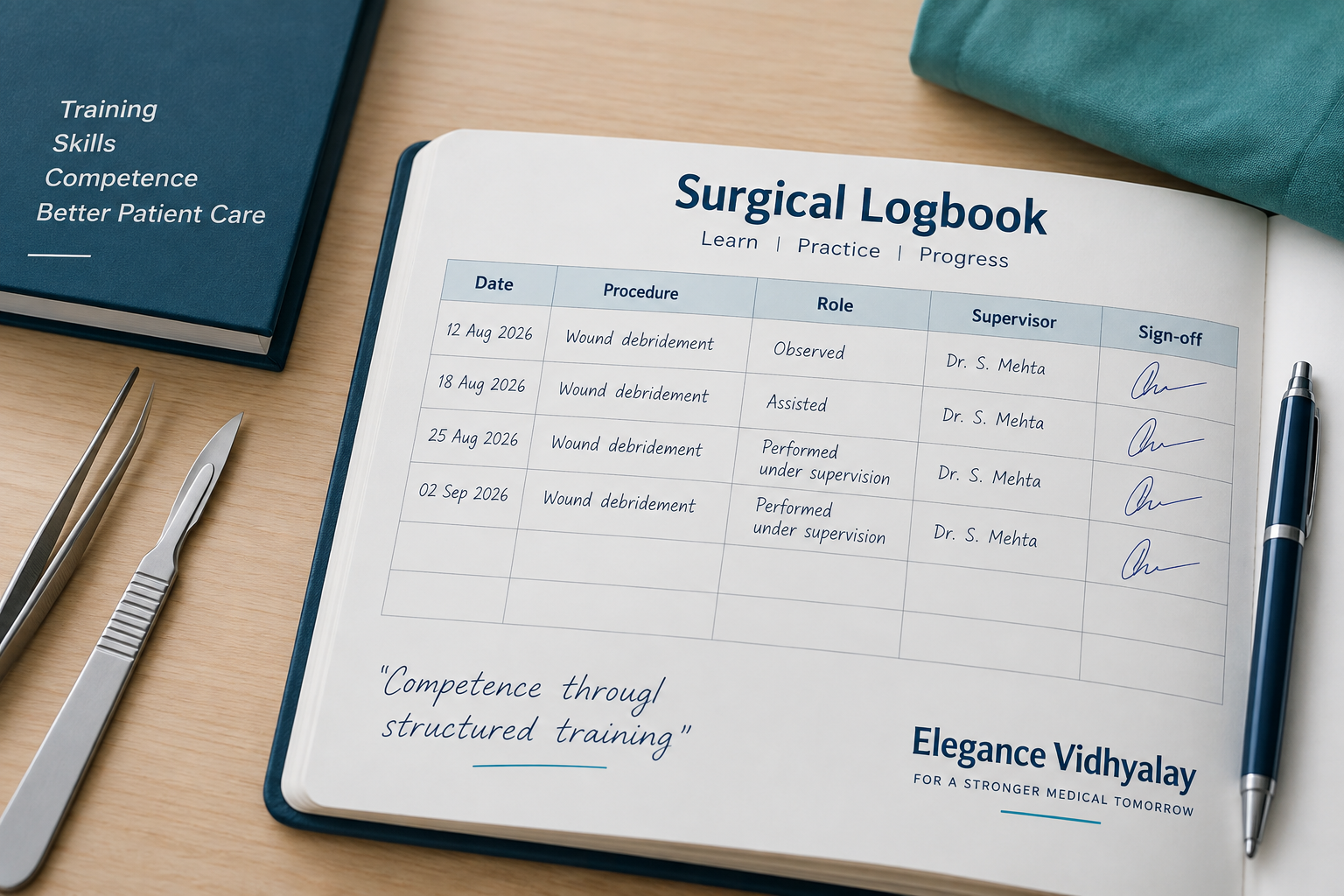
When considering supervised case numbers before independent practice, case count alone does not equal competence. A practical training benchmark for superficial debridement may be roughly 10 cases observed, 10 assisted, and 20 performed under supervision before considering independent practice, with each relevant entry reviewed and signed by the supervising surgeon. These figures should be treated as training benchmarks, not universal licensing thresholds.
The number of procedures completed is useful because repeated exposure allows a doctor to encounter different wounds, clinical decisions, and technical challenges. However, twenty straightforward cases do not necessarily prepare someone for a single complicated case.
Competence therefore needs to combine case numbers, clinical judgement, technical ability, complication recognition, appropriate patient selection, and documented supervisor assessment.
A structured surgical logbook helps make that progression visible.
It is tempting to define competency with a simple number, but supervised case numbers before independent practice should not be treated as the only measure of readiness. Clinical training depends on the quality of exposure, level of supervision, case complexity, technical performance, and clinical judgement.
Two trainees may each record 20 procedures but have very different experience. One may have assessed patients, planned treatment, performed procedures under close supervision, and received structured feedback, while another may have mainly observed straightforward cases.
At Elegance Vidhyalay, practical training focuses on supervised clinical exposure, structured case documentation, and competency-based learning rather than relying only on procedure numbers.
A supervisor should therefore assess more than technical performance. Important areas include whether the trainee can:
This is why how many cases to become competent cannot be answered with one universal number.
Case counts can provide a benchmark. Competence requires demonstrated performance.
A surgical logbook should be more than a list of procedure names.
Its purpose is to demonstrate the type, extent, and progression of clinical exposure. Someone reviewing it should be able to understand what the trainee actually did.
For example, “debridement – 20 cases” provides limited information.
A stronger record distinguishes whether those procedures were observed, assisted, performed under direct supervision, or completed after appropriate independent-practice sign-off.
For privacy and governance reasons, patient information should be recorded according to applicable institutional policies rather than unnecessarily including identifiable personal information.
| Logbook Field | What to Record |
|---|---|
| Case number | Unique training/logbook number |
| Date | Date of clinical exposure |
| Clinical indication | Why the procedure was required |
| Procedure | Procedure or technique involved |
| Complexity | Simple, intermediate, or complex |
| Role | Observed, assisted, or performed under supervision |
| Assessment findings | Relevant clinical findings |
| Procedure planning | Key treatment decision |
| Level of supervision | Direct, indirect, or as defined by the programme |
| Technical performance | Relevant procedural steps completed |
| Complications/issues | Problems encountered and how they were addressed |
| Learning points | Key feedback or reflection |
| Supervisor | Name/designation of supervising clinician |
| Supervisor feedback | Brief competency comments |
| Sign-off | Supervisor confirmation where required |
Digital systems may contain additional fields, but the same principle applies: document what actually happened rather than merely recording attendance.
Doctors seeking structured operative exposure can review Diabetic foot surgery training for surgeons when comparing how surgical training, supervision and practical experience are organised.
There is no universal number of procedures that guarantees competency across all surgical skills.
For the specific training benchmark supplied for this article, superficial debridement can be approached using approximately:
10 observed → 10 assisted → 20 performed under supervision → competency assessment before independent practice.
That progression is more meaningful than simply saying “40 cases” because it shows increasing responsibility.
For broader procedure categories, a training framework can look like this:
| Procedure Complexity | Cases Observed | Cases Assisted | Performed Under Supervision | Performed Independently | Sign-Off Requirement |
|---|---|---|---|---|---|
| Simple procedures | ~10 | ~10 | ~20 | Only after competency sign-off | Supervisor confirms readiness before independent practice |
| Intermediate procedures | Programme/procedure-specific | Programme/procedure-specific | Higher supervised exposure may be required | Only after appropriate competency and privileges | Formal assessment by appropriately qualified supervisor |
| Complex procedures | Extensive exposure may be required | Extensive supervised participation | Specialist training pathway required | Not based on case count alone | Specialist qualification, competency, institutional privileges and other applicable requirements |
The first row reflects the superficial debridement benchmark specified for this article. Numerical targets for intermediate and complex procedures should not be invented or extrapolated from that figure.
Different procedures have different learning curves.
Complex surgery requires appropriate specialist training and cannot be reduced to reaching an arbitrary number in a logbook.
A useful logbook should show progression rather than accumulation.
The trainee should move through identifiable stages.
Can the doctor explain why the procedure is appropriate for this patient?
Technical ability is of limited value without correct patient selection.
Can the trainee identify situations in which the planned procedure should be delayed, modified or referred?
This can be particularly important in wound management where vascular status, infection and depth may substantially change treatment.
The trainee should understand equipment, positioning, preparation, analgesia or anaesthesia where relevant, infection-control requirements and expected procedural steps.
Technical execution should become progressively more consistent under supervision.
The supervisor should be able to assess technique rather than merely confirm that the trainee was physically present.
Competence includes recognising when something is not progressing normally.
Knowing when to stop and seek senior assistance is an important clinical skill.
The doctor should understand dressing, monitoring, follow-up, warning signs, and escalation requirements.
One of the strongest signs of clinical maturity is recognising when a patient requires expertise beyond your own training.
These milestones make surgical logbook requirements more useful than a simple numerical target.
Doctors comparing longer structured programmes can review all fellowships and assess how individual courses approach supervision, clinical exposure and competency assessment.
Training at Elegance Vidhyalay is guided by Dr. Ashutosh Shah, Plastic and Reconstructive Surgeon with 22+ years of clinical experience, with emphasis on supervised learning, appropriate case selection, and documented clinical progression.
Each relevant entry should ideally establish:
What was performed?
Record the procedure accurately.
What did the trainee do?
Distinguish observation, assistance, and supervised performance.
Who supervised it?
Record the appropriate supervisor according to the programme’s requirements.
How did the trainee perform?
Include meaningful feedback where practical.
Was the trainee considered competent at that stage?
Competency sign-off should be separate from simply confirming attendance.
The person providing final sign-off should be appropriately qualified and authorised within the relevant training programme or clinical setting to assess the procedure concerned.
Training providers should explain this process before enrolment.
Doctors can review the Faculty and teaching record when assessing who provides teaching and supervision within a programme.
A final sign-off should not be interpreted as permission to perform procedures beyond a doctor’s qualifications, applicable professional rules or institutional privileges.
This is where the difference between completing training and practising safely becomes particularly important.
If you have insufficient supervised experience with a procedure, the presence of a patient who needs that procedure does not remove the competency gap.
Do not use an unsuitable patient as an opportunity to complete your training independently.
Instead, consider whether:
A thin logbook is useful information. It identifies where more exposure may be needed.
Doctors looking to strengthen particular clinical skills can explore appropriate Programmes for doctors, but course completion should still be followed by competency-based decision-making.
For superficial debridement, the progression described in this training benchmark can be understood in four stages.
Stage 1: Observe
The trainee watches approximately 10 appropriately selected cases while learning assessment, indications, technique, and post-procedure management.
Stage 2: Assist
The next approximately 10 cases allow more active participation while an experienced clinician retains primary responsibility.
Stage 3: Perform Under Supervision
Approximately 20 cases are then performed with appropriate supervision, allowing the trainer to assess technique, judgement, and consistency.
Stage 4: Competency Assessment
The supervisor reviews the trainee’s overall performance and logbook rather than using the numerical total alone.
Independent practice should only be considered when competency, qualifications, applicable regulations, clinical setting, and privileges all support it.
The sequence is therefore more important than chasing a number.
Twenty nearly identical cases may provide less educational value than exposure to a carefully selected range of presentations.
Training should ideally help doctors understand variation in:
Variety helps develop judgement.
However, training programmes should never expose patients to unnecessary procedures simply to increase trainee case numbers. Patient need, consent and safety remain more important than filling a logbook.
A logbook can remain useful after a fellowship or workshop.
It provides a structured record of where your experience is strong and where additional supervision may be needed.
Review it periodically and ask:
Which procedures have I repeatedly performed under supervision?
Where did supervisors identify areas for improvement?
Which types of cases have I rarely encountered?
Where do I still need direct supervision?
Which cases should continue to be referred?
This approach turns the logbook from an administrative document into a professional learning tool.
It can also help when planning further training because you can identify specific gaps instead of enrolling in another programme simply because its title sounds advanced.
The central principle behind supervised case numbers before independent practice is simple: numbers can support training decisions, but they cannot replace competency assessment.
For superficial debridement, a framework of approximately 10 observed, 10 assisted, and 20 performed under supervision provides a practical benchmark for structuring exposure.
It should not be treated as a universal legal threshold or a guarantee of competence.
The logbook should document progression, supervisor feedback, clinical judgement and actual participation. The final decision about readiness should consider qualifications, competency, applicable professional requirements and the complexity of the procedure.
A good training programme should therefore help doctors answer more than:
“How many cases have I done?”
It should help them answer:
“Can I assess this patient correctly, perform this procedure safely, recognise my limits and know when to ask for help or refer?”
That is a much stronger benchmark for independent clinical practice.
There is no universal number. For superficial debridement, 10 observed, 10 assisted, and 20 supervised cases can serve as a training benchmark, followed by a competency assessment. Case complexity, performance, and supervisor judgement remain important.
A logbook should record the date, indication, procedure, complexity, trainee role, supervision level, relevant outcomes, learning points, supervisor feedback, and appropriate sign-off while respecting patient confidentiality.
An appropriately qualified supervisor, authorised within the relevant training or clinical setting, should sign off cases to assess the procedure and the trainee’s performance.
Video may support training or assessment where permitted, but it should not automatically replace supervised clinical assessment or required logbook documentation. Patient consent, privacy and institutional policies must also be followed.
Retention requirements can vary by institution, programme and applicable professional or regulatory rules. Doctors should follow the requirements of their training provider and clinical organisation rather than relying on a universal period.
Seek further supervised exposure rather than assuming course completion equals competence. Discuss the gap with faculty, arrange additional training where possible, and refer procedures that remain beyond your current experience or competence.