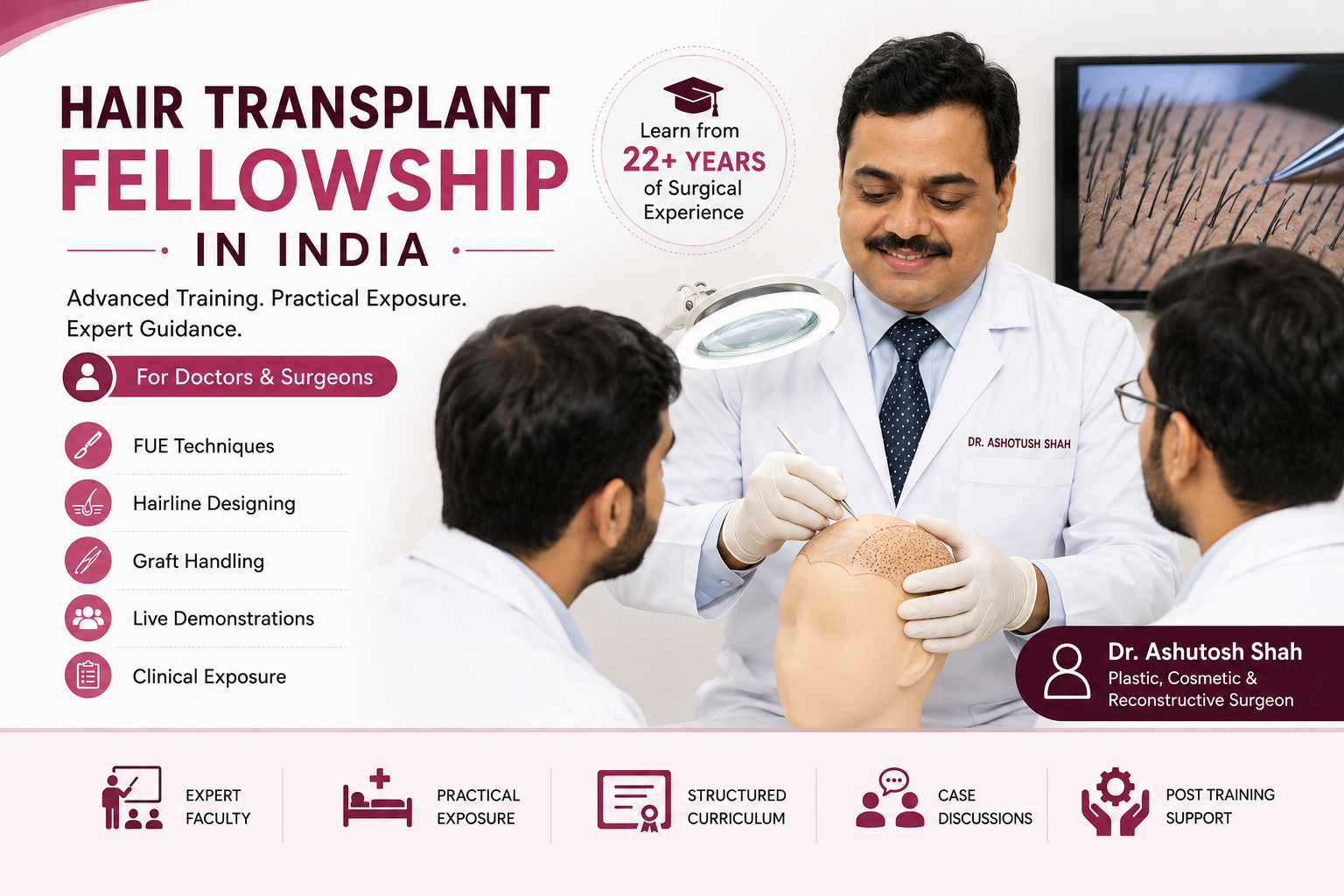
Hair transplantation has become an important part of modern aesthetic practice. For doctors and surgeons who want to expand their skills in hair restoration, structured training can help them understand not only the procedure but also patient selection, hairline planning, donor assessment, graft handling, and postoperative care. A hair transplant fellowship in India can provide doctors with focused learning and practical exposure under experienced surgical guidance. Since hair transplantation is a technique-dependent procedure, offline training is particularly valuable for understanding how theoretical concepts translate into clinical practice.
A hair transplant fellowship is a specialized training program designed to help qualified doctors and surgeons develop knowledge and practical understanding of hair restoration procedures.
Unlike basic theoretical courses, a fellowship or intensive training program focuses on the complete clinical workflow—from evaluating hair loss to planning and understanding the technical stages of transplantation.
Depending on the program, doctors may learn about:
Hair transplantation involves much more than extracting and implanting follicles.
Doctors need to understand whether a patient is suitable for transplantation, how much donor hair is available, how progressive hair loss may affect future appearance, and how to create an appropriate treatment plan.
Structured training allows doctors to learn these concepts systematically instead of relying only on videos or independent observation.
The selected hair transplant fellowship in India follows an offline learning format, which is particularly relevant for procedure-based education.
Offline training allows doctors to observe clinical workflows closely and interact directly with experienced faculty.
Depending on the training structure, it can provide opportunities for:
Watching an FUE procedure online can explain the sequence of steps, but direct clinical exposure provides a better understanding of technique, instrumentation, graft handling, and procedural coordination.
Follicular Unit Extraction (FUE) is an important technique in modern hair transplantation.
Training can help doctors understand how follicular units are identified and extracted from the donor area and how grafts are handled before implantation.
Doctors also need to understand factors such as donor availability, extraction planning, graft quality, hair direction, distribution, and recipient-area planning.
The objective should not simply be learning how to use an instrument. Doctors need to understand the clinical reasoning behind each stage.
A technically successful transplant still needs appropriate aesthetic planning.
Hairline design depends on several factors, including the patient’s facial proportions, age, existing hair pattern, donor availability, and expected progression of hair loss.
During structured training, doctors can learn why a standardized hairline should not be used for every patient.
This combination of technical skill and aesthetic judgment plays an important role in hair restoration.
Based on the selected training information, this program is intended for doctors and surgeons who want to strengthen their knowledge of hair transplantation.
It may be suitable for medical professionals who want to:
Applicants should confirm the specific eligibility criteria before enrolling.
At Elegance Vidhyalay, hair transplant training is designed to give doctors and surgeons structured exposure to modern hair restoration.
Training is guided by Dr. Ashutosh Shah, a Plastic, Cosmetic & Reconstructive Surgeon with 22+ years of surgical experience.
The learning approach emphasizes practical understanding alongside theoretical knowledge, helping participants explore patient assessment, hairline planning, FUE techniques, clinical workflow, graft management, safety, and postoperative considerations.
Learning directly from an experienced surgeon also allows doctors to discuss real clinical situations and understand the decision-making that happens before, during, and after a hair transplant.
Before choosing a hair transplant fellowship in India, doctors should evaluate more than the course certificate.
Check the faculty’s experience, curriculum, practical exposure, live demonstrations, clinical observation opportunities, batch size, mentorship, course duration, and eligibility requirements.
Doctors should also understand that completing a training program does not automatically override applicable professional regulations or scope-of-practice requirements.
A hair transplant fellowship in India can help doctors and surgeons develop a structured understanding of modern hair restoration through theoretical education, clinical observation, and practical exposure.
For doctors who want to move beyond online theory, offline training provides opportunities to observe techniques closely, discuss cases, interact with faculty, and better understand real clinical workflows.
At Elegance Vidhyalay, doctors can learn under the guidance of Dr. Ashutosh Shah and his 22+ years of surgical experience. Enroll now to strengthen your practical understanding of hair transplantation and take the next step in your aesthetic medicine journey.
Yes. The selected Elegance Vidhyalay training targets doctors and surgeons interested in hair restoration.
Offline education can provide valuable demonstrations, clinical observation, practical exposure, and direct interaction with experienced trainers.
Yes. Hair transplantation is technique-dependent, so practical exposure helps doctors connect theoretical knowledge with actual clinical workflow.
Look for experienced faculty, structured curriculum, practical exposure, clinical observation, case discussions, mentorship, and appropriate eligibility criteria.
Training is guided by Dr. Ashutosh Shah, Plastic, Cosmetic & Reconstructive Surgeon with 22+ years of surgical experience.