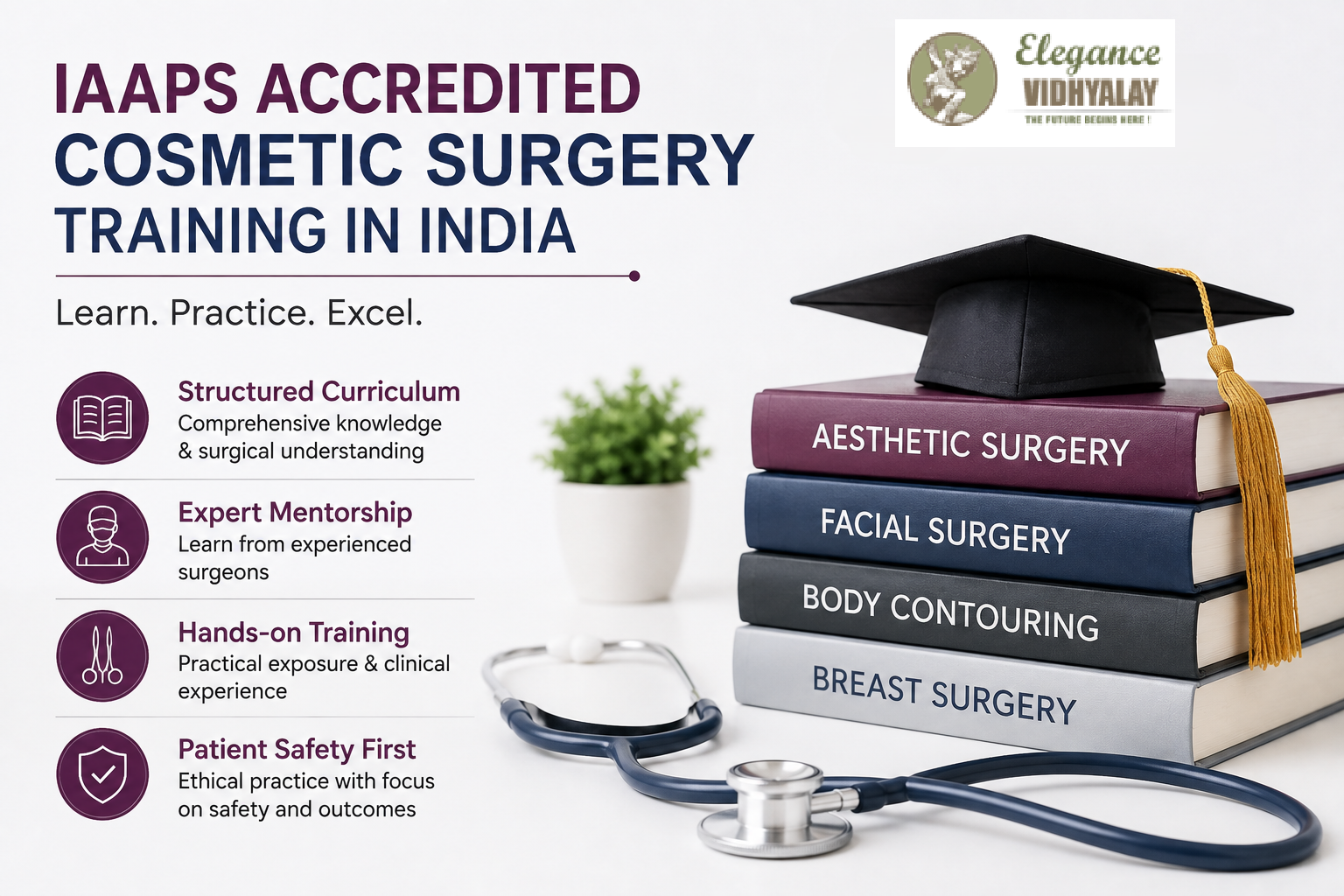
For doctors and surgeons who want to advance their skills in aesthetic and cosmetic surgery, choosing the right training institute is an important professional decision. The quality of training can influence how well a doctor understands patient assessment, treatment planning, surgical principles, safety, complication management, and practical techniques. This is why many medical professionals search for an IAAPS-accredited institute for cosmetic surgery in India when exploring structured fellowship training.
An appropriate program should go beyond classroom theory and provide a combination of academic learning, clinical exposure, practical understanding, experienced mentorship, and responsible surgical education.
An IAAPS-accredited cosmetic surgery fellowship is a structured educational program associated with the standards or accreditation requirements of the Indian Association of Aesthetic Plastic Surgeons (IAAPS).
For doctors considering such a fellowship, the important factors include the program’s curriculum, faculty, training environment, practical exposure, eligibility requirements, and accreditation status.
Because accreditation and course recognition can change, applicants should verify the current accreditation status directly with the institute and relevant professional organization before enrolling.
Cosmetic surgery is a medical and surgical field where training quality matters.
Doctors need more than an understanding of individual procedures. They also need to develop clinical reasoning around:
Choosing a structured fellowship can help doctors follow a more organized learning pathway rather than attempting to learn isolated procedures independently.
Based on the selected program information, this fellowship is intended for doctors and surgeons who want advanced education in cosmetic and aesthetic surgery.
It may particularly interest medical professionals who want to:
Applicants should check the specific qualification and eligibility requirements before applying.
The exact curriculum depends on the fellowship program. However, cosmetic surgery education should provide a foundation that connects theoretical knowledge with clinical decision-making.
Not every patient requesting cosmetic surgery is automatically an appropriate candidate.
Doctors need to understand medical history, aesthetic concerns, expectations, anatomical characteristics, and other factors before recommending treatment.
Structured training can help participants develop a more systematic approach to consultation and patient selection.
A strong understanding of anatomy is essential for cosmetic surgery.
Training should help doctors connect anatomical knowledge with surgical planning rather than studying anatomy only as an academic subject.
This becomes particularly important when understanding different facial and body procedures.
Good cosmetic surgery requires individualized planning.
Doctors need to consider the patient’s anatomy, concerns, expectations, available treatment options, potential limitations, and safety before deciding on an approach.
Case-based discussions can be particularly useful for developing this type of clinical reasoning.
Cosmetic surgery cannot be learned through textbooks and recorded lectures alone.
Clinical observation and appropriate practical exposure allow participants to understand surgical workflow, instrumentation, procedural steps, patient preparation, and real-world decision-making.
The exact amount and type of hands-on experience should be confirmed with the institute before enrollment.
Knowing how a procedure is performed is only one part of surgical education.
Doctors also need to understand when not to perform a procedure, how to recognize potential problems, and how postoperative care influences recovery.
A comprehensive training program should therefore emphasize safety throughout the learning process.
Both learning formats can contribute to a doctor’s education.
Online learning can be useful for theory, anatomy revision, recorded lectures, case discussions, treatment-planning concepts, and academic interaction.
Offline training becomes particularly important for clinical observation, live demonstrations, direct faculty interaction, and practical exposure.
For a surgical field, combining theoretical flexibility with appropriate in-person training can provide a more complete learning pathway.
A fellowship is not simply about memorizing procedural steps.
Experienced surgical mentors can explain why they choose one approach over another, how they assess patients, what limitations they consider, and how they manage difficult clinical situations.
This type of mentorship helps participants understand the clinical reasoning behind cosmetic surgery, not merely the technique itself.
It can also provide a valuable learning environment for discussing cases and asking questions that arise during training.
For doctors searching for an IAAPS-accredited institute for cosmetic surgery in India, Elegance Vidhyalay offers fellowship-based education designed for doctors and surgeons interested in aesthetic and cosmetic surgery.
Training at Elegance Vidhyalay is guided by Dr. Ashutosh Shah, a Plastic, Cosmetic & Reconstructive Surgeon with 22+ years of surgical experience.
The training approach focuses on building a structured understanding of cosmetic surgery through areas such as:
Doctors considering the IAAPS fellowship should contact Elegance Vidhyalay to confirm the current IAAPS accreditation status, fellowship structure, eligibility criteria, duration, practical components, certification, and upcoming batch details before enrollment.
Before enrolling, do not select a fellowship based only on its name or certificate.
Look closely at the actual learning experience.
Consider the faculty’s clinical experience, curriculum, accreditation status, practical exposure, clinical environment, mentorship opportunities, batch structure, case discussions, and support provided during training.
It is also important to understand whether the fellowship aligns with your existing medical qualifications and professional scope of practice.
Not automatically.
Completing a fellowship or training course does not by itself override applicable professional regulations, credentialing requirements, or an individual’s permitted scope of practice.
Doctors should perform procedures only when they have the appropriate qualifications, competency, clinical privileges where required, and professional authorization.
Responsible training should reinforce this distinction.
Choosing an IAAPS-accredited institute for cosmetic surgery in India should involve more than comparing course fees or certificates. Doctors should evaluate the quality of the curriculum, faculty experience, practical exposure, mentorship, patient-safety education, and current accreditation status.
IAAPS stands for the Indian Association of Aesthetic Plastic Surgeons.
The selected fellowship targets doctors and surgeons. Exact educational qualifications and eligibility requirements should be confirmed with the training institute before applying.
Some theoretical components may be delivered online. However, cosmetic surgery is a practical surgical field, so appropriate clinical and hands-on exposure remains important.
Accreditation status is an important factor when evaluating a program. Because affiliations and accreditation can change, doctors should verify the current status before enrollment.
Yes. Online education and lectures can build theoretical understanding, but surgical skills require appropriate clinical observation, practical exposure, supervision, and experience.