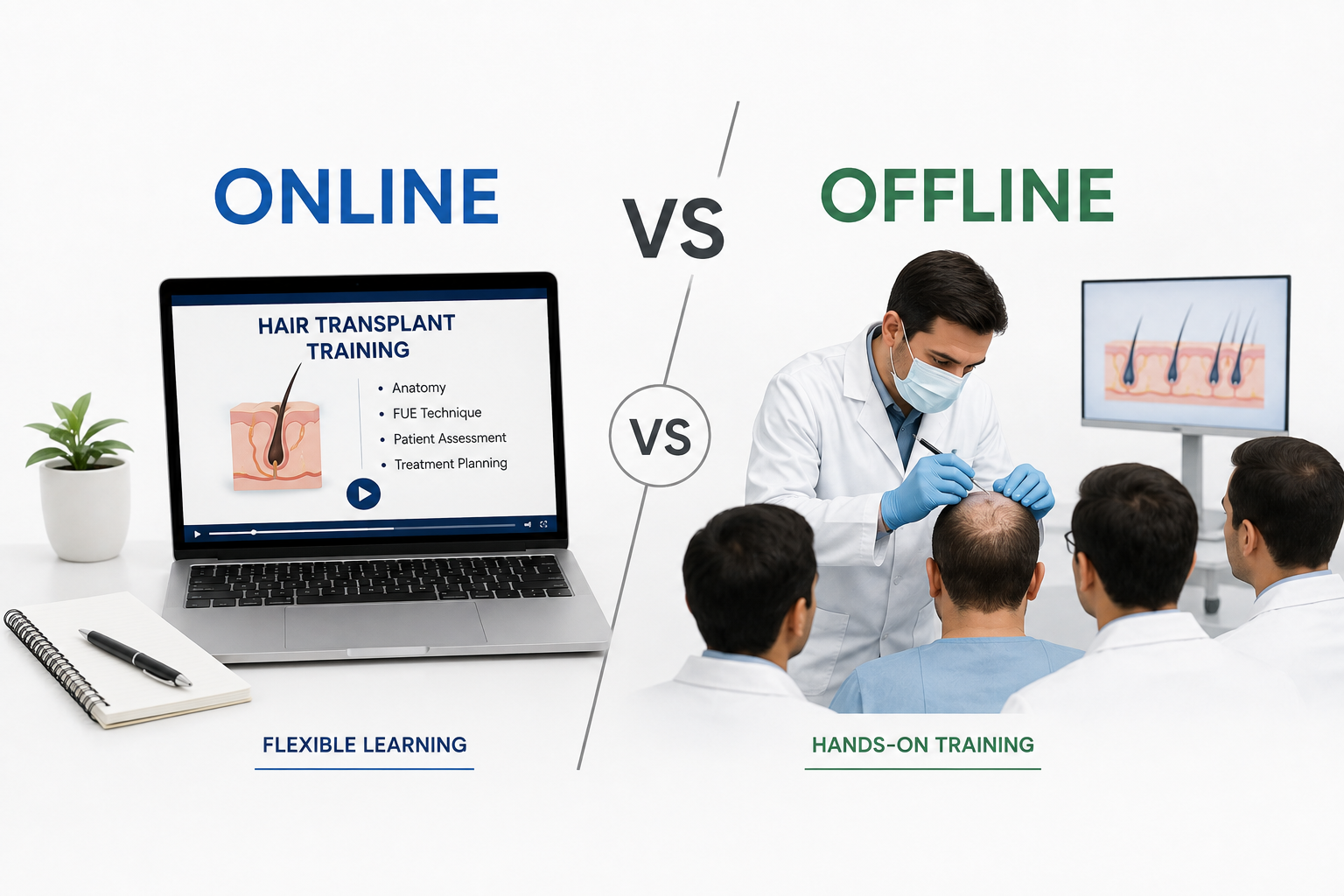
Hair transplantation is a technique-driven field where doctors need both strong theoretical knowledge and practical understanding. For medical professionals planning to learn hair restoration, one common question is whether they should choose online education or attend an in-person program. When comparing online vs offline hair transplant training in India, both formats can contribute to learning, but they serve different purposes. Online training provides flexibility for studying concepts and revising theory, while offline training provides direct demonstrations, practical exposure, interaction with faculty, and opportunities to understand procedures in a clinical environment.
For doctors and surgeons, the right choice depends on their existing experience, learning goals, schedule, and need for hands-on exposure.
Online hair transplant training allows doctors to study theoretical and academic aspects of hair restoration remotely.
Depending on the course structure, online sessions may help participants understand topics such as:
Online education can be especially useful for busy doctors who want to begin learning or strengthen their theoretical foundation without frequently travelling for classes.
Offline training takes place in a physical learning or clinical environment where doctors can interact directly with trainers.
It may include classroom teaching alongside live demonstrations, clinical observation, case discussions, and hands-on learning, depending on the specific program.
For a technique-oriented field such as hair transplantation, direct exposure can help doctors understand aspects of a procedure that are difficult to appreciate through a screen alone.
The main difference lies in the type of learning experience.
| Online Training | Offline Training |
|---|---|
| Flexible learning | Direct faculty interaction |
| Convenient for working doctors | Practical clinical exposure |
| Useful for theory and revision | Useful for technique-oriented learning |
| Can be accessed remotely | Requires physical attendance |
| Suitable for case discussions and concepts | Can include demonstrations and supervised practice |
| Easier to fit around clinical schedules | Better suited to developing practical understanding |
Neither format needs to replace the other. A course that appropriately combines theoretical and practical education can offer doctors a more balanced learning experience.
Many foundational concepts can be introduced effectively through structured online teaching.
Doctors can study hair growth, follicular anatomy, scalp characteristics, and other foundational concepts before moving into procedural training.
Hair transplantation begins with determining whether the patient is an appropriate candidate.
Online case discussions can help doctors understand how factors such as hair-loss pattern, donor availability, expectations, and treatment goals influence planning.
A natural-looking hairline requires consideration of facial proportions, age, existing hair, and expected progression of hair loss.
The theoretical principles behind planning can be taught online and reinforced later during clinical exposure.
Online education can explain the principles of Follicular Unit Extraction (FUE), including extraction concepts, graft handling, implantation planning, and procedural workflow.
However, understanding these concepts theoretically is different from developing the physical skills required to perform them.
Hair transplantation involves practical skills.
Doctors need to understand how theoretical principles translate into actual clinical situations. Offline training can provide closer exposure to patient assessment, procedural setup, technique, graft handling, workflow, and clinical decision-making.
Most importantly, learners can interact directly with experienced faculty and receive feedback.
For doctors who want to move beyond theoretical understanding, this practical environment can be particularly valuable.
Online training can provide a useful foundation, but doctors should not consider theoretical education alone equivalent to practical procedural training.
Watching a demonstration can explain what a surgeon does, but supervised practical exposure helps learners understand how the technique actually feels and works in a clinical setting.
Hair transplant procedures involve precision, judgment, coordination, and technique. These aspects benefit from appropriate practical learning and mentorship.
Online learning may be useful for doctors who:
The flexibility of online education makes it particularly useful as one component of continuing medical education.
Offline training may be more suitable for doctors who want:
Doctors beginning their practical hair transplant journey may particularly benefit from structured in-person exposure.
For many doctors, combining both formats can provide a more complete learning pathway.
Online education can establish the theoretical foundation before an in-person session. Doctors can arrive at practical training already familiar with anatomy, terminology, procedural principles, and treatment planning.
Offline sessions can then focus more heavily on demonstrations, practical understanding, clinical decision-making, and faculty interaction.
This creates a logical progression:
Learn the concepts → understand the procedure → observe techniques → gain appropriate practical exposure → continue learning through mentorship.
Rather than choosing a course simply because it is online or offline, doctors should evaluate the overall quality of the program.
Consider the curriculum, trainer’s clinical experience, amount of practical exposure, teaching format, case discussions, demonstrations, batch size, mentorship, and opportunities for continued learning.
Doctors should also verify the program’s eligibility requirements and understand how the training relates to their existing qualifications and permitted professional scope.
For doctors and surgeons comparing online vs offline hair transplant training in India, Elegance Vidhyalay provides hair transplant education designed around professional medical learning.
Training is guided by Dr. Ashutosh Shah, a Plastic, Cosmetic & Reconstructive Surgeon with 22+ years of surgical experience.
The learning approach emphasizes theoretical understanding alongside practical aspects of modern hair restoration. Depending on the selected program, doctors can strengthen their understanding of FUE techniques, patient assessment, treatment planning, clinical workflow, and procedural considerations.
Experienced mentorship also allows learners to understand not only procedural steps but the clinical reasoning involved in selecting and planning treatment.
Learning does not necessarily end when a workshop or course finishes.
During real clinical practice, doctors may encounter different hair-loss patterns, donor-area limitations, patient expectations, and treatment-planning questions.
Access to experienced guidance can help doctors continue developing their understanding as they gain clinical experience.
This is particularly important in a field where patient selection, planning, technique, and judgment all influence outcomes.
When comparing online vs offline hair transplant training in India, the question should not simply be which format is better.
Online training works well for theory, flexibility, revision, and case-based education, while offline training offers direct demonstrations, clinical exposure, faculty interaction, and practical learning.
For doctors and surgeons who want a broader learning experience, combining both formats can provide a stronger pathway from theoretical understanding to practical exposure.
Yes. Online training can be useful for learning theory, anatomy, patient assessment, treatment-planning concepts, case discussions, and procedural principles.
You can learn FUE concepts online, but procedural skills benefit from appropriate hands-on training, clinical observation, and experienced supervision.
It depends on the learning objective. Online training provides flexibility and theoretical education, while offline training is more appropriate for direct demonstrations and practical exposure.
Yes. A program offering online and offline learning options can make education more manageable for doctors who need to balance training with clinical responsibilities.
The selected Elegance Vidhyalay course targets doctors and surgeons. Applicants should confirm the program’s specific eligibility requirements before enrolling.
Hands-on exposure helps doctors connect theoretical knowledge with procedural workflow and technique while receiving guidance and feedback from experienced trainers.