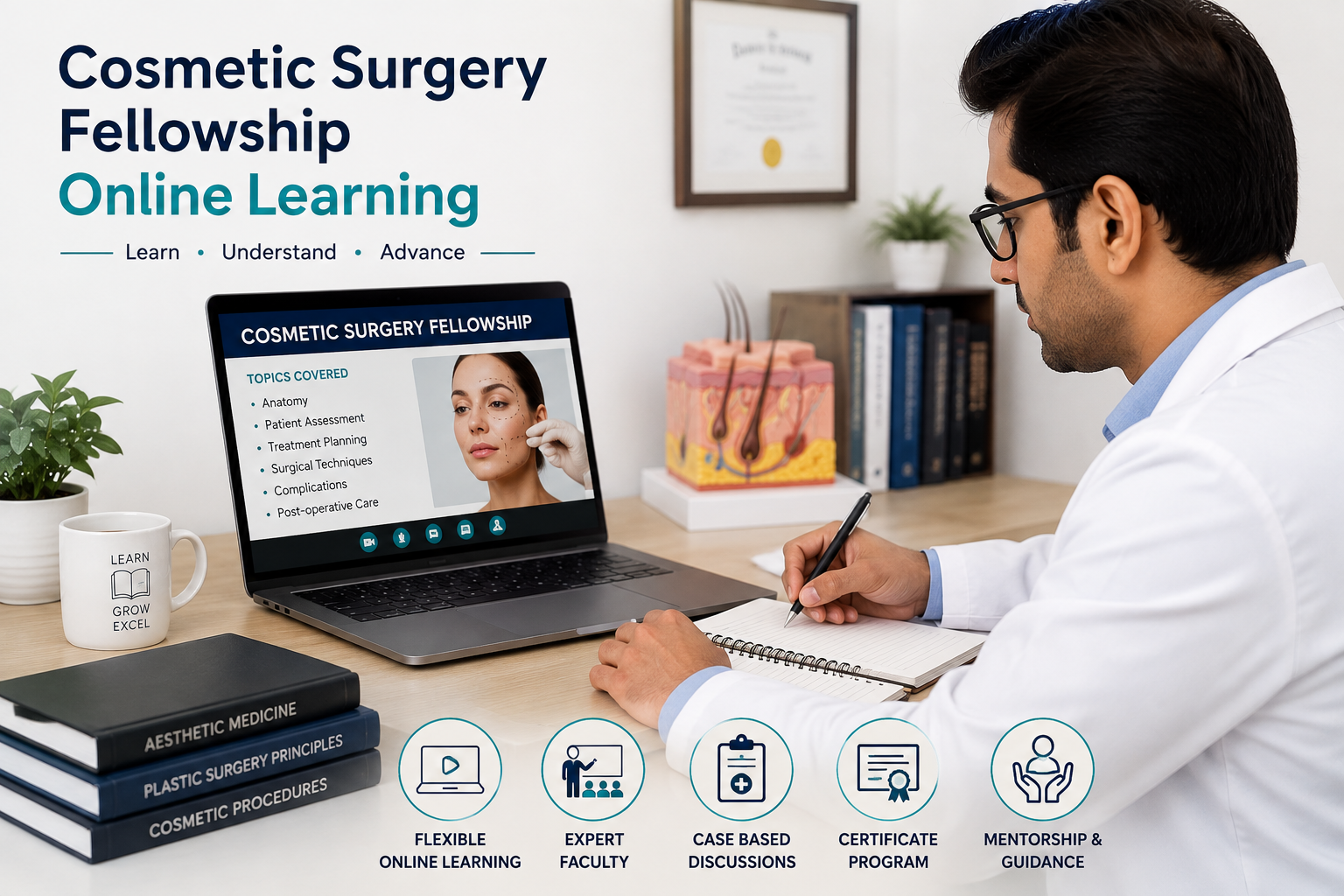
Doctors and surgeons interested in cosmetic and aesthetic medicine often want to continue their education while managing an existing clinical practice. This naturally raises an important question: Can a cosmetic surgery fellowship be done online in India?
Online learning can cover an important part of cosmetic surgery education, particularly theoretical knowledge, treatment planning, case discussions, recorded demonstrations, and academic concepts. However, cosmetic surgery is a practical medical field. Surgical techniques and procedural skills require appropriate hands-on training, clinical observation, mentorship, and supervised practical exposure.
For this reason, doctors should understand the difference between learning cosmetic surgery theory online and developing the practical competencies required to perform procedures safely.
An online cosmetic surgery fellowship is a structured educational program that allows doctors to study selected aspects of aesthetic and cosmetic surgery remotely.
Depending on the program, online learning may include:
The exact curriculum, eligibility, practical components, certification, and recognition can differ significantly between fellowship programs.
Not completely.
A doctor can learn a substantial amount of theory and clinical reasoning through online education, but surgical and procedure-based skills cannot be adequately developed through videos or lectures alone.
Cosmetic surgery involves real patients, anatomical variations, surgical instruments, tissue handling, clinical decision-making, and management of unexpected situations.
Therefore, doctors interested in cosmetic surgery should view online education as one component of professional training, rather than a replacement for supervised practical experience.
Online education can provide a strong theoretical foundation before practical training.
Understanding anatomy is essential in cosmetic surgery. Online sessions can help doctors revise relevant anatomical structures and understand their relationship to different procedures.
Good cosmetic outcomes begin with appropriate patient selection.
Doctors can learn how to evaluate patient concerns, understand expectations, recognize important medical considerations, and develop an appropriate treatment plan.
Case-based online learning can help doctors understand how experienced surgeons approach different clinical situations.
Instead of simply learning procedural steps, participants can develop their understanding of why one treatment may be more appropriate than another.
Doctors also need knowledge about preparation, patient counseling, recovery, follow-up, and recognizing potential complications.
These subjects can be effectively introduced and discussed through structured online education.
Recorded demonstrations can help participants observe surgical steps and understand how experienced surgeons approach a procedure.
However, watching a procedure should not be considered equivalent to performing it under supervision.
Cosmetic surgery requires practical skills that develop through observation, supervised practice, repetition, and mentorship.
Hands-on training allows doctors to understand aspects that are difficult to reproduce through online lectures, including tissue handling, instrument use, procedural workflow, positioning, technique, and real-time clinical decision-making.
It also allows experienced faculty to observe the learner and provide immediate feedback.
For this reason, doctors comparing fellowship programs should check whether the course provides opportunities for clinical observation, live demonstrations, hands-on exposure, or supervised training in addition to online education.
Yes. Online education can be particularly convenient for doctors and surgeons who already have clinical responsibilities.
Instead of regularly travelling for theoretical classes, doctors can study selected modules remotely and use in-person sessions for practical components when the program provides them.
Online learning can therefore offer:
For busy medical professionals, this can make continuing education more manageable.
Based on the selected course targeting, this type of fellowship is intended for doctors and surgeons interested in developing further knowledge in cosmetic and aesthetic procedures.
Applicants should always verify the fellowship’s exact eligibility requirements before enrollment.
This is especially important because eligibility for medical and surgical training may depend on a person’s existing qualifications, specialty, professional registration, and the procedures included in the program.
Online and in-person education serve different purposes rather than necessarily competing with each other.
Digital education works particularly well for theoretical concepts, anatomy revision, academic discussions, case analysis, and treatment planning.
In-person training becomes important when learners need clinical observation, hands-on exposure, supervised procedural experience, and direct technique feedback.
For procedure-focused medical education, a program that appropriately combines both elements can provide a more complete learning experience.
Before enrolling in a cosmetic surgery fellowship, doctors should carefully evaluate what the program actually provides.
Important questions include:
Doctors should also understand that completing an educational fellowship does not automatically expand their legally permitted scope of practice.
For doctors exploring cosmetic and aesthetic surgery education, the experience of the faculty is an important consideration.
At Elegance Vidhyalay, training is guided by Dr. Ashutosh Shah, a Plastic, Cosmetic & Reconstructive Surgeon with 22+ years of surgical experience.
Learning under experienced surgical mentorship can help participants better understand not only procedural concepts but also patient selection, clinical judgment, treatment planning, safety considerations, complication awareness, and responsible aesthetic practice.
Elegance Vidhyalay offers fellowship-based education for doctors and surgeons interested in expanding their understanding of aesthetic and cosmetic procedures.
For professionals asking, “Can a cosmetic surgery fellowship be done online in India?”, the key is to understand what portion of the chosen fellowship can genuinely be delivered online.
Theory, case discussions, treatment planning, and academic learning can work well remotely. Practical surgical competencies, however, require appropriate clinical and hands-on exposure.
Doctors should therefore select their training based on the curriculum, faculty expertise, learning format, practical opportunities, and their individual professional goals rather than choosing a course simply because it is available online.
So, can a cosmetic surgery fellowship be done online in India? The theoretical portion can be learned effectively online, providing doctors with flexibility and access to structured education. However, cosmetic surgery remains a hands-on medical field, and online education should not replace appropriate supervised practical and clinical training. Choosing a fellowship that combines strong academic learning with appropriate practical exposure can help doctors build a more complete foundation in cosmetic and aesthetic surgery.
Theoretical components can be delivered online, but cosmetic surgery involves practical skills that require appropriate hands-on and clinical training. Check the specific structure of the fellowship before enrolling.
It can provide foundational theoretical education, but suitability depends on the doctor’s existing medical qualifications, experience, and the fellowship’s eligibility requirements.
Yes. Flexibility is one of the main advantages of online medical education, allowing practicing doctors to study theoretical modules around their professional schedules.
No. Recorded demonstrations can improve understanding of procedural steps, but they cannot replace supervised clinical and hands-on experience.
The selected program targets doctors and surgeons. Applicants should verify their eligibility and whether the program aligns with their qualifications and intended area of practice.