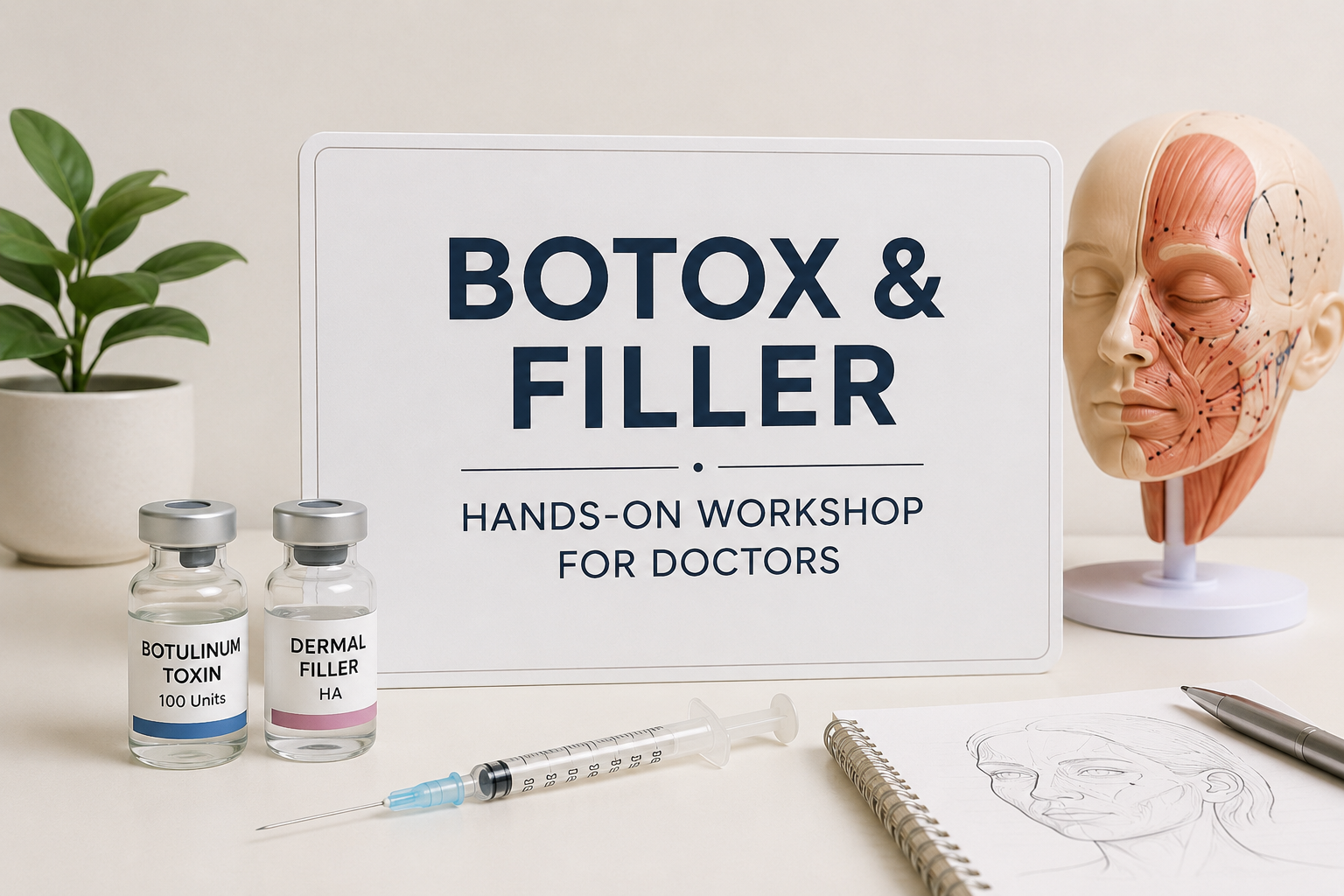
Botox and dermal fillers are widely used in modern aesthetic medicine, but learning injectable treatments involves much more than understanding theory. Doctors need a strong foundation in facial anatomy, patient assessment, treatment planning, injection techniques, and safety before developing confidence in clinical practice. An in-person Botox filler workshop in India allows doctors and surgeons to move beyond classroom concepts and develop practical skills through demonstrations, supervised practice, case discussions, and expert guidance.
For medical professionals planning to enter or expand their aesthetic practice, hands-on training can form an important part of their learning journey.
Reading about injection techniques or watching recorded demonstrations can help doctors understand the basics, but injectables require practical skills that develop through supervised training.
Hands-on workshops allow participants to better understand facial anatomy, injection points, treatment planning, technique, and patient safety. Training materials associated with this topic also emphasize a progression from specialized education to hands-on practice, mentorship, clinical observation, and continuous learning.
This type of learning can help doctors connect theoretical knowledge with real clinical situations.
A structured workshop can focus on several important areas of aesthetic medicine.
Understanding facial anatomy is fundamental before learning injectable procedures. Training may cover important muscles, facial structures, treatment areas, and anatomical considerations relevant to injectable treatments.
This foundation helps participants understand why injection placement and technique matter.
Every patient’s facial structure and aesthetic goals are different. Doctors need to learn how to assess the face rather than follow the same treatment pattern for everyone.
Training can introduce participants to:
These skills help doctors approach aesthetic treatments more systematically.
During Botox-focused sessions, participants can learn the principles behind botulinum toxin treatment and observe how experienced practitioners approach different facial areas.
Training may include discussion of facial muscle anatomy, injection-point planning, technique, patient assessment, and safety considerations.
The objective is not simply to memorize injection points but to understand the clinical reasoning behind treatment.
Dermal filler training focuses on understanding facial volume, proportions, assessment, and treatment planning.
Depending on the workshop curriculum, doctors may receive exposure to commonly treated facial areas and learn how experienced practitioners plan filler treatments according to individual anatomy and aesthetic goals.
This is one of the biggest advantages of choosing an in-person Botox filler workshop in India.
The training approach can include supervised practice on models, helping participants understand practical aspects of technique, injection depth, treatment areas, and precision.
An instructor can also observe technique and provide immediate feedback, which is difficult to reproduce through online-only education.
Observing an experienced injector can help doctors understand how knowledge translates into actual clinical decision-making.
Participants can learn how practitioners approach:
Clinical observation and mentorship are also highlighted as important stages in learning Botox and filler procedures.
Online education can be useful for learning theory, revising anatomy, and understanding basic treatment concepts. However, aesthetic injectables also involve practical skills.
An offline workshop provides direct interaction between the learner and trainer. Participants can ask questions during demonstrations, observe techniques closely, discuss cases, and receive feedback during supervised practice.
For doctors who already understand the theory but want practical exposure, an in-person format can therefore be particularly valuable.
Based on the selected course targeting, this workshop is intended for doctors and surgeons who want hands-on aesthetic training.
It can be relevant for medical professionals who are:
Participants should always check the institute’s specific eligibility requirements before enrollment.
Not every training program provides the same learning experience. Before enrolling, doctors should review the course structure and determine how much practical exposure the program actually provides.
A useful workshop should emphasize areas such as facial anatomy, structured teaching, supervised practical training, experienced mentorship, patient safety, case discussions, and continued learning.
Training material for aesthetic education also highlights qualified training and experience as important components of patient safety.
One of the most important shifts during aesthetic training is moving away from thinking only about “where to inject.”
Good aesthetic education teaches doctors to look at the entire patient.
Before considering treatment, a practitioner needs to understand facial anatomy, proportions, the patient’s concerns, realistic expectations, treatment planning, and potential risks.
This clinical thinking is what makes structured education different from simply watching a procedure.
At Elegance Vidhyalay, the in-person Botox and filler workshop is designed to give doctors and surgeons structured exposure to aesthetic injectable techniques with an emphasis on hands-on learning, clinical understanding, and expert mentorship.
Training resources from Elegance Vidhyalay identify Dr. Ashutosh Shah as a mentor with MBBS, MS, M.Ch., DNB qualifications and 22+ years of surgical experience.
For doctors who want more than online theory, an in-person Botox filler workshop in India can provide the practical environment needed to observe techniques closely, ask questions, discuss cases, and learn under experienced guidance. Enroll now at Elegance Vidhyalay and take the next step toward building practical skills and confidence in aesthetic medicine.
Yes. In-person aesthetic workshops are available for qualified medical professionals. Eligibility and course requirements can vary by institute.
Hands-on training provides practical exposure, direct instructor feedback, clinical observation, and opportunities to connect theoretical knowledge with real treatment situations.
Online learning can provide useful theoretical knowledge, but practical injectable skills benefit from supervised in-person training and clinical observation.
Training can cover facial anatomy, patient assessment, treatment planning, Botox and filler principles, practical techniques, safety considerations, case discussions, and supervised practice. Exact content depends on the selected program.
The selected program targets doctors and surgeons. Participants should confirm the specific eligibility criteria with Elegance Vidhyalay before enrolling.
Hands-on exposure allows beginners to observe techniques closely and receive direct feedback while building their understanding of practical aesthetic medicine.