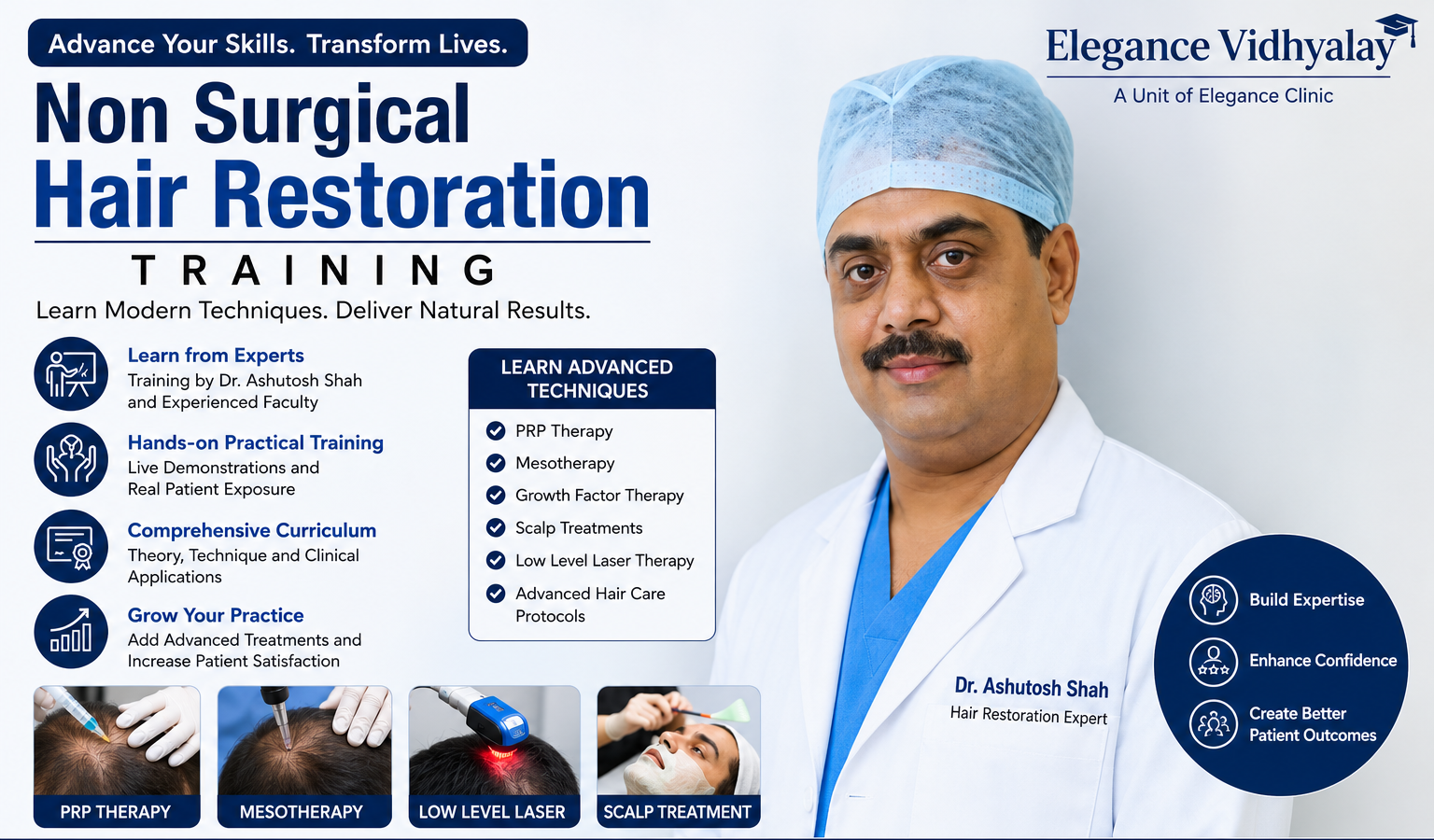
Hair loss concerns are increasing rapidly across India. Men and women from different age groups are now searching for modern hair solutions that offer natural looking improvement without long downtime. Because of this growing demand, many aesthetic professionals are showing interest in non surgical hair restoration training.
Today, patients want safer, faster, and more comfortable hair treatments. As a result, clinics and aesthetic centers are also expanding their services beyond traditional hair transplant procedures. This shift is one major reason why non surgical hair restoration education is becoming popular in India.
At Elegance Vidhyalay in Surat, Dr. Ashutosh Shah focuses on practical learning and real world patient understanding so professionals can build confidence in modern hair treatment techniques.
Hair related concerns are no longer limited to older individuals. Even younger people today experience hair thinning, hair fall, and reduced hair density.
• Stress and busy lifestyle
• Hormonal imbalance
• Poor nutrition
• Genetic factors
• Pollution and environmental exposure
• Frequent chemical treatments
Because of these issues, more patients now seek modern hair restoration solutions.
Non surgical hair restoration includes modern techniques designed to improve hair appearance, scalp health, and hair density without major surgery.
Many patients prefer these options because they usually involve:
• Minimal downtime
• Comfortable sessions
• Natural looking improvement
• Faster return to routine life
• Gradual and realistic results
At Elegance Vidhyalay, professionals are trained to understand different hair concerns and treatment approaches carefully.
The aesthetic industry in India is growing quickly. Patients today expect clinics to provide multiple treatment options rather than only hair transplant procedures.
Because of this, many professionals want to learn advanced non surgical hair restoration techniques.
Social media and online information have increased awareness about hair treatments.
Many cities including Surat are seeing rapid growth in aesthetic and hair care centers.
Professionals with advanced aesthetic skills often get better practice growth opportunities.
Doctors and aesthetic practitioners now want to expand beyond basic cosmetic procedures.
Many people think only hair transplant treatment is useful for hair loss. However, non surgical treatments are also commonly used alongside hair transplant procedures.
At Elegance Clinic, Dr. Ashutosh Shah often explains that patient needs differ depending on:
• Hair loss pattern
• Scalp condition
• Age
• Expectations
• Hair density
• Lifestyle factors
Because of this, learning both hair transplant and non surgical techniques can help professionals provide better patient guidance.
A good training program focuses on both theory and practical exposure.
Professionals learn how different hair conditions affect treatment planning.
Good communication is important in aesthetic practice.
Each patient requires personalised guidance and realistic expectations.
Modern aesthetic procedures require proper safety understanding.
Hands on learning helps improve confidence during patient handling.
At Elegance Vidhyalay, practical learning is given strong importance because real patient understanding matters greatly in aesthetic practice.
Non surgical hair restoration training may be useful for:
• Doctors
• Aesthetic practitioners
• Cosmetic professionals
• Clinic owners
• Professionals entering aesthetic medicine
Many learners choose training to improve their existing practice, while others want to start new aesthetic services.
Surat has become one of the growing cities for aesthetic treatments and cosmetic education. Patients are increasingly seeking advanced cosmetic and hair care solutions.
Because of this demand, professionals are also looking for trusted training programs in Surat.
Elegance Vidhyalay provides learning in a professional environment where practical understanding and patient focused care are prioritised.
Many learners expect instant expertise after a short course. However, aesthetic practice improves gradually with experience and patient interaction.
A good training program helps professionals:
• Understand patient concerns
• Improve consultation confidence
• Learn treatment safety
• Build practical exposure
• Understand realistic outcomes
Dr. Ashutosh Shah believes that practical understanding is equally important as technical knowledge.
Many patients benefit from non surgical treatments depending on their condition.
Many beginners also join aesthetic education programs to build new skills.
Different patients require different treatment plans.
Hair improvement usually develops gradually over time.
Many learners prefer Elegance Vidhyalay because of its practical and patient focused approach.
Training focuses on practical clinic experience.
Dr. Ashutosh Shah shares real patient based understanding during sessions.
Learners gain understanding of current aesthetic trends and patient expectations.
Responsible treatment planning and realistic consultation are always encouraged.
Some professionals feel uncertain while handling hair consultation cases. Others want to expand clinic services but lack practical exposure. A few learners simply want to stay updated with modern aesthetic trends.
At Elegance Vidhyalay, training is designed to help learners improve confidence and practical understanding gradually.
The demand for non surgical hair restoration is increasing rapidly across India because patients now prefer modern, comfortable, and natural looking hair solutions. As awareness grows, professionals are also looking to upgrade their aesthetic skills through advanced education.
At Elegance Vidhyalay in Surat, Dr. Ashutosh Shah focuses on practical learning, patient understanding, and realistic treatment knowledge so professionals can confidently build their aesthetic expertise.
Training cost may vary depending on course duration, practical exposure, and learning modules.
Yes, many beginners and aesthetic professionals choose this training to improve skills.
Many programs include basic understanding of hair transplant concepts along with non surgical methods.
Good training programs often focus on practical demonstrations and patient interaction.